Since the start of last week, stock markets worldwide have been in correction mode amid ongoing uncertainty surrounding the spread of the coronavirus and its associated economic impact.
The global equity index MSCI World lost around 10% — measured in euros — over the four days from Monday to Thursday (24 to 27 February). The DAX shed about 9% over the same period. Since the start of the year, the two indices are down by around 6% (MSCI) and about 7% (DAX) respectively — again as of 27 February. The downward movement is currently continuing.
Here we'd like to put the current events on the markets into perspective for you as objectively as possible, and to stress right from the outset that even in this downward phase, a cool head makes better investment decisions than a gut feeling that may well be charged with emotion.

As of this hour, the following can be said:
- There's no denying the epidemic's relevance for the economy. It is already foreseeable that there will be growth-dampening effects — not only in China but, given China's heavy influence on the world economy and the way things are internationally interlinked, on a global scale too.
- The longer entire regions are unable to carry out their usual economic activity and production, the more intermediate and finished products will be missing from global supply chains.
- It is not possible to quantify the negative effects on global economic growth precisely, for two reasons:
- Firstly, and obviously, there is simply no way to predict how long and how widely the epidemic will progress.
- Secondly, it is impossible to foresee what other economically significant factors will affect the economy and growth in China and the world in 2020.
- With an eye on the tariff conflict that still hasn't been finally resolved, we assume that, in light of the coronavirus, the key players in the US and China are more likely to keep moving closer together.
This applies especially to Donald Trump, above all in view of his sought-after re-election in November this year, for which a noticeable weakening of the US economy on account of the tariff dispute would be poison.
There are, moreover, other compelling reasons that argue against a hasty sale of stocks — even in times of coronavirus:
- In the course of the current correction, stock-market valuations (price-to-earnings ratio, price-to-book ratio) are heading towards more attractive levels, which is tempting people to buy.
- In any case, thanks to the persistently low-interest-rate environment and the extremely high liquidity in the markets, stocks have for quite some time now held the status of „the only alternative“ — and given that savings and fixed-term deposit accounts pay no interest, that isn't going to change any time soon.
- We are undoubtedly dealing with a novel, rapidly spreading virus. Right now, no one can seriously assess how the situation will develop. In terms of aggressiveness, however, the alarm has so far remained within limits. There have been no dramatically rising death rates so far (scientists currently assume a mortality rate well below 2%) — above all, it is tragically people with serious pre-existing conditions who have fallen victim to it. The annual flu waves usually affect considerably more people as a rule — including those with fatal outcomes.
- Should the economy cool off noticeably as a result of the coronavirus, we expect additional (even stronger) monetary-policy stimulus from central banks and economic stimulus programmes from the affected countries.
- Once the coronavirus problem has been solved — something scientists are working on flat out — there should be noticeable catch-up effects in the economy.
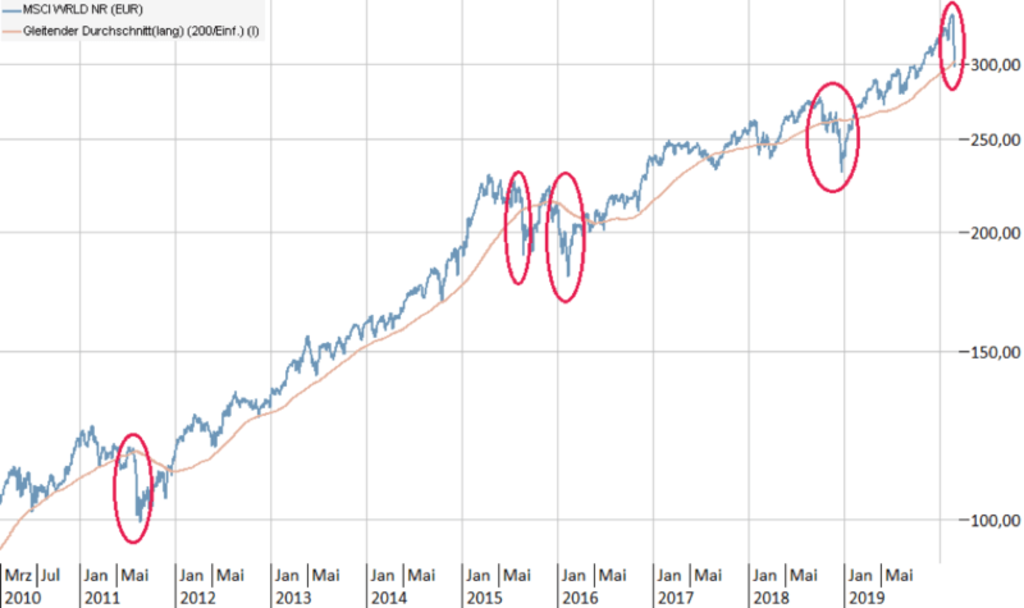
- To put it in perspective: the current price correction on stock markets worldwide has so far been no more unusual than the setbacks we've had to deal with in the past (see the chart below).
MSCI World
10-year chart in euros and including net dividends
Last but not least, we'd like to stress that, while the current price losses are unquestionably painful, they should be seen in perspective against the profit cushion built up over time historically:
- Cumulative 3-year performance of the MSCI World: 21.3%
- Cumulative 5-year performance of the MSCI World: 38.2%
(each in euros including net dividends, as of the closing prices of 27 February 2020)
The DAX, incidentally, gained a cumulative 4.5% and 8.5% respectively over the two periods.
Conclusion
Admittedly, as long as there's no clarity on how effectively the virus can be contained and combated, there's a risk that global markets will stay nervous for the time being. From an investor's point of view that is undoubtedly uncomfortable, because it pushes them into a waiting role for now.
The last thing needed in the coronavirus crisis, though, is scaremongering. That goes for supposed virus experts who wildly speculate about the further spread of the disease, as well as for business representatives who prematurely call for state aid because they scent an approaching recession.
Don't let yourself be rattled, and keep calm: a whole range of factors suggests that this time, too, patience will be rewarded over the longer term, even if the effects of the virus on the world economy and possible reactions from governments cannot be seriously forecast at the moment.
Rest assured: we are keeping a very close eye on the situation for you, but — entirely in keeping with our long-term investment philosophy — we advise against irrational snap decisions.