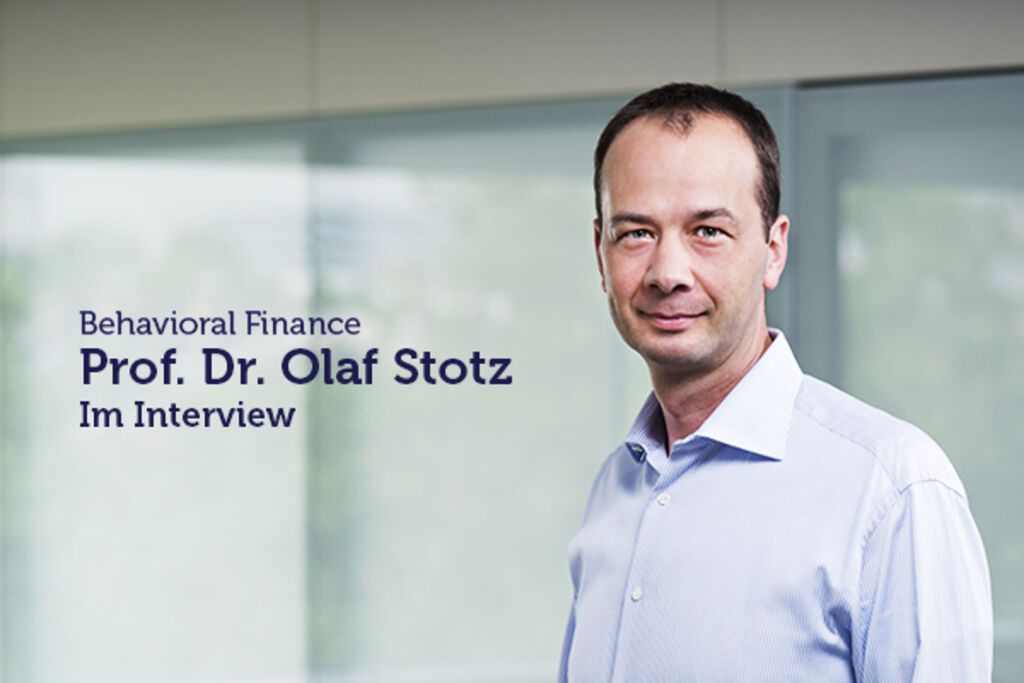
Behavioral finance tracks down the psychological traps of investing. Prof. Dr. Olaf Stotz of the Frankfurt School of Finance & Management explains which cognitive biases prove especially costly – and how to avoid them.
Prof. Stotz, what exactly does behavioral finance concern itself with – and why?
Classical financial market theory is about the question of how people ought to act rationally in the capital market. But people don't always act rationally. Everyone knows this from everyday life: you eat or drink too much, even though you know it's unhealthy. Behavioral finance tracks down these „unhealthy behaviors“ in the markets. The behavioral patterns uncovered by research are referred to as cognitive distortions, or „biases.“ These are certain behavioral tendencies, some of which are deeply rooted in the brain.
In your view, what is the most significant „bias“ when it comes to investing?
When investing, „overconfidence bias“ is especially likely to lead to mistakes. Overconfidence means having exaggerated faith in your own abilities. A classic example: in studies, drivers were asked whether they counted themselves among the best 30 percent. Around 80 percent of respondents did. Such inflated self-assessments also occur in investing – among private investors as well as among stock-market experts and investment professionals. Part of this pattern is that people tend to attribute successes to themselves, but failures to others or to circumstances. Ultimately, this leads to a kind of illusion of control. Seen from an evolutionary standpoint, this perceptual pattern is basically a good thing. You don't give up too quickly. In the capital market, however, it can have fatal consequences. It leads, for instance, to excessive trading activity and therefore to high costs. It leads investors to take on above-average risks while achieving below-average returns.
What are some other relevant behavioral patterns?
These include, among other things, certain heuristics. These are simple decision rules that seem to make complicated relationships easier to manage. For example: I know a company's products. I think they're good. So the stock must be good too. But they also include „mental accounts.“ This is the phenomenon whereby people usually think about individual investments rather than about a whole portfolio. This is especially true of retirement provision. The multi-pillar concept, with its different mental accounts for „state pension,“ „occupational pension,“ or „subsidized“ and „unsubsidized,“ already encourages this. What matters far more is the overall picture. And the long-term perspective. Yet that too doesn't come most naturally to the human way of thinking.
Why is that?
Complex trains of thought are handled by the rational half of the brain, but for many people that half is slow to get going. The emotional, intuitive half of the brain, by contrast, works more easily. It's primarily what we use to manage our daily lives. Biases and heuristics are stored above all here. An example: stocks are a risk investment. But because prices fluctuate strongly, especially in the short term, the risks of this asset class are perceived disproportionately and therefore in a distorted way. The media reinforce this trend; after all, short, sharp movements get reported particularly often. The heuristic „stock equals risk“ is established, and the investor stores it in the intuitive half of their brain. What you'll come across far less often, in any case, is a depiction of the risks of an equity savings plan over the coming 30 years. Those risks are of course far lower, because exaggerations and understatements on the stock market cancel each other out over the long run. Stocks also offer protection against inflation, since companies benefit from price increases. You can't say that of a German government bond. But such trains of thought usually take place in the rational half of the brain.
What helps to steer clear of cognitive biases?
The tools that help to guard against cognitive biases are, in particular, ETFs and savings plans. If I set up a savings plan based on ETFs, I automatically diversify my investment and thereby guard against simple heuristics, for example, because I'm not selecting individual securities. I put the portfolio on a broad footing and avoid excessive trading. On top of that, I automatically adopt a long-term perspective. Diversification and a long investment horizon are the most important levers for investment success.
Here you can find out more about your ETF savings plan at quirion.