When it comes to investing, risks can't be eliminated, but they can be kept under control: diversification and rebalancing are the decisive levers here. We explain to you why that is.
Tomorrow, prices on the equity market will rise. Perhaps. Then again, they might just as well fall. What will happen on the markets tomorrow, this summer or in two years' time is something no one can truly know. Even if you have a hunch about it. Or afterwards somehow believe you'd sensed it all along. Right now in particular, though, no one really needs telling that events can occur which no one was reckoning with only shortly before. That's just how it is.
Making the most of the diversification advantage
Our forecast-free investment concept at quirion doesn't even pretend it's any different. Forecast-free investment decisions mean system instead of a crystal ball: we don't speculate about how things might develop on the markets. Capture the market returns, spread the risks as widely as possible – that is the principle. The starting point for constructing client portfolios is a global portfolio built from ETFs and index-tracking funds. Investors determine how high the weighting of equities and bonds is relative to each other, in steps of ten from a 10 percent equity component up to 100 percent. It's simple, low-cost and efficient.
Holding the weighting steady
The risk profile of a client portfolio is a constant for us. But because the markets do fluctuate, the weightings within the portfolio change continuously. If share prices in the US rise, this component increases relative to the others. After all, the markets don't move in the same rhythm. This is where rebalancing comes into play: to offset the fluctuations, we regularly readjust the portfolios back to the target profile. On expensive markets, gains are
locked in, while relatively cheap markets are topped up.
Acting with discipline
Why lock in gains, when the saying so often goes that you should let your profits run? The answer is actually simple. As the share of a particular position rises, the portfolio's dependence on that position grows. In the long term especially, the result is then that the intended risk profile is missed. Yet disciplined, precisely targeted action is very important when it comes to investing. Genuine long-term investors like the so successful Norwegian sovereign wealth fund therefore pursue the concept of a well-founded, strategic asset allocation very consistently.
Reducing risks, optimising returns
Our client portfolios are very broadly positioned, meaning they contain many positions. However, how rebalancing plays out in the performance of securities portfolios can be shown well using a simplified example with just three portfolio positions: two securities portfolios run against each other, one with rebalancing and the other without. Both start out with the same value and the same strategy, namely 70 percent equities and 30 percent bonds (see chart).
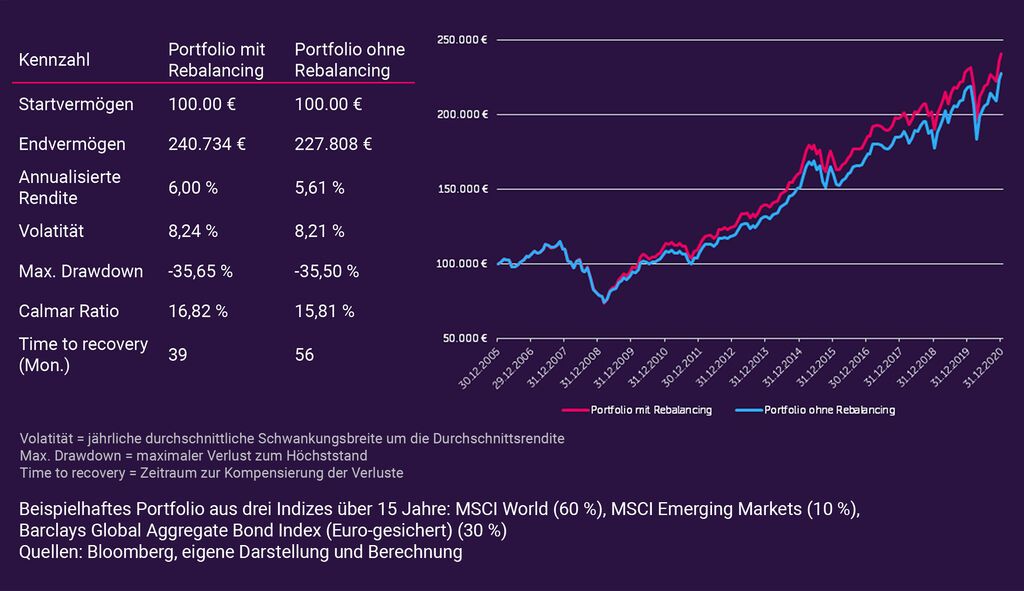
The result: in this example, rebalancing increases the return and reduces the risk.
Adjusting at least once a year
Capital-market research shows that the big turns on the markets in particular cannot be forecast – not even with the most sophisticated risk models.
In its 2018 study “Robo Advisors in der Krise”, the Institut für Vermögensaufbau compared various approaches to risk management. The result, in a nutshell: if a portfolio's equity ratio fluctuates with the market, a stress event can lead to considerably sharper setbacks than is the case with systematic rebalancing. So we stick to the plan: rebalancing of the portfolios takes place at least once a year. And additionally whenever the defined percentage shares of equities or bonds in the overall portfolio are exceeded or fall short by 10 percent (not percentage points!). If the share of equities or bonds in the portfolio is very small, thresholds of 15 or 20 percent apply respectively.
Calibrating the portfolio precisely
When we carry out rebalancing, we always do it for the entire portfolio at once. After all, investors should get exactly the set-up they wanted. So we don't simply reduce, say, one of the equity components, but recalibrate all positions so that the ratios are right again. If we recognise that a better-suited ETF is now available for a particular market, we optimise that at the same time. And if we recognise that rebalancing at the planned point in time would be unfavourable – because the spreads are wide and execution therefore expensive – we postpone it until the situation has normalised. But this is only very rarely necessary – for instance, during the coronavirus crisis last spring.
With savings plans, by the way, we automatically carry out a small rebalancing with every savings-plan instalment. That's because every savings instalment is based on the chosen orientation and the current status. If equities happen to be particularly expensive right now, more of the savings instalment goes into bonds. Whether savings plan or one-off investment: restoring the target allocation is a simple and effective means of risk management. And this becomes especially apparent precisely when the markets come under unexpected pressure.
Did you know? quirion portfolios contain more than just a single standard ETF. We bring several sources of return into your portfolio and balance their weighting optimally.