US President Donald Trump is changing the ground rules for global trade. It is safe to assume that his tariff policy will keep the economy and the markets busy for a long time to come. That the US will end up as the big winner, however, is highly doubtful.
Whether baby gear or power drills, coffee capsules or mattresses: many everyday products in the US have already become noticeably more expensive. That is because the new tariffs are pushing up the cost of imports. Companies pass these on to consumers wherever they can. Especially for products where consumers cannot or will not simply switch to other providers.
Economists at the German Economic Institute (IW) believe that American consumers will ultimately have to shoulder the lion's share of the tariffs. They point to studies on the China tariffs from US President Donald Trump's first term in office, which they say demonstrated this effect. At any rate, American consumers can hardly be counted among the winners of the new tariffs. Whether, and which, US companies will benefit is still written in the stars. Building up production capacity does not happen overnight and, depending on the industry, can drag on for many years. What conditions will apply once new plants come on stream is completely unclear: quite a big risk, because the conditions can change quickly.
Many new trade barriers
In his tariff poker, Trump is counting on America's standing as a world power and the appeal of the huge US domestic market. For context: with 340 million people at present, its share of the world's population is about 4.3 percent. Private consumption in the US reached around 19.8 trillion US dollars last year. That corresponds to around 18 percent of global gross domestic product and exceeds the gross domestic product of China, the world's second-largest economy no less.
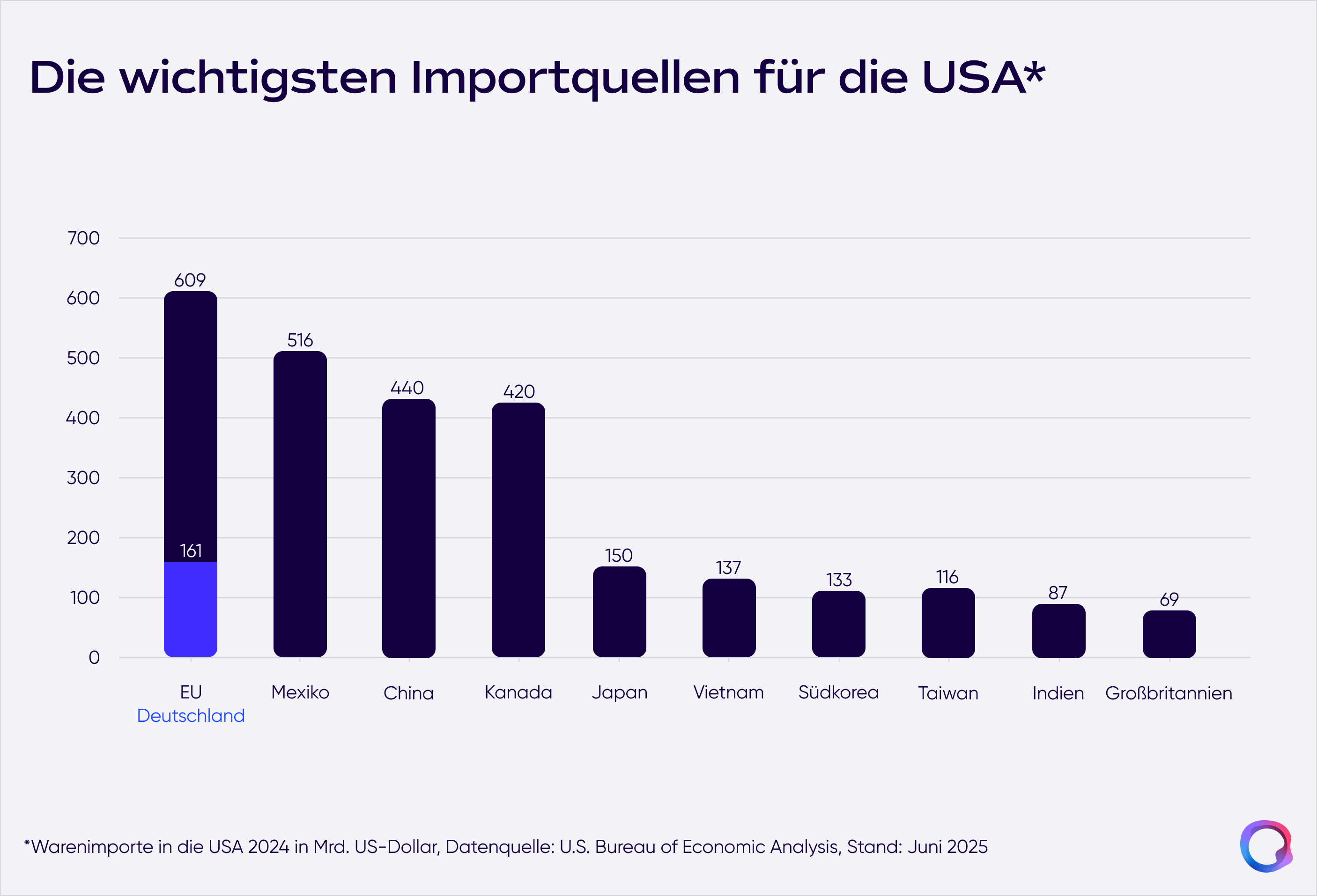
For imports from the EU into the US, the tariff is almost uniformly 15 percent - for now, at least. For a small number of goods, mutual tariff-free treatment was agreed, though not, for example, for automobiles.
Trump has, however, already threatened higher tariffs should the EU fail to deliver the 600 billion dollars in investment that he considers firmly promised.
For imports from Japan and South Korea, the US base tariff is likewise 15 percent, for the UK 10 percent and for Vietnam 20 percent. Canada is hit harder, at 35 percent - and so is India: on top of a base tariff of 25 percent, Trump slapped a further 25 percent punitive tariff on the country. Much remains uncertain and in flux. Mexico, for instance, has been granted a further extension by Trump for negotiations.
Complex chains of effects
The effects of the new tariffs are unpredictable. Their influence on prices and consumer behaviour, or on companies' balance sheets and investment decisions, will only become apparent over time. But it is obvious that the tariffs will not be without effect. Shortly before the deal with the EU, the economic researchers at the ifo Institute published the results of a survey of German industrial companies. According to it, one third of those surveyed expect the US market to lose importance. At the same time, around 40 percent expect growing sales opportunities in the EU internal market. But competition will be tough: 59 percent of companies believe that Chinese providers will push more heavily into European markets as a result of the US tariffs.
Who will be a winner from the new tariffs cannot be forecast. Though on balance there are more losers: "New tariffs always mean losses of prosperity. For everyone involved," underscores Philipp Dobbert, chief economist at quirion and Quirin Privatbank. You cannot simply use new tariffs to divide up the shared pie differently. "With tariffs, the pie - that is, the global economy - gets smaller overall."
But do the new tariffs not at least fill the state coffers, giving the US some relief on its high national debt? "To think that way would be a classic bit of wishful arithmetic," Dobbert observes. "That would only hold if nothing changed apart from the tariffs." Higher prices usually dampen demand, which shrinks tariff revenue. And if increased US production partly replaces imports, that reduces revenue too.
Economic policy or power politics?
Even after the recent deals, the topic is unlikely to disappear from the headlines. Even before the new tariffs took effect, Trump had already threatened more, for example on semiconductors and pharmaceutical products. "Trump will presumably keep reaching for the tariff cudgel to achieve political goals," Dobbert expects.
That this is not just about economic policy is shown, among other things, by Trump's tariff policy towards Brazil. In addition to a base tariff of 10 percent, Trump announced a punitive tariff of 40 percent. That is because he considers the trial over an attempted coup against the former Brazilian president Jair Bolsonaro, whom he holds in high regard, to be a violation of human rights.
Previously, Trump had repeatedly justified his tariff demands with unfair trading conditions that could supposedly be identified by a trade deficit with the US. But the US does not run a deficit in its trade with Brazil, it runs a surplus. By its own logic, the US would have to pay Brazil a tariff.
Broad diversification in the portfolio
So it is unclear both how things will proceed politically with the tariffs and how the tariffs will play out economically. It is also unclear how the various regional stock markets will each react when something shifts on the issue.
What is clear is that the wind on the stock markets can quickly change. That has already been demonstrated several times this year. In the US, for instance: during the weak phase in the first few months, investing in US shares was suddenly called into question across the board. But afterwards, major American stock indices quickly reached several new all-time highs again.
For investment strategy, that means: "Position the portfolio broadly for the long term and stay invested, even if prices swing more sharply here and there in between," Dobbert emphasises. "We pursue this strategy with our global ETF portfolio too." Because over the long term the stock markets trend upwards, as the global economy is geared towards growth. "Trump's tariff policy will not change anything about that relationship either."
More about the automated ETF portfolio can be found here.