Mr Kussmann, why should emotions play no role in investing?
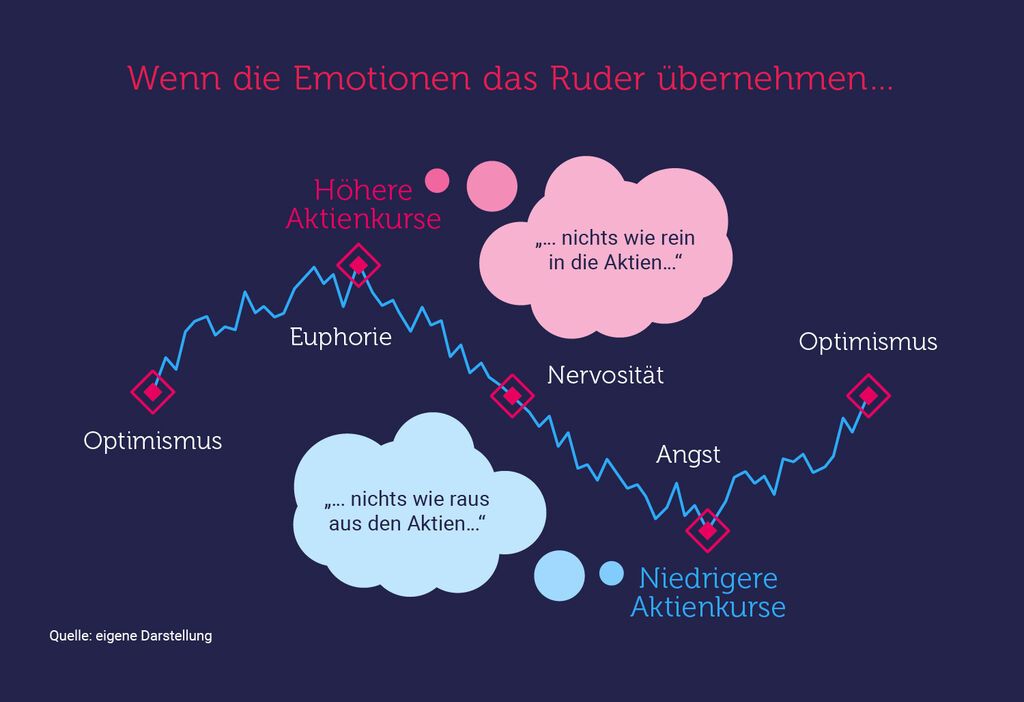
Private investors sometimes let themselves be heavily guided by their emotions. Both the gains they've made and the losses they've accumulated trigger feelings that influence their investment decisions. It has been scientifically proven that this results in a negative effect on returns compared with the performance achievable on the market. So gut instinct, which is very valuable in many areas of life, has been shown to be harmful when it comes to investing. Here, objective facts should be what count.
There are plenty of irrational behaviours that are better avoided. What is the most common one you observe among private investors?
In rising equity markets, investors tend towards higher equity allocations, because in these phases risks are often underestimated or ignored altogether. People then believe they can better absorb any potential losses. In highly volatile or falling markets, by contrast, investors shy away from risk and reduce their equity allocations. This pro-cyclical investor behaviour is also known as the herd instinct. It is emotionally driven and often bound up with poor timing and an overestimation of one's own abilities. As a result, these investors achieve a lower return than a portfolio that has simply stayed invested through the various market phases.
There's also a lot of talk about "home bias". What exactly does that mean?
Home bias describes the preference for the familiarity of investments in one's home market – in our case, Germany. Many investors feel safest and best informed there. But this shouldn't be the yardstick for where the bulk of one's capital is invested, because it leads to insufficient diversification. Here, an emotional reason – "love of home" – causes the investment mistake of an inadequately mixed portfolio, which in turn can lead to disproportionate losses in returns.
But surely adequate diversification can be achieved by holding lots of individual stocks, can't it?
That, too, is a misconception. Many investors think they can adequately diversify their portfolio with a larger selection of solid individual stocks. After all, the loss on one stock could be offset by the gain on another. But one risk with single-stock investments is holding on to poorly performing shares for too long. As long as the loss isn't realised, it seems to hurt less, and the belief in a price recovery outweighs the rational reasons in favour of a decision to sell. This is also referred to as selective perception. At the same time, realising the loss would be an admission of having once made the wrong investment decision. Admitting mistakes is often difficult in other areas of life, too. Instead of realising smaller losses, many investors then cling to the hope of being able to sell again at some point at their purchase price. For many stocks, however, that moment never comes again, and other holdings can then often no longer compensate for such losses.
What strategy can help you clear these psychological hurdles?
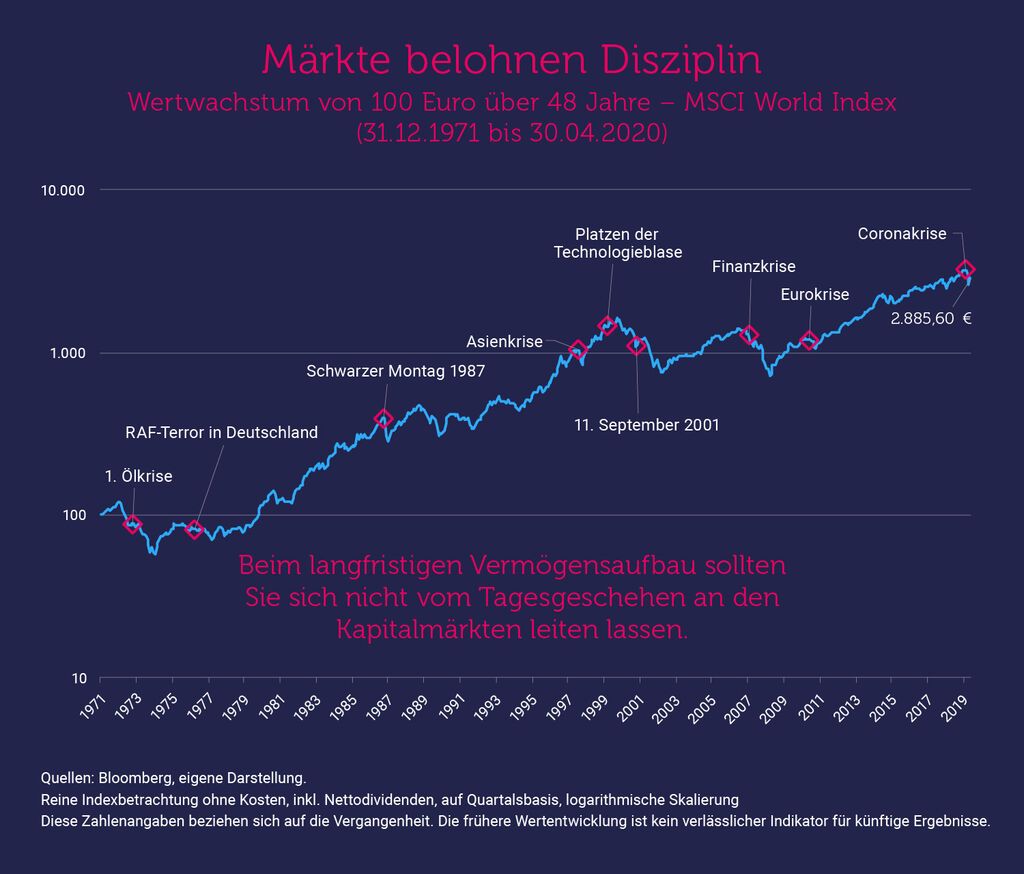
In order not to be emotionally swayed by either market fluctuations or forecasts, we recommend orienting yourself around the global capital flows – that is, investing your money the way it is actually distributed worldwide. On the equity markets, for example, around 85% is held in developed markets worldwide and around 15% in emerging markets. Anyone who sets up and weights their portfolio accordingly avoids many psychological traps and steers clear of unnecessarily excessive single-stock, sector and country risks. The basic prerequisites for such a market strategy are discipline and staying power. When building wealth over the long term, you should therefore not let yourself be guided by the day-to-day goings-on on the capital markets. Once you've chosen a strategy, you shouldn't abandon it hastily, because that usually costs returns.
What does that mean for the "home-loving" German investor?
Probably a reduction in their weighting of German equities. Only three percent of the world's equity capital is invested in German shares. In most German portfolios, this weighting is likely to be considerably higher. The decision on how heavily German equities should be weighted should be made by the market. Supply and demand determine this virtually automatically, and usually more efficiently than, say, active fund managers. If the share of German equities in global stock-market capital were to rise at some point to five or six percent, our recommended weighting would increase accordingly. Entirely without value judgements, and following a rational investment strategy.
How do professional investors, such as quirion's portfolio managers, prevent their emotions from taking over? After all, they too are only human.
Professional investors commit themselves to clear rules. We consistently banish forecasts and speculation from our investment decisions, for example, and orient ourselves around the capital-market flows described above. That takes the emotion out of investment decisions. At the same time, we need the self-discipline just mentioned in order not to deviate from the strategy, especially during volatile market phases. Professionals manage this considerably better than private investors do.
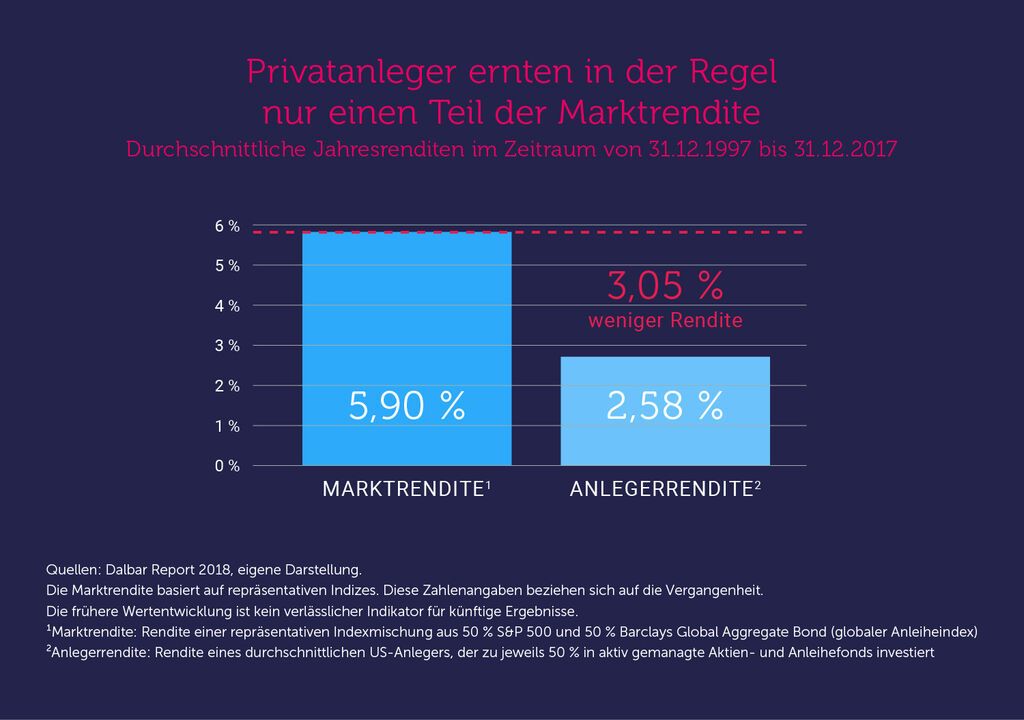
There are a great many studies on this, and they all demonstrate a negative effect on returns. In the so-called Dalbar Report (2018 edition), for instance, the annual returns of the broad market (as measured by representative equity and bond indices) were compared with a balanced private-investor portfolio over 20 years. Compared with the market, the investor portfolio performed on average about three percent worse per year. Over such a long period, that adds up to a fortune. The main reasons for this were poor timing, a lack of diversification, and high costs in the private investor's investments.
How can private investors avoid this and instead secure the market return for themselves?
In our view, the essential basis for securing the market return is a forecast-free investment strategy. For all the expertise that active fund managers undoubtedly possess, every forecast remains merely an assumption about a future development and is, in our view, always uncertain and pure speculation. In addition, the investment horizon for equity investments should be at least five, and better still ten, years. But the most important thing for long-term success is to set a strategy that suits the investor. In doing so, the weighting of equities and bonds – alongside the investment horizon – should be determined above all by the investor's return expectations and tolerance for losses, and not influenced by market assessments or the ups and downs of the markets. Because only then can the investor stick to their strategy even in weaker phases and, in the end, reap the market return.
An overview of the most common stumbling blocks in "investor psychology":
- Herd instinct
Buying and selling decisions are made pro-cyclically, in line with the fluctuations on the market. In rising markets people buy, and in falling markets they sell.
Risk: poor timing and an increased cost burden due to more frequent transactions - Home bias
Investments in the home market are overweighted because of the perceived greater sense of security. Risk: insufficient diversification - Selective perception
Investors avoid realising losses and removing from their portfolio the holdings they once considered good.
Risk: losses keep growing and the purchase price is never reached again. - Overestimating one's own abilities
Very active investors often overestimate their own performance. They consider themselves very successful at timing entries and exits and at selecting investments.
Risk: a lack of diversification and poor timing erode returns. And unnecessarily frequent transactions push up the cost burden.
No one can predict share prices with any certainty. And that is why fund managers who work with forecasts cannot beat the market over the long term. quirion's intelligent investment concept is based on well-founded findings from capital-market research, not on predictions. On the one hand, we rely on low-cost index funds, which we assemble into an optimal portfolio depending on your risk profile. On the other hand, we give attractive securities a higher weighting than others in your portfolio. For us, attractive means value stocks (shares with high balance-sheet asset values) and small caps (shares with a small market capitalisation). We limit risks through strategic risk management.
Would you like to learn even more about our forecast-free investment philosophy? Then download our white paper here (PDF, 1.13 MB)!