Nothing is as it seems, least of all on the stock market. In this article, we explain the relationship between a country's economic growth and the return of its stock market, one that is likely to surprise many.
Many contestants on Günther Jauch's "Who Wants to Be a Millionaire" consider the €300 question easy, only to stumble on it. The following could be one of those nasty €300 questions:
When a country's economy grows strongly, that country's stock market performs:
a) very well
b) very poorly
c) it's impossible to say
Sounds easy, no reason to use a lifeline. Right? Quite a few would go for a) and then be bitterly disappointed. Because, after an agonising commercial break, Jauch would say: "The correct answer is, and dear viewers, would you have known? c), it's impossible to say." In the TV quiz, the chance at a million euros would now be gone, and in real life too, investors lose a lot of money because of mistaken ideas about how the capital markets work.
The facts
This €300 question is an excellent example of how, on the stock market, seemingly simple and logical relationships look completely different on a second look. Now to the facts:
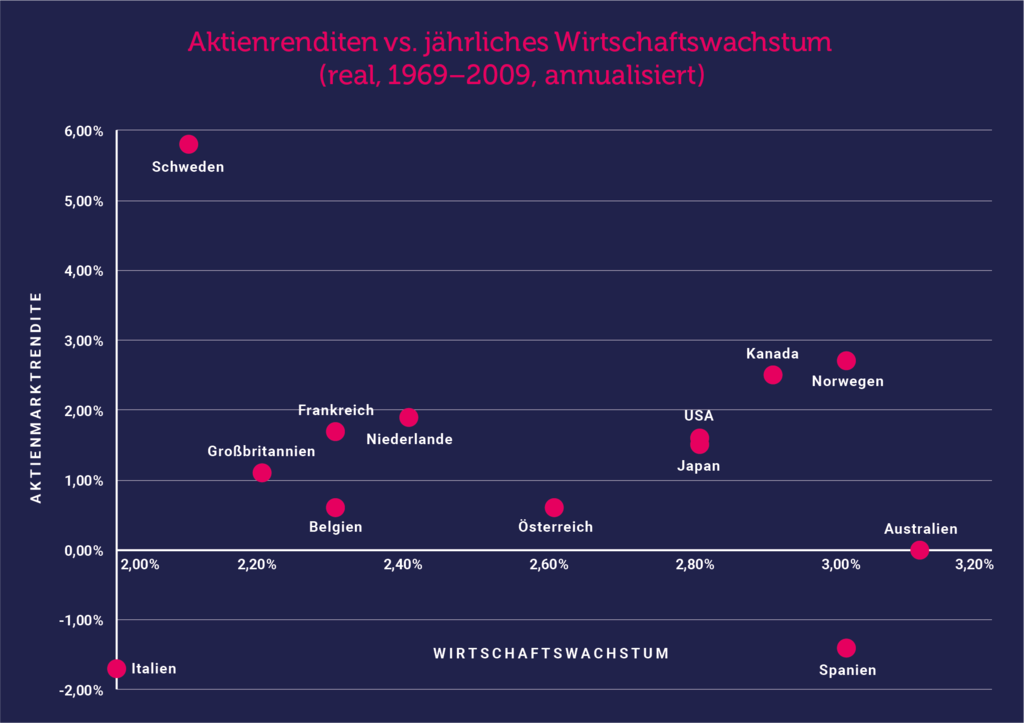
Source: The figures were taken from a study by MSCI.
Note: The figures relate to a simulation of past performance.
Past performance is not a reliable indicator of future results.
The MSCI chart shows, on the horizontal axis, how strongly countries have grown over the past 40 years, and on the vertical axis how well their stock market has performed. For anyone surprised that the equity returns are so low for most countries: that's because the returns are shown after deducting the inflation rate. What's more, the period under review includes two very poor stock market phases, the 1970s and the financial crisis of 2008 and 2009. But the overall level of returns isn't the point anyway: what matters to us are the differences between the individual countries. And these show that higher economic growth, meaning a position "far to the right," does not generally go hand in hand with higher equity returns, meaning a position "far up." Instead, the countries are scattered across the chart. Sweden and Spain in particular disprove the common cliché: the Scandinavian kingdom had very high returns despite low growth. The Iberian Peninsula, by contrast, showed high growth, yet its returns were among the worst.
One swallow does not make a summer, and a single study on its own proves nothing conclusively. But anyone who goes looking for studies on the relationship between economic growth and stock market performance will find plenty of further confirmation: whether you examine shorter periods or include emerging markets, nothing about the chart's message changes (see the sources at the end of the article).
The second look
But how can the intuitive and downright compelling thesis of economic growth as the engine of the stock market be so clearly wrong? For that, we need a second look at the economic relationships:
- Companies, especially large, listed companies, are increasingly operating internationally. Their profits are barely earned in their home country any more. Porsche, for example, sells 90 percent of its cars abroad, which decouples a country's economic performance from that of its companies.
- Listed companies make up only a small part of a country's economic output. To put two figures into perspective: gross domestic product in Germany stands at €3.4 trillion. The 30 DAX companies, by contrast, generate value added of "merely" around €200 billion, less than six percent of total economic output. Many large companies, such as Robert Bosch GmbH or Deutsche Bahn AG, aren't even listed on a stock exchange. And economic activity takes place predominantly in small businesses, in trades, in mid-sized companies or in fast-growing start-ups. That established, large companies automatically benefit from an economy's processes of change and growth is by no means a given.
- Next step in the chain of reasoning: what matters for a company's stock market value isn't the scale of its economic activities, but its ability to generate profits. For instance, Deutsche Bank, with its 100,000 employees, may still be a giant in economic terms, yet on the stock market you can get the share for the proverbial peanuts. Even DAX newcomer Wirecard is now worth more than Deutsche Bank, even though it employs only 5,000 people.
- And it goes further: what's decisive for a share's return isn't a company's current profits, but its future ones. And, careful now, even that is wrong: to be precise, what's relevant is how much higher or lower the future profits will turn out to be than market participants currently expect. In other words: developments that stock market professionals can foresee are already reflected in a share's price today, and only a deviation from that expected development causes price swings. This applies to individual companies, but also to entire stock markets: Japan, for example, is still one of the richest countries on earth. But its stock market plunged into the abyss in the 1990s because the country couldn't live up to the high expectations. Conversely, Russia's stock market boomed in recent years despite a weak economy. Why? Things didn't turn out as bad as had initially been feared.
- Final point: interestingly, not even a company's economic performance need be closely linked to the return on its own share. That's because a company can grow not only with the help of self-generated profits, but also through acquisitions or by raising new capital. An example: Commerzbank is currently among the 40 most valuable listed companies in Germany. So things can't have gone that badly for shareholders in recent years? Far from it. Since the financial crisis, the share has lost a whopping 97 percent of its value, which you can't tell from the stock market value, because investors (namely, the state) injected "fresh money" through the issue of new shares. Conversely, the return for shareholders can be high without a company's share price rising: this is always the case when the company pays out high dividends to its shareholders.
Conclusion
So sometimes, on a second look, the stock market can be pretty complicated. The good news: in the end, it turns out to be quite simple after all. Big money doesn't lie in the street. And promises to earn that big money by simply picking a few growth countries are empty promises (at least for the customer; whether product providers earn well from such products is another question). So please be warned should a supposed tiger economy turn out to be a paper tiger next time around.
Sources
The chart presented was created with data from a study by MSCI.
You'll also find studies on the lack of a relationship between economic growth and equity returns here, here, here, and here.