
Dividends are a potential source of income for equity investors. But they don't work well as a guiding principle for an investment strategy, argues our Senior Portfolio Manager Kai Hattwich. In this interview, he explains why.
It's dividend season again. Companies with high payouts are getting more attention. What role do they play in quirion's portfolios?
Our portfolios, which hold more than 8,000 stocks, also include many companies that pay high dividends. But companies with high dividends hold no special status in our investment strategy. Neither the size of the dividend nor the dividend yield - the ratio of the dividend to the share price - can be used to derive "stock tips." Both can be a sign of exceptional profitability, but they don't have to be. Sometimes companies pay high dividends even when their earnings situation is deteriorating. That eats into their economic substance. The dividend yield, in turn, doesn't only rise when the dividend increases - it also rises when the share price falls.
For some time now, people have often said that dividends are the new interest. What about the advantage of ongoing income?
Anyone making claims like that is comparing apples and oranges. Stocks pay dividends, bonds pay interest. In terms of risk profile, the two are fundamentally different. Bondholders can be more or less certain not only of receiving the interest, but also of getting their principal back at the end of the term. Stocks work differently. There are no guarantees whatsoever about future payouts. Price performance is central. What underpins both is the profitability of the companies. To achieve a balanced ratio of return and risk with an equity investment, broad diversification is essential.
And what if you spread the risk using dividend ETFs?
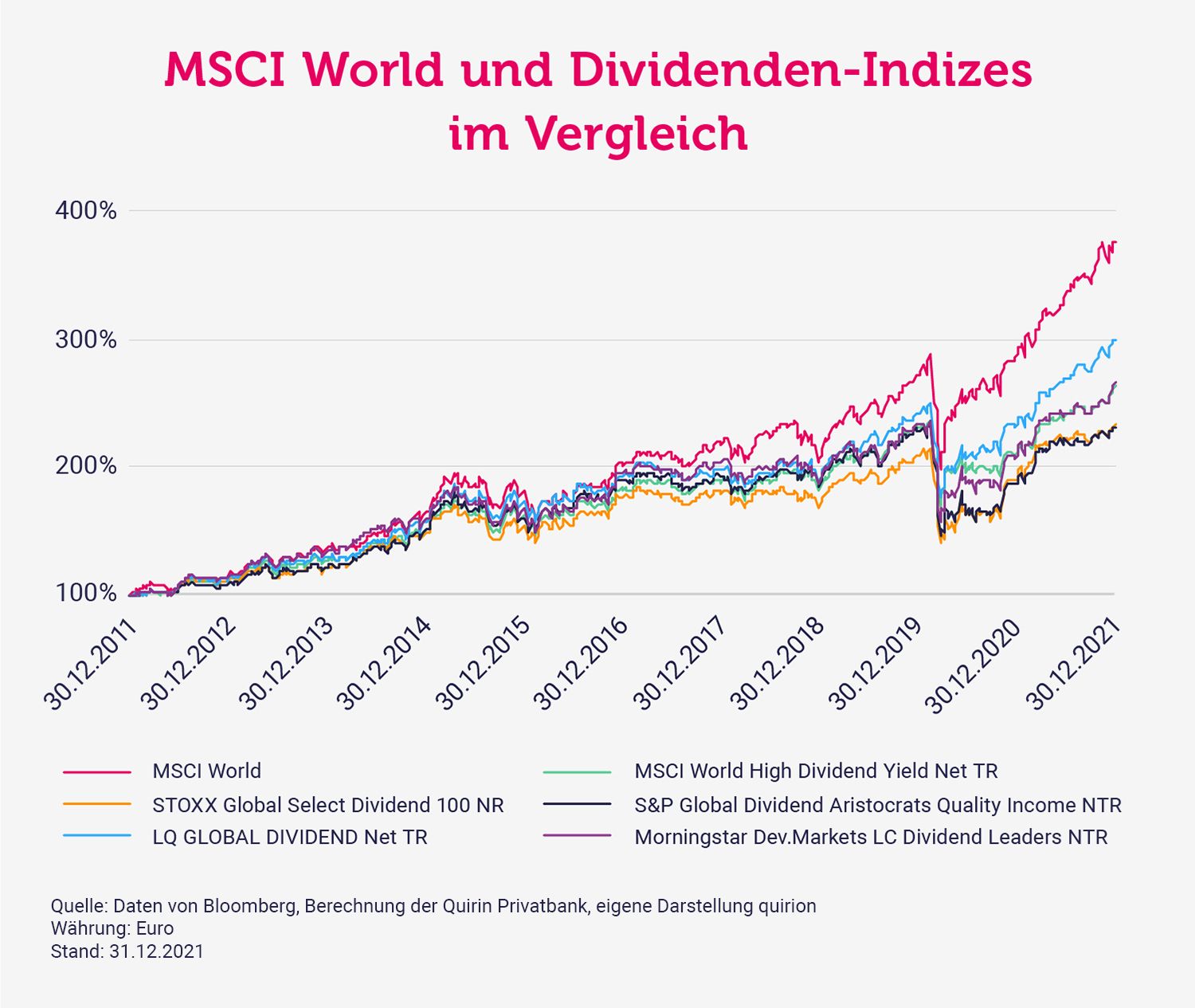
That's not genuine diversification, because these are very one-dimensional products. In any case, dividend ETFs and the indices they're based on have performed worse than more broadly positioned portfolios in recent years. Overall, they have a weaker risk-return profile.
Why is that?
First of all: focusing on the dividend always means looking in the rearview mirror. When a company's outlook dims and this is reflected in weaker prices, the stock initially stays in the underlying indices. In terms of diversification, many interesting stocks are missing - for example, those of small and medium-sized firms. These often include growth drivers that aren't "dividend stars." Numerous tech stocks in the US also have comparatively low dividend yields. Such companies tend to reinvest profits rather than pay them out. On top of that, dividend ETFs sometimes have an overweight in individual sectors, such as the energy industry. That sector was in demand on the markets recently, but had previously been through many troughs. The energy sector is closely tied to energy policy and is therefore exposed to particular risks. New regulation can quickly call business models into question.
Some dividend strategies take a more selective approach, additionally factoring in things like the debt ratio or the business outlook. Is that any better?
It at least makes diversification even harder. The more filters I use, the fewer companies qualify for my investment. Sophisticated dividend strategies that take further selection criteria into account move even more strongly toward single-stock investing than dividend ETFs do. That increases the risks considerably. We take a fundamentally different approach: rather than trying to filter individual stocks out of the market, we try to capture as many of the relevant return factors of the global equity markets as possible.
So dividends aren't a return factor?
No. In academia, the dividend question was settled long ago. The fact that not just a single dividend index, but a whole bundle of them, performed worse than the broader market over a decade is the quantitative refutation of the "dividend narrative." Its proponents often only mention the trades that turned out well. This creates the impression that dividend strategies are especially worthwhile. But when you look at the dividend indices, you see the result of systematically applying the dividend selection criterion to the stock market - including the unpleasant developments. A while ago, we scrutinized every possible return factor on the basis of current capital market research and aligned our investment strategy with the relevant ones.
And what are the relevant factors?
One genuine factor, for example, is "value." This refers to what are known as value stocks. In assessing which companies belong in this category, profitability is one of several criteria. Incidentally, the dividend yield in our portfolio, at around two percent, is somewhat higher than in the especially broadly positioned MSCI All Country World Index. As mentioned: "dividend stocks" hold no special status with us, but many are nonetheless part of the portfolio.