In the world's largest economy, the government is changing in January. In Europe's largest economy, new elections will be held in February. A lot will be moving in the political landscape in the coming year. But that changes nothing about the principles of smart investing.
The next US administration is taking shape. If Donald Trump has his way, TV host Peter Hegseth will become Secretary of Defense. Not the only personnel decision that has startled quite a few people in advance: the planned appointment of vaccine skeptic Robert F. Kennedy Jr. as Secretary of Health immediately put pharmaceutical stocks under pressure on the markets.
When Trump takes over the White House on 20 January 2025, a number of things will be different than in his first term. Above all, the Senate and House of Representatives are now in Republican hands as well. A good starting position for Trump to put his agenda into action. The situation is quite different in Germany: which government will set the course and what the majority ratios in the Bundestag will be won't yet be clear when Trump takes office for the second time. After the abrupt collapse of the „traffic light“ coalition, new elections will first be held on 23 February.
More protectionism?
Some of Trump's campaign promises are sure to give the next German government headaches – among them the threat of high import tariffs of generally 10 to 20 percent. Last year, just under 10 percent of German exports went to the US. Already, Germany's economic weakness is dampening the economy of the eurozone. Trade conflicts between the US and the EU would hardly be helpful.
The fact that Trump is set on strong trade restrictions is a topic in many countries. On imports from China, Trump even wants to levy a tariff of at least 60 percent. Could his second term become a burden for the entire global economy? „We already know Trump's protectionist ambitions from his first presidency,“ notes Philipp Dobbert, chief economist at quirion and Quirin Privatbank. Even back then, the global economy did not collapse.
„It's certainly conceivable that stronger trade barriers could have an impact on global economic development,“ Dobbert qualifies. „But world trade has always dealt with such barriers; Trump isn't inventing them anew.“ In recent decades, he says, it has become clear that world trade brings gains in prosperity and growth for everyone who takes part in it. „In the process, world trade has again and again adjusted to barriers of all kinds.“
What is the stock market doing?
The US stock market initially greeted Trump's election victory euphorically. The prices may have been helped by the fact that the Fed cut its key interest rate once again shortly after the election. In the days that followed, prices then declined somewhat again. One weighing factor: Fed chair Jerome Powell had emphasized that there is time to take before making further rate cuts.
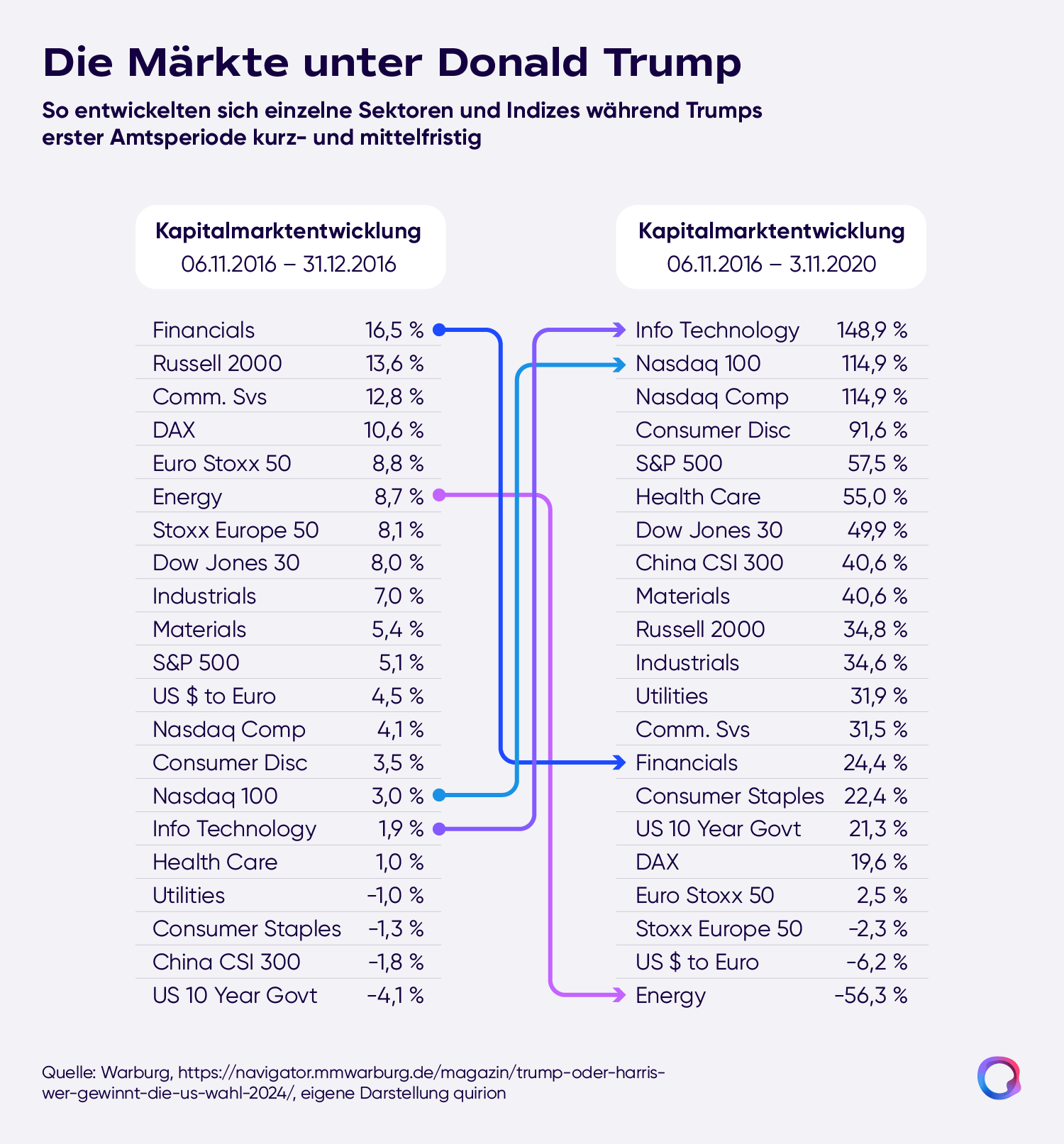
Politics isn't everything. And initial reactions to the election result aren't really meaningful for how things develop further. A brief look back at Trump's first presidency: back then, in the first weeks after the election, the areas of the US stock market that were expected to get a boost from his policies did indeed show a certain strength – stocks from the financial and energy sectors, or smaller companies, for example. But when you then look at the development over the entire term of office, the result is put into perspective considerably.
Inflation remains a topic
Company balance sheets, the economy, key interest rates: none of this can be read off from election manifestos. „Whether the Fed effectively gets inflation under control – and does so without triggering slumps in the economy – is something that will only be decided now,“ notes economist Dobbert. A more protectionist trade policy, along with the tax cuts Trump has planned, could well fuel US inflation again. „In the eurozone, too, the matter of inflation isn't over yet.“
But however things continue on that front in the coming months – what counts for building wealth is the long-term perspective. And so far, over the long term and on average, stock prices have always risen.
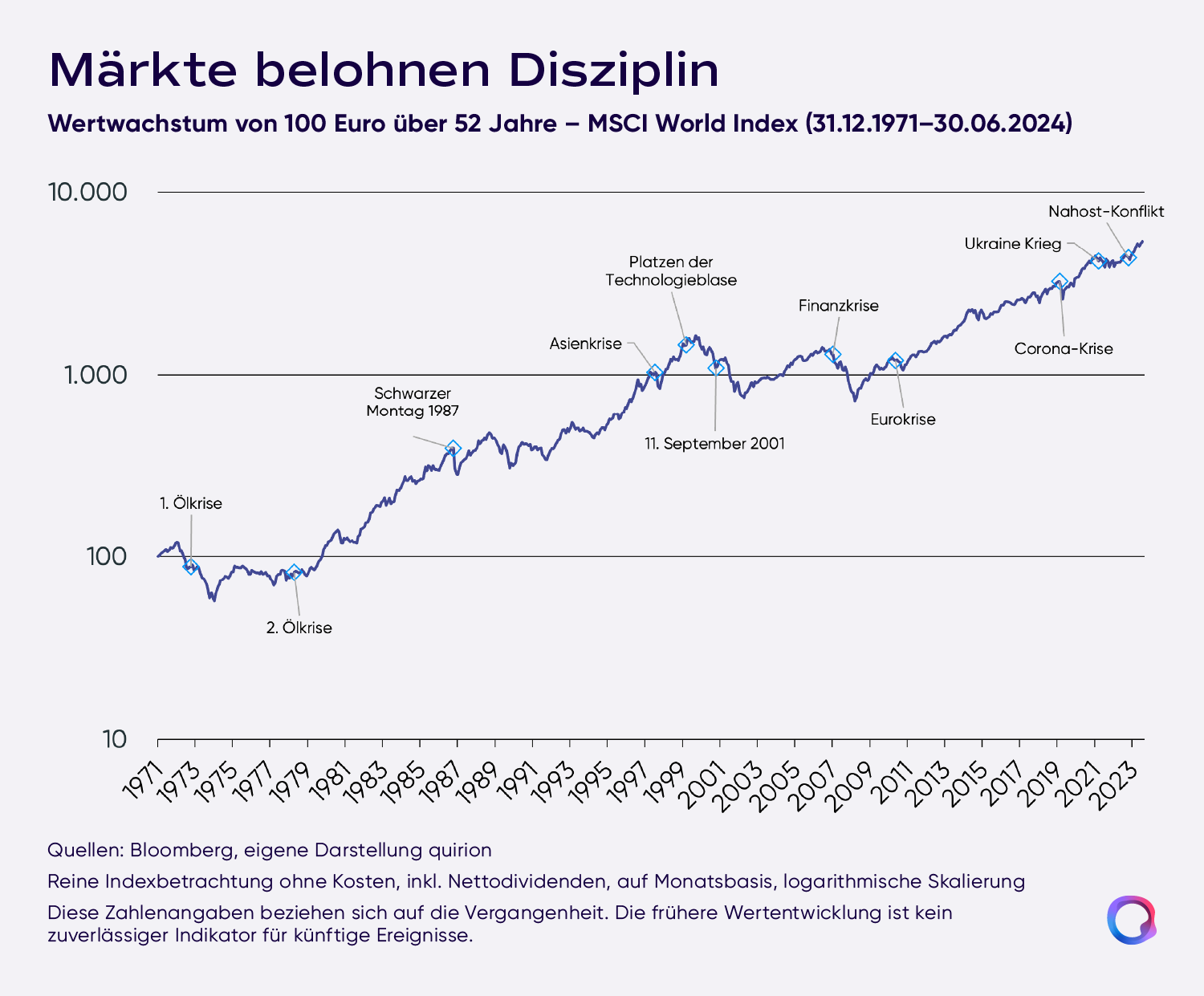
Stocks give you a stake in companies and thus in the economy. The economy, in turn, is geared toward growth. „Neither changes of government nor major crises have ever changed anything about this connection,“ notes Dobbert. Of course, it didn't always go straight up. „But over the long term, it paid off to be invested and to stay invested.“
Being and staying invested: „This principle only applies, however, to a broadly diversified investment in which the ratio of return opportunities to risks is as optimal as possible,“ Dobbert emphasizes. Anyone who bets on individual stocks or market segments could lose a great deal if the bet doesn't fit the respective circumstances. „With a globally diversified portfolio, by contrast, I'm not speculating on a particular course of events. And so I don't have to worry about it either.“