Most people have heard at some point that broad diversification matters when it comes to investing. But that doesn't yet make it clear what diversification actually means in practice. And its value isn't always obvious either, even though it can hardly be overstated.
Don't put everything on one card, don't put all your eggs in one basket: investors hear this advice fairly often. Because when you're investing, diversification reduces the danger of being “caught on the wrong foot”, to use another figure of speech that comes up a lot in this context.
But how many securities does it take for a portfolio to be diversified? Are a few dozen enough, does it have to be hundreds, or even thousands? What other criteria matter when it comes to diversification? And how does it affect your return prospects?
Many paths to diversification
“When it comes to diversification, there isn't just one method,” notes Prof. Dr. Stefan May, Head of Investment Strategy at Quirin Privatbank and at quirion. “The range is broad.” At one end of the spectrum, he says, is what science calls “naive diversification”. “By that we mean a combination of several securities that comes about more or less at random.” Even that, he says, can offer certain diversification effects.
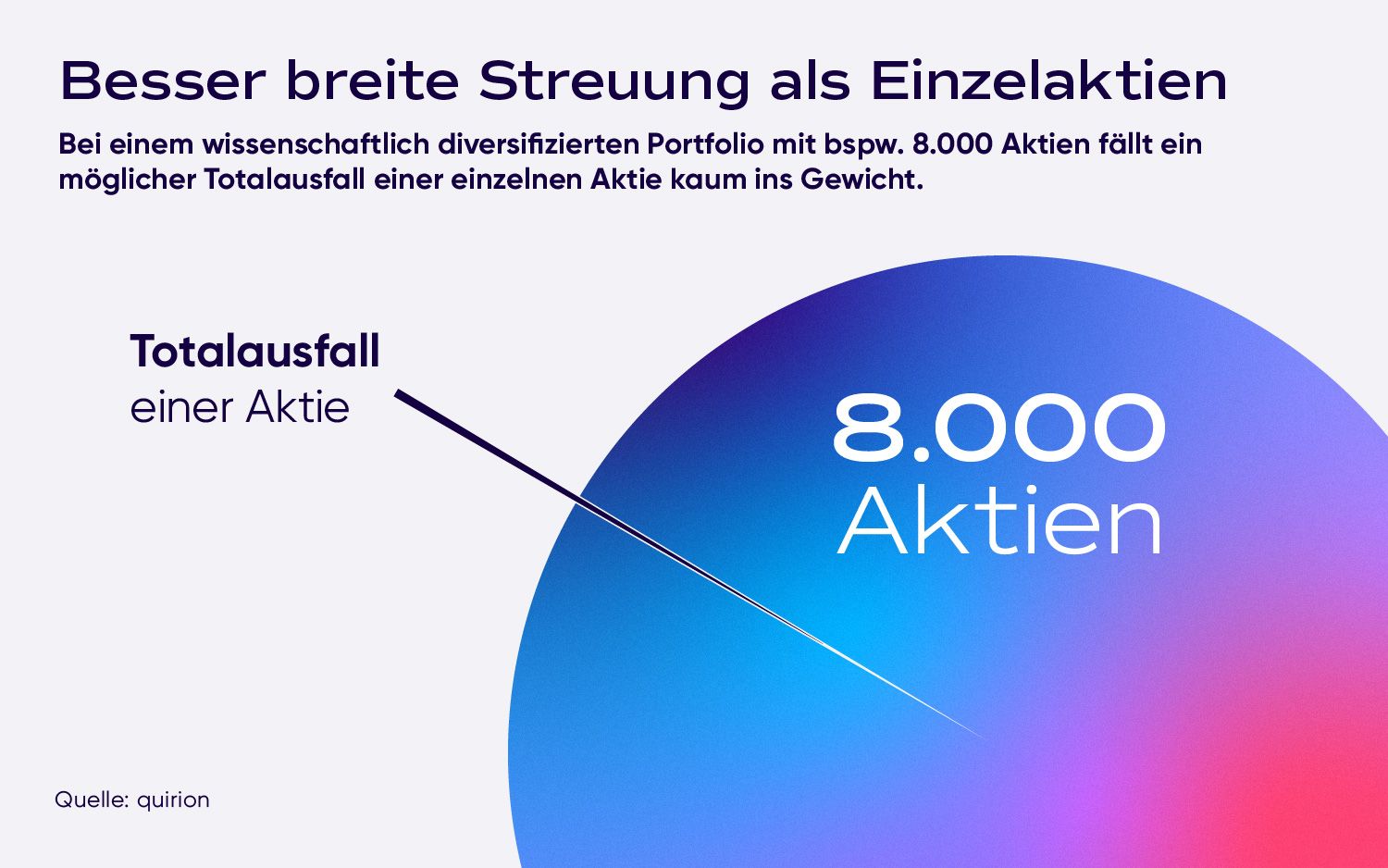
The number of securities plays a big part in this. The principle: anyone who invests in just one stock, or too few, makes all of their money dependent on the success or failure of individual companies. Someone who invests in a dozen stocks is already somewhat less affected if a single company fails. The larger the number of securities, the smaller the impact on your own investment result.
A world portfolio for the equity market
At the other end of the spectrum of diversification strategies, for May, is diversification based on scientific criteria. For diversifying an equity portfolio, he has one method above all in mind, namely orienting yourself around five so-called return factors and market capitalisation within a world portfolio.
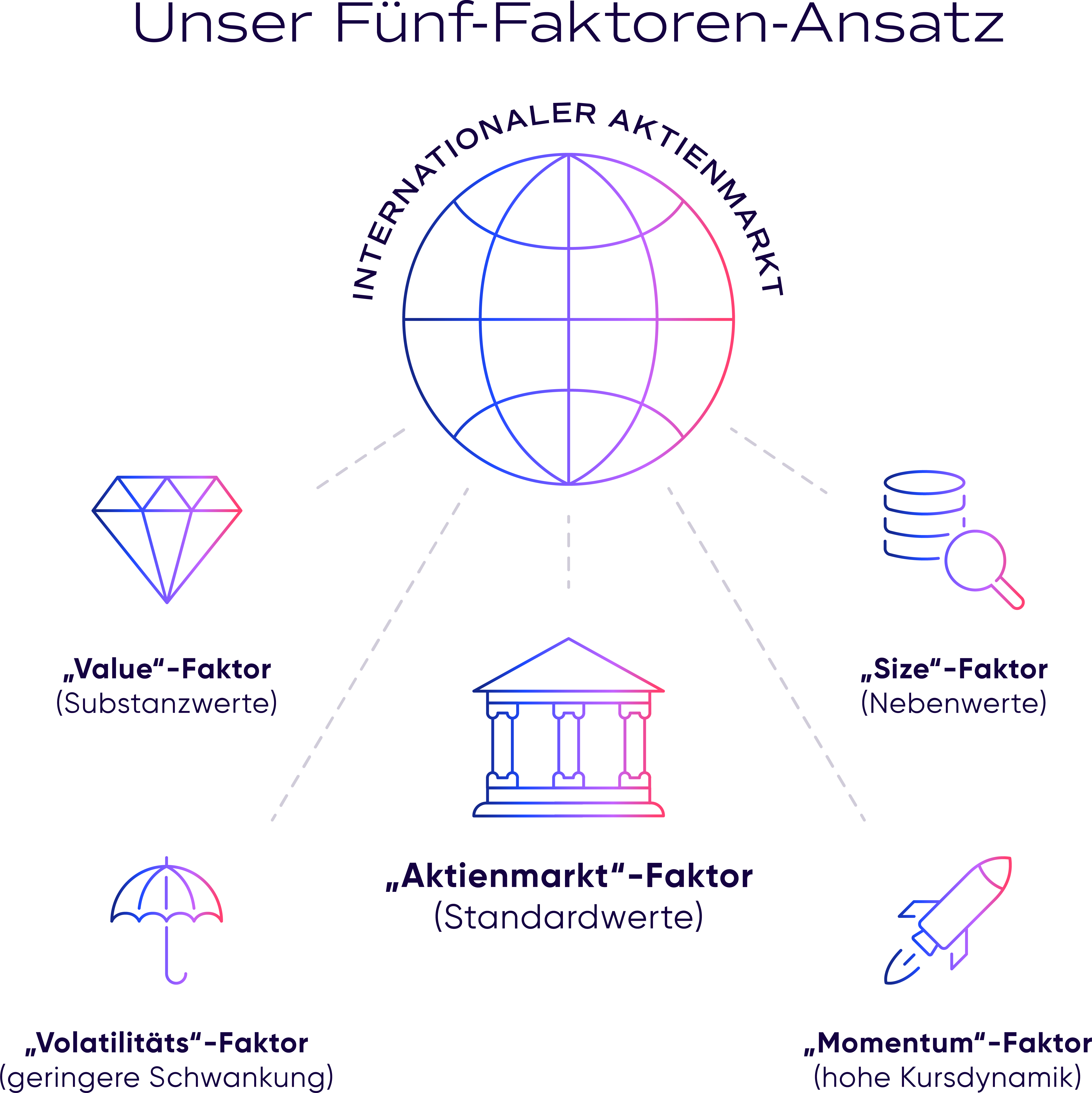
“Ultimately, every stock has a set of characteristic features that decisively influence both its return potential and its risks,” May explains. “Most of these risks can be more or less neutralised through sensible diversification.” In science, these are referred to as unsystematic risks. “What remains is the systematic risk. Only that is appropriately rewarded, because it can't be filtered out through diversification.”
The goal is what's known as an “efficient portfolio”. In one of these, risk is minimised within the relevant asset category. That category can be a pure equity portfolio, a mix of stocks and bonds, or a pure bond portfolio. The aim is always to strive for the best possible ratio of return potential to risk.
The “psychological price”
However you diversify, though, spreading your investments leads to averaging. “The overall performance of a diversified portfolio is always the weighted average performance of all its components,” May explains. “And the size of each weighting depends on which method was used to diversify.”
Average means that, at any given point in time, there are portfolio components performing noticeably better or worse than the portfolio as a whole. “That sometimes causes investors a certain unease, especially when particular markets or industries are rising sharply.” Tolerating that is, in a sense, the psychological price of diversification.
Why is it worth paying the psychological price? “Because nobody knows the future, and systematic diversification within a world portfolio like quirion's global ETF portfolio simply offers a well-thought-out ratio of return potential to risk,” May states. And that, he says, is what it ultimately comes down to: “Because it increases the probability of benefiting from the average returns that are always positive over the long term, and it reduces the impact of turbulence in individual industries or regions, as long as you stay invested for a long time.” This value, he says, can hardly be overstated. “A lack of diversification is the main reason why, for many people, the increase in value lags behind the market return.”
Diversification is especially broad in quirion's ETF portfolios. The global ETF portfolio, for example, contains around 8,000 stocks and bonds from more than 2,900 issuers. You can also take part via the ETF savings plan Plus, which, just like a lump-sum investment, gives you a full stake in the entire portfolio with every savings instalment. And that starting from as little as €25 a month.