Our investment strategists rely on being forecast-free and on keeping a steady hand. Even so, something is constantly changing in our global portfolios. That applies to the equity side as much as to the bond side.
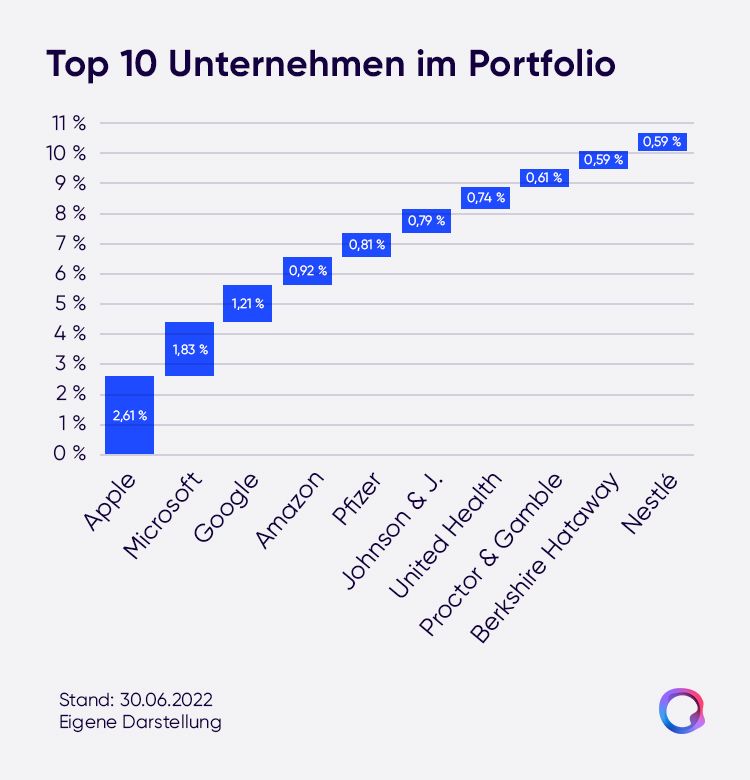
The top position has stayed the same: at the end of the first half of the year, Apple was still the stock with the highest weighting in quirion’s global equity portfolio. But otherwise, a fair amount has happened in the top 10 over the past months. Tesla and Facebook, for example, still far up front in September 2021, are no longer among the top holdings. In their place you now find shares from the health care segment such as Pfizer, or consumer goods companies such as Procter & Gamble. That’s because many tech stocks have come under considerable pressure. More defensive holdings were in demand.
The market decides
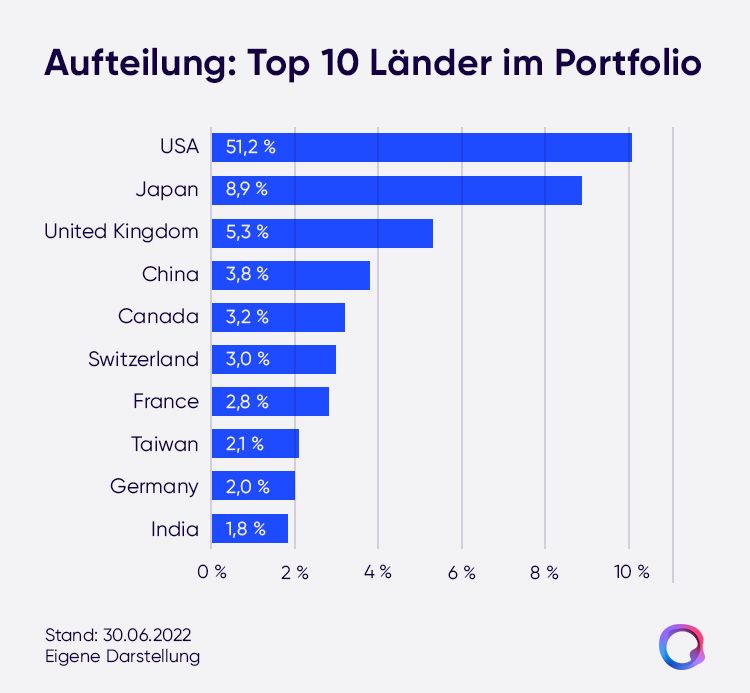
But the changes in the portfolio are not because the views of our investment management have shifted. The line-up is largely shaped by movements in market capitalisation. This is determined by the number of shares outstanding and the current price at any given time. „By orienting ourselves to market capitalisation, the various characteristics of stocks – such as sectors or valuation levels – are automatically represented in our portfolio in the way they are demanded by the entirety of all investors,“ explains Philipp Dobbert, Chief Economist and Head of Asset Management at quirion. Individual regions, too, are represented according to the current size of the respective stock market.
Because quirion’s goal is to reflect the return of the entire „global equity market“ as precisely as possible through the way the portfolios are structured – and not to rely on its own opinions or forecasts. „We rely on the historical fact that equity markets rise over the long term,“ the economist emphasises. „We don’t speculate about exactly when which stocks will be in demand. The market decides that.“
Broader is better
The first half of the year, however, was pretty disappointing on the markets: the DAX, the S&P 500 and the MSCI World all recorded a loss of around 20 percent in US dollars. quirion’s global equity portfolio held up better, with a loss of around 10 percent. „Of course, the development isn’t pleasing for anyone,“ Dobbert stresses.
In comparison, it nonetheless becomes clear that a global and especially broad line-up has significant advantages for the risk-return profile. „In times of crisis, globally positioned portfolios usually fall less sharply than regionally limited ones. That’s because the risks are more concentrated there.“ In Germany, for example, the energy supply is heavily dependent on Russia, unlike in the United States, say. Energy shortages would affect many industries, particularly in Europe. That could weigh on prices further. With a global line-up, the impact of such regional developments carries less weight.
Several factors count
The DAX consists of 40 stocks, the S&P 500 of 500. Even the comparatively broad MSCI World only reaches around 1,500 stocks. quirion’s equity portfolio, by contrast, reflects over 8,000 holdings. And for quirion’s portfolio, it is not the market weighting alone that is decisive for the weighting of individual holdings. The most representative possible combination of the five most important equity market factors also influences the specific line-up. One of them is the size of the company: in many well-known indices, small and mid-sized companies are underrepresented. Asset Management balances this out through specific investments – and thereby completes the diversification. In this way, the best possible balance between expected return and expected risk is created. That is another advantage over large stock market indices such as the MSCI World.
A turning point for bonds
The broad line-up of the global equity portfolio already cushions certain risks. But a pure equity investment is not the right thing for every risk profile. Most quirion portfolios therefore also contain bonds to varying degrees. The main aim of adding them is to cushion the fluctuations of the equity market. That is why two thirds of the bond portfolio consists of short-dated bonds with high credit quality, for example government bonds from industrialised countries. The bond portfolio is also broadly diversified, with over 1,000 bonds.
In the bond market in particular, a lot has happened since the start of the year. „It really is a historic slump that we are experiencing in the bond market – there is no sugar-coating it,“ Dobbert states. „We haven’t seen such a dynamic rise in yields, and thus such a sharp drop in prices for benchmark bonds, for over 30 years.“ The reason for this, he says, is above all the relatively swift turn in interest rates – particularly in the United States – in the wake of sharply rising inflation.
Forecast-free, with bonds too
Even so, the investment strategist maintains: „No other asset class has provided a counterbalance to fluctuations as reliably so far, and that still holds true – even if there were some weeks this year in which bonds performed worse than equities.“ That was an exceptional situation, he says. What’s more: „When key interest rates rise, that also affects newly issued bonds,“ Dobbert explains. „When bonds in our bond portfolio mature, they are gradually replaced by bonds with more attractive interest rates.“ So here too the portfolio stays in motion and renews itself automatically.
But wouldn’t it be better, in such turbulent phases, to say goodbye to bonds and „park“ the capital, for example in freely available liquidity? „As with equities, the same applies to bonds: market timing simply doesn’t work,“ Dobbert emphasises. Even if you managed to get out and accepted that „only“ inflation would erode the purchasing power of the „parked“ assets considerably: „Hitting the right moment to get back in – that would be sheer luck. Relying on a systematic investment strategy and sticking with it is sometimes hard, but over the long term it is always better.“