The year isn't quite over yet. And yet one thing can already be said: in 2023, too, there was plenty in the economy and on the markets that hardly anyone had foreseen. 5 developments that surprised many.
1) The US economy more robust than expected
It has already been called the „most anticipated recession in economic history.“ But at least so far, it has failed to materialise: over the course of 2023, the US economy proved far more robust than had been expected. Seasonally adjusted and annualised, US gross domestic product grew by 2.2 percent in the first quarter, by 2.1 percent in the second, and by a strong 5.2 percent in the third.
„Effectively fighting inflation without triggering a recession: if that were to succeed, it would be historically unprecedented,“ explains Philipp Dobbert, chief economist at Quirin Privatbank and at quirion. That is especially true because interest rates have risen particularly fast and sharply. „That, too, was historically exceptional — so we are in uncharted territory.“
2) Asian emerging markets disappoint
At the start of the year, China and other Asian emerging markets were seen in many outlooks as beacons of hope. „Will 2023 be the year of the emerging markets?“ Such were the headlines, and others like them. But while the American S&P 500 rose around 20 percent from January to the end of November, the MSCI Emerging Markets Asia, in US dollar terms, only just managed to move into positive territory.
China and many other Asian emerging markets have not yet been able to return economically to the growth of earlier years. „But over the long term, the momentum of the emerging markets, which are seeking to catch up with the industrialised nations, is a pillar of global economic development,“ economist Dobbert notes. „That's why they still belong in every well-diversified portfolio.“
3) Japan's stock market boom impresses
Which stock market index posted a price gain of 30 percent from the start of the year to the end of November? At the end of 2022, hardly anyone would have bet on Japan's Nikkei 225. The rise began as early as January. Between April and June, prices then moved upward with particular momentum, reaching a level not seen for over 30 years.
With hindsight, a number of reasons can be found for the boom: the relatively strong economic performance, for example, reforms in the preceding years, and negative key interest rates. That the market would rise so sharply in this year of all years was nonetheless something no one had expected beforehand.
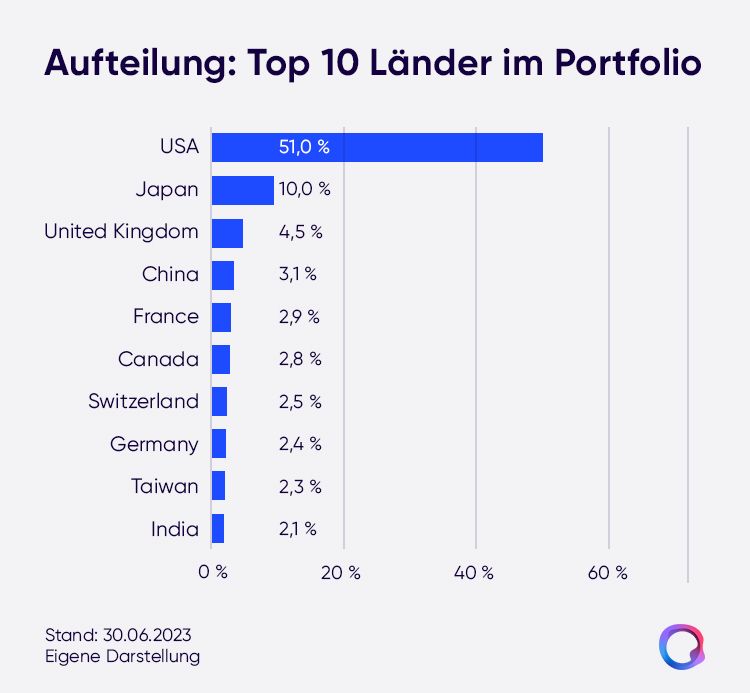
Regardless of the reasons or expectations for the future, Japan ranks second among countries in quirion's global ETF portfolio. „We go by market capitalisation, not by forecasts,“ Dobbert explains. „If prices — and thus market capitalisation — rise sustainably, our investors participate too.“
4) Small caps lag behind
It didn't come entirely unexpectedly, given the sharp rise in interest rates and the economic conditions. But the persistence of the trend nonetheless caught many people's eye. „This year, once again, it was above all large standard stocks, particularly from the technology sector, that carried the upward movements,“ Dobbert explains. „The shares of smaller companies did develop positively, but simply not as strongly.“
Whether company size (Size) or intrinsic value (Value): both return factors play a role in quirion's global and sustainable ETF portfolios. „We're sticking with that,“ Dobbert emphasises. „Because both factors are highly relevant to optimising diversification within a global portfolio.“ After all, this ensures that smaller companies, which still have their growth ahead of them, are appropriately taken into account too — just like shares whose valuations have not yet been driven to dizzying heights.
5) Bond markets fluctuate with interest rate expectations
After the heavy losses of 2022, the bond markets proved considerably more stable in 2023. Yet the bond market kept surprising with ever new twists. This was evident, for example, in the yield on the internationally benchmark 10-year US government bond: at the start of the year it stood at 3.88 percent. In early March it reached an interim high of just over four percent, then slumped to 3.25 percent by early April. The back-and-forth subsequently continued at an elevated level, at one point even pushing the yield above 5 percent. By the end of November it was back at 4.2 percent.
In the US in particular, every piece of economic data was scrutinised for possible consequences for future central bank policy. If the labour market was stronger than expected, yields rose in anticipation of further rate hikes. If data pointed to a cooldown, they fell again. „Presumably the end of this rate-hiking cycle has now actually been reached,“ explains economist Dobbert. Central bank policy is nonetheless likely to remain in focus. Next year, possibly with the sign reversed: speculation about when the Fed will cut rates again has already begun.
What comes next?
Surprises are the engine of short-term price movements. They are not unusual — they are the rule. Because on the capital markets, expectations about future developments are what is traded. But those expectations change again and again, because no one knows the future. „In your investment strategy, you're best off sticking to what you know,“ Dobbert explains. „The equity markets are geared toward growth over the long term and on average, just like the world economy.“
With the broadest possible diversification, you participate in this growth without exposing yourself to overly large risks. In doing so, bonds, with their lower volatility, can additionally stabilise the portfolio. „All of this will hold true in 2024 as well,“ Dobbert underscores. „Regardless of what surprises await us in the coming year.“