To reach your own investment goals, it is important to make the right decisions. But perhaps even more important to avoid missteps. Here is a whole range of things you can do without.
1) Promises of guarantees
Guarantees are very important to most people when it comes to retirement provision. That was the finding of a survey this year commissioned by the German Insurance Association. The wish is entirely understandable: you want to be able to count firmly on a certain amount in old age.
But what many people are not aware of: guaranteed benefits do not mean the whole thing is worthwhile. Because guarantees cost money. So it is possible to end up getting back less than you paid in. Stiftung Warentest, for example, in a comparison of private pension insurance policies has shown exactly that. Guarantees and high fees throttle the build-up of wealth. It is not without reason that, for example, one in four of the roughly 20 million Riester contracts taken out has already been cancelled early.
Anyone who tackles investment goals such as retirement provision with a long-term view, and who, when investing on the capital markets, watches for the best possible balance between return opportunities and risks, can safely do without promises of guarantees.
2) Active fund strategies
Trading actively and promising better results than the average: that sounds good at first. But really the alarm bells should always ring when someone promises to "beat the market." Because to do so, that person would have to be able to see into the future. Who would trust anyone who claims to?
The result of decades of capital-market research is, at any rate, that no one systematically and reliably outperforms the broad market. An analysis by S&P Global, published in September, has just shown once again: over a ten-year period, 98 percent of euro-denominated funds for global equities were unable to outperform a comparable index.
So you can also save yourself the generally much higher fees of active funds. And put your money instead into a global ETF portfolio that is as broadly diversified as possible – one that follows the markets rather than trying to beat them.
3) Individual stocks in the account
What holds for active funds applies all the more to investing in individual stocks on your own: the more concentrated the selection, the higher the risk. Anyone who invests in only one or a few individual stocks becomes heavily dependent on the success or failure of individual companies. The danger of a total loss is great.
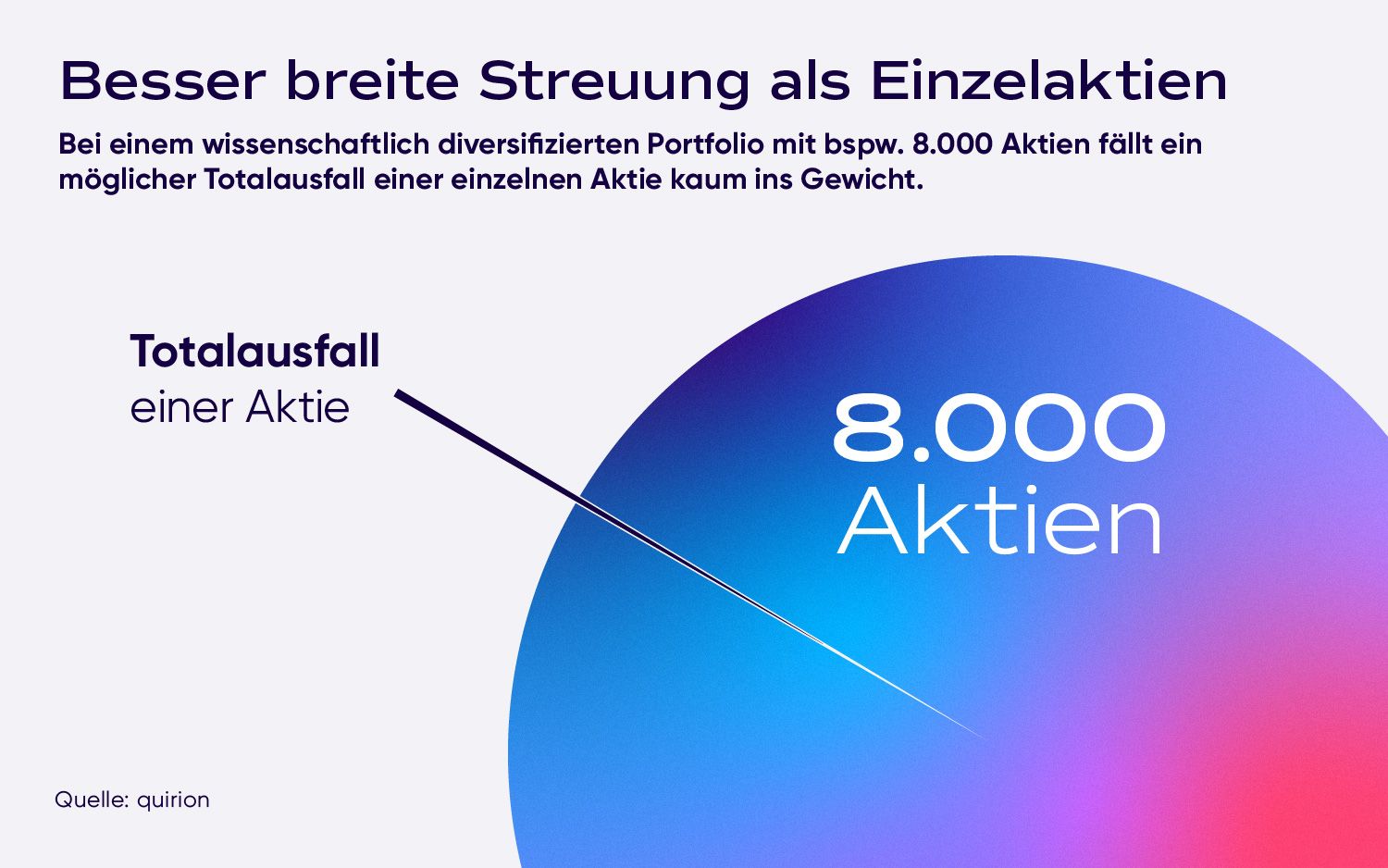
Many celebrated "stock-market stars" of yesteryear have long since disappeared from the market. According to a study by US economist Hendrik Bessembinder, the average span during which companies were listed on the US market in the years 1926 to 2018 was just 7.5 years. The market participants change constantly. But the market remains.
4) Private equity & co.
Whether private equity or venture capital: holdings that are not traded on the stock exchange enjoy a special reputation. Because for a long time they were accessible only to institutional investors and people with large fortunes. That certainly makes it sound as though something quite special might lie behind this kind of investing.
With the "European Long-Term Investment Funds" (ELTIFs) reformed in 2024, it has become much easier to invest in private equity & co. That is why several providers are now beating the advertising drum hard for them. Compared with equity ETFs, though, the costs of such products are generally very high. Transparency, by contrast, is low. And redeeming units is tied to holding periods. Whether investors can hope for extraordinary investment results is, moreover, highly questionable. Various studies.
5) Complex products such as certificates
Sometimes they promise to cap potential price losses, sometimes the chance of above-average results. All of them are highly complex. We are talking about derivatives such as certificates. Their performance is tied to that of an underlying asset – for example to certain stocks, commodities or currencies. The extent to which investors participate in the performance depends on the particular structure of the products. Issuers charge handsomely for that.
Products with "leverage" are especially risky in this respect. The prospect of profiting disproportionately from certain movements in the underlying asset with little capital outlay comes hand in hand with a particularly high risk of loss. In a study, BaFin took a close look at the market for so-called turbo certificates. According to it, between 2019 and 2023 roughly three in four retail investors suffered losses with them, on average €6,358 each. In total, the losses over the observation period added up to more than €3.4 billion. Anyone who wants to build wealth over the long term is better off keeping their hands off them.
Looking for a smart investment strategy? More here.