The natural reaction to a market crash: do something about it, swap out funds, get angry at your investment decision, sell everything. But anyone who wants to succeed with their investments resists these natural reflexes, keeps a cool head, and stays the course.
- Temporary price declines are completely normal. They cannot be predicted, and so they cannot be avoided either. „Experts“ who claim otherwise are not credible.
- Our recommendation to you: stay the course. Give your assets some time, and turn your attention back to your everyday life.

Watching your assets shrink hurts. This is especially true at the start of an investment phase, when a strategy has not yet had a chance to prove itself and the hard-earned money you deposited just moments before comes under fire. But anyone who resorts to drastic measures in such a situation and sells often only makes everything worse. Perhaps the following points will help you weather market fluctuations successfully.
„Experts“ cannot help you
Some price declines can be explained well in hindsight. The financial crisis is one such example – at its peak, the entire global economy was no longer turning a profit. And then there are crashes that remain baffling even after the fact: to this day, experts are still puzzling over why the markets collapsed in October 1987. Prices on the stock markets are made by people, and human sentiment can swing abruptly from greed to panic and back again.
These mood swings make forecasting future prices „even more impossible“ than it would be in an emotionless world. So here is what does not exist: price crashes that can be predicted. So-called experts who supposedly can do this rely on a psychological trick: they simply always predict a crash – and once one finally comes, they turn out to have been right.
The upswings that these „experts“ miss in the meantime, on the other hand, are forgotten. You do not have to be an expert to predict that mild – and, more rarely, severe – price crashes will keep happening in the future too. A glance at our chart below is enough to see this. But no one knows when these price declines will occur. In such a world, the right and, ultimately, the most calming approach is: invest – at the level of risk that suits you personally – and then stay the course.
What does quirion do when the markets fall?
Falling prices make us uneasy too. At times like these, we take another particularly careful look at whether our investment strategy is on the right track. We are convinced that empirical analyses – much like the one outlined further down in this text – can yield valuable insights. Our own analyses, and those of independent experts, confirm it time and again: crises cannot be predicted!
- We have consistently structured your portfolio so that it comes through a crisis in the best possible shape. The recipe for success here is maximum diversification, meaning spreading your assets across as many securities as possible. While this does not protect you from general market declines, it reliably minimizes any loss risks beyond that.
- When markets move significantly, we automatically trigger a rebalancing. In other words, we restore the original investment weightings. In particular, this means that we buy up additional shares of securities that have fallen sharply. This way, your portfolio benefits from recovering prices. Above all, though, the original portfolio alignment is restored – the one that optimally reflects your individual risk level and protects you from unnecessary further fluctuations in value (the key word being diversification).
What can you do?
- Above all: keep a cool head. Temporary price declines are nothing unusual. They will occur in the future too, just as rainy days will keep following spells of good weather. Even so, it remains the right thing to invest your money in the capital market.
- Are the losses genuinely causing you financial worry – or can you no longer afford further losses? Then it may make sense to review your choice of strategy. The advisory journey on our homepage is designed to help you gauge the risk level that suits you. There, we show you the losses and gains you should expect with our strategies.
- Don't look. Studies have shown that the more often investors check their portfolios and the more they react to price movements, the worse the returns they generate. The witticism of legendary investor André Kostolany still holds true: you should „buy stocks and then go to sleep“. And the hugely successful portfolio manager Peter Lynch strikes the same note when he says that „investors have lost far more money preparing for corrections than in the corrections themselves“. Our services are designed so that quirion takes care of everything your portfolio needs, leaving you free to get on with your everyday life.
- Look forward instead of back. How can you boost your future return? Cutting the costs of your investment is almost certainly part of the answer. Do you hold expensive actively managed funds? A market crash is a good opportunity to get rid of such funds, because it reduces potential capital gains taxes. Are you fully invested? Money in your checking account is guaranteed to lose value over the long term, because inflation continually eats away at cash holdings. A savings plan is a good way to invest money without any hassle, and it reduces the likelihood of getting in at the wrong moment with a large lump-sum investment.
Background knowledge on market crashes
In the chart below, we have plotted the performance of global stock markets since 1971. Two things can be seen with the naked eye. First: stocks rise over the long term. Between the start of 1971 and mid-2018 – that is, within 47 years – €1 turned into €39. That corresponds to an impressive annual return of 8.0%. But the second point is just as true: stocks are risky, and time and again assets melted away painfully. Clearly visible to the naked eye are the financial crisis (2008–2009, a loss of over 50%), the crash after the turn of the millennium (2000 to 2003, likewise a loss of over 50%), and the lean spell of the 1970s (1973 to 1975, again well over 50% loss). The chart also conceals dramatic days and weeks – for instance, the week of 19 to 23 October 1987, in which stocks lost 15% of their value in just five days.
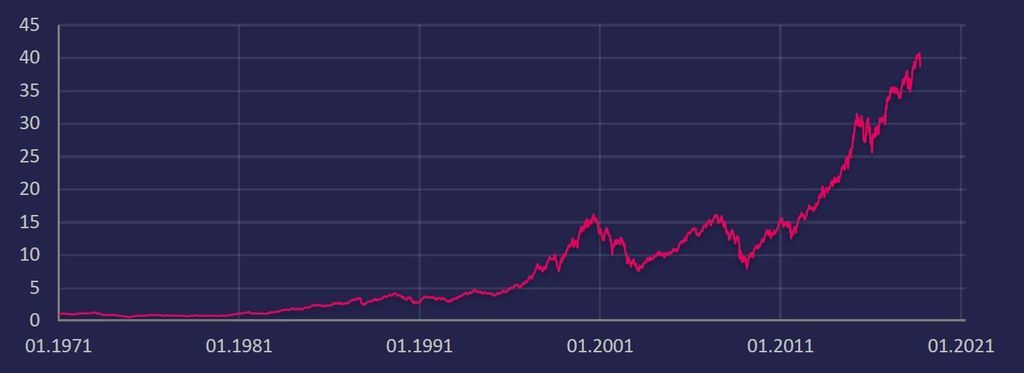
Stock markets are risky. The average loss an investor has to endure each year between the market's high and low point is 18%. Roughly once a year, the stock markets lose more than 5% in a single week, and in every third year the year-end portfolio statement shows a loss. These figures, mind you, apply to a well-diversified investment in the global stock market; individual stocks are considerably riskier still. But it is precisely because stock markets are risky that they generate a high return on a long-term average.
Very few investors can stomach a rollercoaster ride like this. Who can honestly say they could shrug off phases in which 50 or 60% of their assets are wiped out and still sleep well? Most investors cannot, and that is exactly why, alongside a pure equity strategy, quirion offers nine further strategies in which the fluctuations in value are in some cases considerably smaller.
Performance after market crashes
In the table below, we have taken a somewhat closer look at historical market movements. On average, the market rose by 0.17% per week – but only on average: the probability of a positive week was „only“ 56%, while with a 44% probability a week closed in the red. How did the market perform when it had fallen by more than 5% the previous week (a „market crash“)? The answer: exactly the same. On average the return is positive, the probability of a gain is greater than that of a loss, but a market recovery is by no means certain. The same picture emerges over a one-year horizon: on average there was a 9.8% return.
If the previous year was bad, what follows the year after is a return similar in size to that of all other years. Because it is by no means the case that things „keep heading downhill“ after a price decline and that you have to get out. The opposite is true. Over the longer term – over 5 years – the return after a bad year is even somewhat higher than the general average, and with a high probability of 83% you end up in the black. An average return gain of 63.1% over five years shows just how attractive stock markets are for investors who can cope with the price fluctuations that come with them.
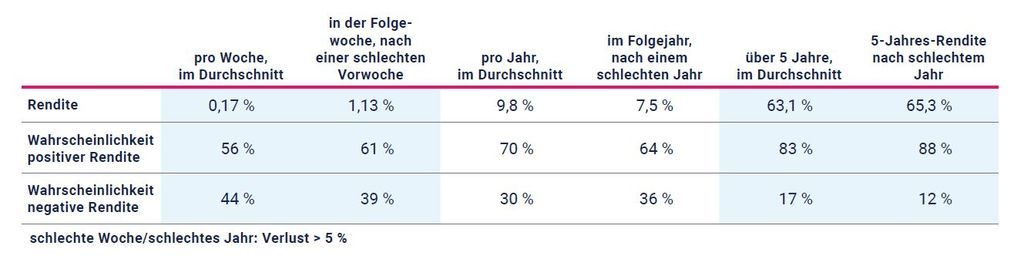
Savvy investors may now be tempted to bet on the return differences shown: that is, buy after a bad week and bet on a recovery (1.13% return is better than 0.17%) and sell after a bad year (7.5% is not as good as a 9.8% return). We do not recommend this, because we tested our results against a different dataset of American returns over a period of almost 100 years: the return differences cannot be confirmed. The results depend too heavily on statistical outliers and on the dataset and observation period used.
That said, stock markets do tend to perform above average after market crashes. And one robust finding is this: in every analysis – no matter which trading rule you set up – positive returns follow, on average, after the event under study. Falling prices simply cannot be predicted! Anyone who exits the market has to assume they will miss subsequent price recoveries. This behavior of the market is only logical, too, because – as we have already mentioned – investors want to be able to count on a positive return in exchange for the risk they take on. And the market does not care whether your personal portfolio is in the red or not. The market simply looks ahead and assesses – usually soberly, sometimes euphorically, sometimes skeptically – companies' profit prospects.
In closing
Spells of bad weather are an inescapable part of investing. Only those who accept this can grow their assets successfully over the long term. We, too, as your asset manager, have to accept it, as hard as that is for us as well. But once it „clicks“, there is something liberating about it: we can then devote our time to the things we can influence. At quirion, we work on structuring your portfolio efficiently and for strong returns. And you, too, can get back to living your life instead of watching price tables.