
Many stock markets performed brilliantly in 2023, with large-cap standard and growth stocks from the technology sector proving to be the frontrunners in particular. In this blog post, you can read how quirion's investment strategists view the road ahead – and why quirion's portfolios are well positioned even if things turn out differently.
The influential economist John Kenneth Galbraith divided forecasters into two categories: those who don't know anything about the future, and those who don't know that they don't know anything about the future. "We are fully aware that no one can see into the future," assures Arndt Kussmann, Head of Investment Communication at Quirin Privatbank and quirion. "That is why we emphasize again and again that investment strategies should not rely on forecasts."
Nevertheless, taking stock of the underlying conditions for investing from time to time can make sense. Those who are well informed are not so easily rattled. So what is the starting position in the global economy and with key interest rates? And what can be expected with a view to the bond and stock markets?
Will the "soft landing" succeed?
Fighting inflation with sharp interest rate hikes without triggering a recession: if the US Federal Reserve were to pull this off, it would be historically unprecedented. So far, the US economy has proven enormously resilient. Support came, among other things, from the robust labor market. This keeps private consumption, so important for the US economy, at a high level.
But at least a slowdown of the US economy is quite likely, in Kussmann's assessment. "In any case, several leading indicators point to this." According to the International Monetary Fund's (IMF) October forecast, US gross domestic product (GDP) is expected to grow by 1.5 percent – following 2.1 percent in 2023. That would be a soft landing.
For the eurozone, the IMF estimates growth of 1.2 percent in 2024, after only 0.7 percent last year. Performance was recently weak, particularly in Germany. "On the other hand, with Spain and France, countries whose economic policy course was often criticized in the past now seem to be becoming growth engines," Kussmann notes.
The emerging markets were able to widen their growth lead over the industrialized nations in 2023 compared with 2022. "But that was due more to lower growth in the industrialized countries than to economic momentum in the emerging markets," Kussmann explains. Although economic growth in the emerging markets will probably continue to be higher than in the industrialized countries in 2024, striking growth spurts are not to be expected here either.
Rate cuts on the horizon
Inflation rates have already fallen significantly in both the US and Europe. "If the economic slowdown in the US materializes, an initial key rate cut there around the middle of the year is likely," Kussmann states. "With a sharper economic downturn, it could happen even sooner."
It is also considered likely that key interest rates in the eurozone will fall, albeit not as sharply as in the US. "By the end of the year, we expect a cut in the key interest rate from the current 4.5 to 4 percent – provided that inflation does not pick up significantly again by then."
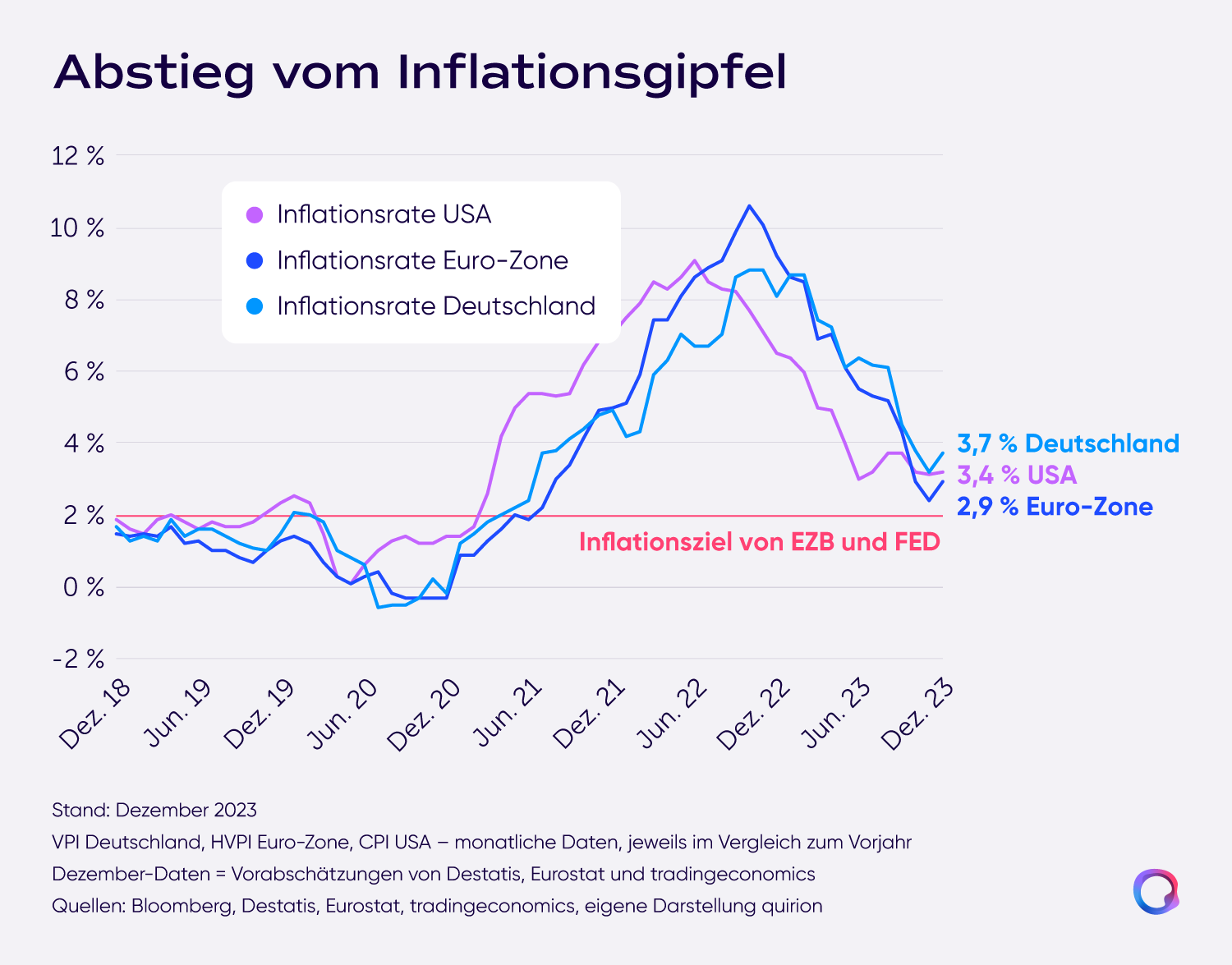
Presumably further declining inflation rates, upcoming key rate cuts and a slowing economy are actually good conditions for a pleasing bond year in 2024. "Actually", because there is one fly in the ointment, says Kussmann: "In anticipation of this prospective environment, the bond markets already responded at the end of 2023 with strong price gains and, as a result, sharply falling bond yields." This circumstance does not entirely eliminate, but does considerably limit, the potential for further yield declines or price gains in the new year. Nevertheless, the following holds true: bonds with strong credit ratings form an anchor of stability in a portfolio. "Since the interest rate turnaround, they can fulfill this function much better than in the zero-interest era before it. And because of the higher interest rate level, there is definitely also the prospect of another positive bond year even without further major price gains."
Stock markets have run ahead
Speculation about falling interest rates also caused many stock markets to rise sharply last year. "The question now is whether they have already run too far ahead," Kussmann notes. It will probably come down above all to whether the market's rather ambitious expectations regarding rate cuts are met or not. Should interest rate expectations be disappointed, that could cause temporary unrest. Earlier or sharper rate cuts, by contrast, could support share prices.
Further momentum will certainly come from companies' earnings performance. Analysts' earnings estimates for listed US companies are quite optimistic – despite the economic challenges. In Europe, the estimates for earnings growth are more moderate than in the US and the emerging markets, and European stocks are also relatively cheaply valued. In Europe, this limits the "risk of disappointment" and creates room for positive surprises.
Conclusion for the investment strategy
Whether it concerns corporate earnings or the economy, interest rates or political developments: assessments of future market developments are never a sensible basis for a solid investment strategy, but merely provide a certain orientation. "For a good investment strategy, it is important in 2024 too to systematically rely on the broadest possible global diversification," Kussmann emphasizes. "Then unexpected developments in individual sectors or regions cannot throw you off track."
quirion's global ETF portfolio comprises around 8,000 stocks from more than 70 countries. Even if there are stronger fluctuations in the short term: "This portfolio is permanently geared toward the return opportunities of the world's capital markets," Kussmann underscores. "At the same time, the particularly broad diversification means you avoid exposing yourself to excessive risks."