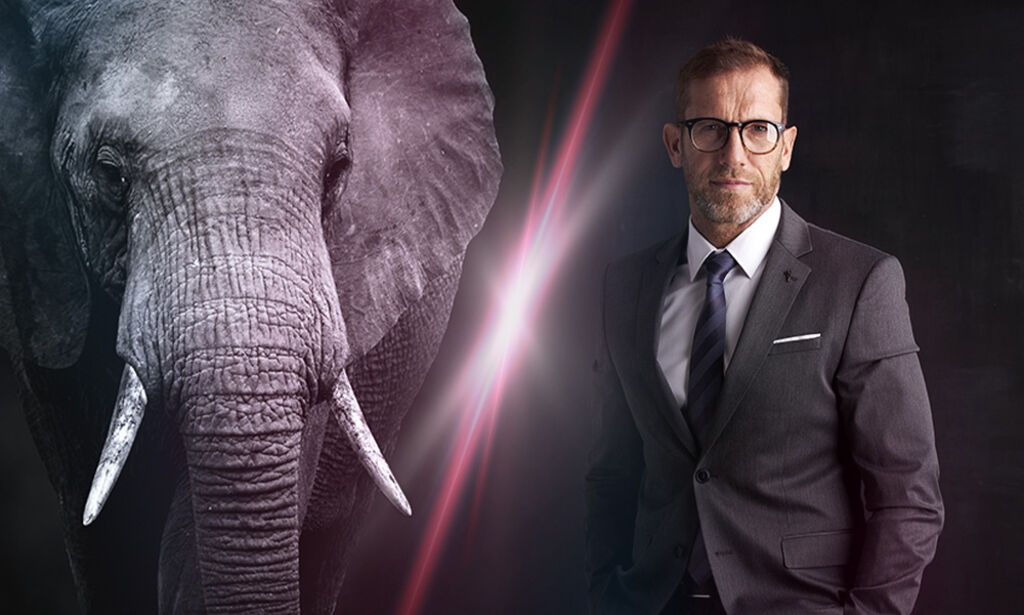
If you had the choice, would you rather have your assets managed by the head of a major German bank's investment team – or by an elephant? The question may sound absurd, but it isn't. Over the past six months, the online portal boerse.ARD.de organized exactly this contest between an elephant and a stock-market professional as part of a big „ARD Stock Challenge“. Tamo, the bull elephant from Kronberg Zoo, took on Chris-Oliver Schickentanz, head of Commerzbank's investment team. In November 2019, both contenders picked five of the 30 stocks in the German stock index DAX. In exchange for the reward of a few apples, Tamo munched his way through the middle of the list of names and bet on Bayer, BASF, Beiersdorf, BMW and Continental. Investment professional Schickentanz, after careful deliberation, chose Adidas, Allianz, Deutsche Post DHL, RWE and – Wirecard. After the pole position changed hands several times, the elephant's portfolio is currently in the lead. While Mr. Schickentanz had to book a loss of -22 percent, Tamo's was only -19 percent – on the notional investment sum of €50,000, that works out to a respectable lead of €1,500 for the elephant.
Contests of this kind crop up again and again; they go back to a parable by the American finance professor Burton Malkiel. He illustrated his thesis that „investment professionals cannot beat the market“ with a monkey that throws darts blindfolded at the price tables in a newspaper, thereby assembling a portfolio against which the professionals regularly lose.
Such games may be dismissed as amusing anecdotes, but they perfectly illustrate the approach to successful equity investing. Because Tamo can beat the professional precisely because he makes no mistakes when picking stocks. On the stock market, success does not go to those who are especially clever, but to those who assess their own knowledge realistically. A random selection of stocks, like the one Tamo made, protects you from overestimating yourself. People – including investment professionals – on the other hand, frequently make misjudgments. Chris-Oliver Schickentanz, for instance, justified his stock picks in November 2019 by citing, for RWE, a shift toward renewable energy; for Adidas, strong jersey sales during the European Football Championship; and for Wirecard, generally strong upside potential. None of that came to pass: RWE shares did rise, but not because of progress in renewable energy – rather, because of favorable terms in the coal phase-out. Adidas is currently not selling a single Euro Championship jersey; instead, the global corporation could no longer (or would no longer) pay the rent on its stores. And the promise of upside potential at Wirecard needs no further comment.
Is it unfair to fault the investment manager for not having foreseen these developments in November 2019? No – because only with reliably accurate forecasts of the future can you achieve the excess returns that active fund managers need to cover their fees and that they promise their investors. The more honest statement would have been that the future forecasts from November 2019 were exactly as reliable as how easy the apples were to reach that Tamo took his cues from.
You also have to be clear that the return of the elephant's portfolio is driven not by elephant knowledge, but by the knowledge of all investors worldwide. Because it is they who set companies' buying and selling prices in the daily stock-market trading.
This is not intuitive. Because an athlete, for example, will hardly end up on the winner's podium if they don't train hard. If, on the other hand, you make no effort at all when picking stocks, that changes nothing about your prospects of success: because the effort is made by armies of professional analysts and fund managers whose consolidated opinion determines the price of the stock. Your own analysis is merely one more among many others, and therefore adds no value.
Schickentanz was not the only one to bet on Wirecard. Dirk Müller, portrayed in some media as a „prophet of crisis“, also considered the deception allegations „nonsense“ a few years ago and bought more after the allegations emerged – and even though, by his own account, he sold in time before the most recent crash, his fund achieved only a zero return over the past few years despite hefty fees, even though the stock markets rose sharply. The „DWS Deutschland fund“, too – a heavyweight on the German fund market with a volume of over €4 billion – was invested.
One might consider these examples isolated cases and counter them with examples of successful funds. But studies also confirm systematically that professionals – despite an undeniably more convincing presentation – are ultimately barely any better at selecting stocks than an elephant. For instance, examined Nobel laureate Eugene Fama studied 5,238 funds over a period of 22 years. According to his analysis, fewer than one percent of all managers generate an excess return that covers their costs.
For this reason, quirion concentrates on services that genuinely create added value. These are the construction of a broadly diversified portfolio, the selection of the best ETFs, cost-efficient securities trading, and steering the portfolio risk through regular rebalancing.
Speaking of diversification: at quirion, we achieve maximum diversification by buying almost all the securities available worldwide. This strategy can be understood as a refinement of the emotionless, random drawing of a few individual stocks. In effect, you tip a whole basket of darts onto the newspaper page and buy every stock. That does mean, alongside all the winners, also picking up all the loss-making stocks. But their influence on performance is strongly limited by their inevitably small weighting. Wirecard's share of quirion's equity portfolio came to a modest 0.03 percent. So even a total loss on this position would be completely lost in the daily ups and downs of the stock markets. This shows that diversification protects against losses better than an expensive and murky gaze into the crystal ball.