The uncertainties surrounding the ever-worsening coronavirus crisis and its possible effects on the economy and corporate profits are currently sending the stock markets into an outright panic. Precisely in such an emotionally charged environment, it is crucial for long-term investment success not to sell in a rush. From the experiences of the past, the following behavioural pattern of many investors during certain stock market phases can be vividly derived.
Strategic investors master their emotions
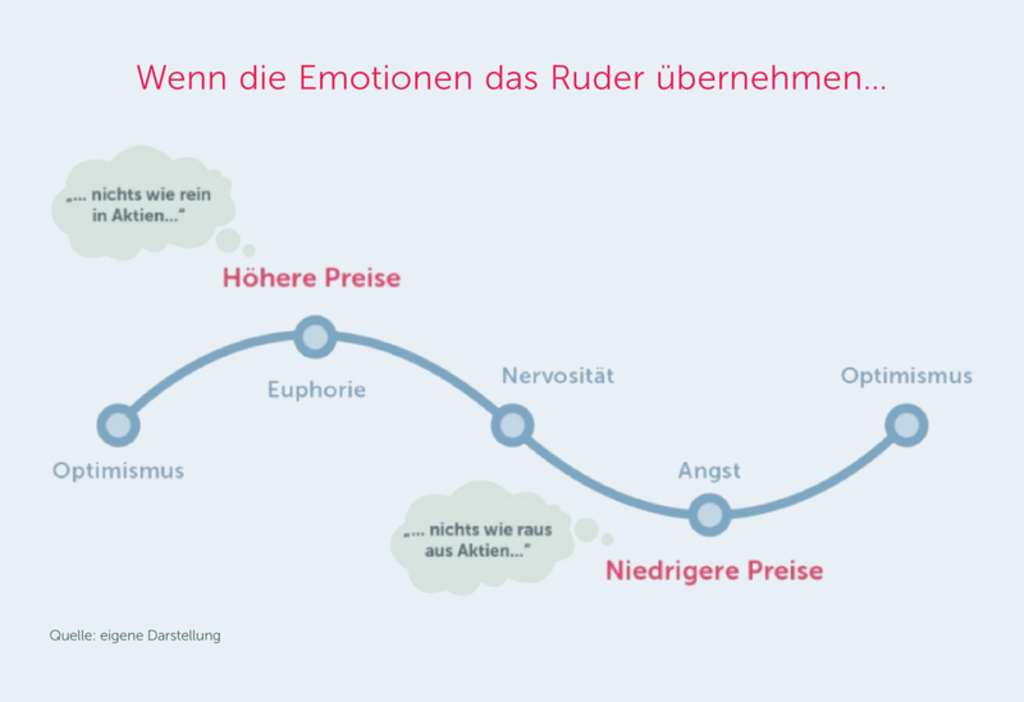
In difficult market phases, which, viewed over the long term, are however temporary in nature, fluctuations must be endured – even if it is sometimes hard – in order to secure long-term investment success. So don't let yourself be thrown off course, either, by excessively negative reporting – as is currently often to be observed in the case of the coronavirus.
Staying invested is sometimes exhausting, but it pays off in the long run
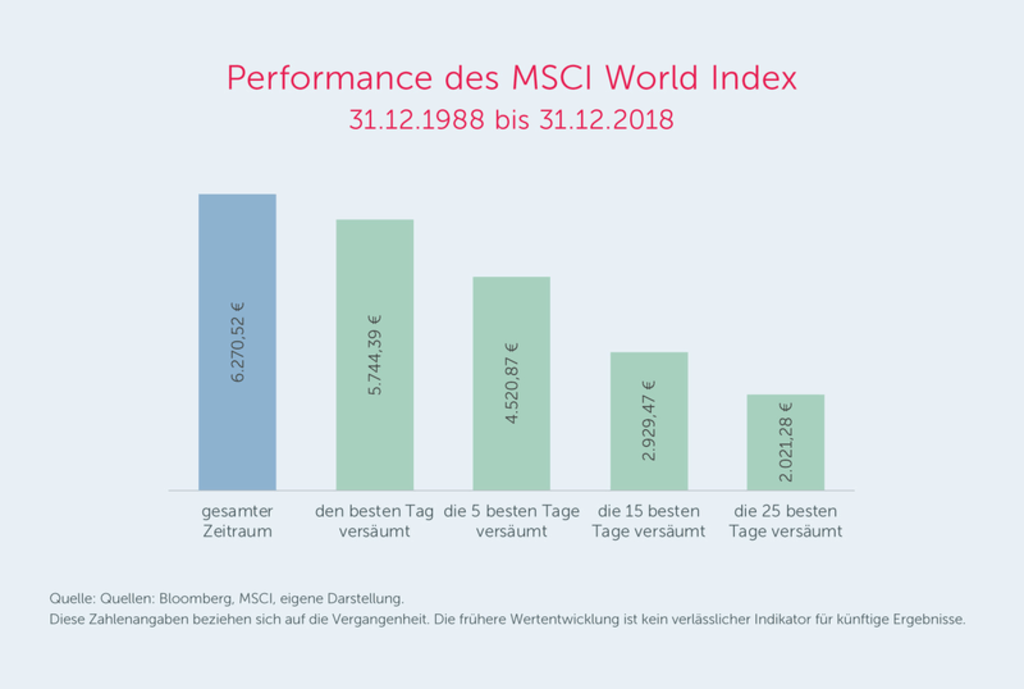
The negative effects of emotional decisions usually show up quite quickly. Modern financial market research proves, time and again anew, that timing attempts (that is, choosing supposedly correct entry and exit points for an investment) are doomed to fail. Because the exact timing of returns is simply not predictable, every day without an investment is a risk of lagging behind the return of the overall market. The following chart illustrates this by way of example, using the performance of the world equity index MSCI World since 1988.
The bottom line: even just a few missed days are enough to significantly diminish long-term investment success. Being able to „endure“ short-term uncertainties thus transforms into more return over the long term.
Holding on – ultimately the smarter (and more return-generating) decision
As a rule, however, many investors don't yearn to avoid missing good (stock market) days; instead, their dream scenario goes like this: to exit the equity market during turbulence (ideally just before), to bring their assets to safety for the time being, and then – „when things are looking up again“ – to get back in in good time. As tempting as this (theoretical) approach may sound, it is nonetheless a great illusion!
For practice shows the following: if you get off the stock market train during „stress phases“, you usually only find your way back in once the market has already recovered strongly (and the aforementioned best days have been missed). By then, however, it is already too late, and crucial return points are consequently lost. Just how unfavourably this (timing) behaviour would historically have affected performance, we can demonstrate with the help of further sample calculations.
Our „return compass“ shows us that on the world's equity markets of the developed countries (measured by the MSCI World Index), from 1972 to 2019 the respective annual losses were greater than 9% in only seven years (out of a total of 48).
For the years following the respective loss years (that is: the loss year + the five subsequent years), we have now calculated the average performance p.a. for two behavioural patterns:
- Holding on: the investor remained continuously invested even after the losses – that is, for all six years.
- Exiting and re-entering after, for example, two years: the investor sold after the loss year and got back in after two years (i.e. they missed the two years following the loss year).
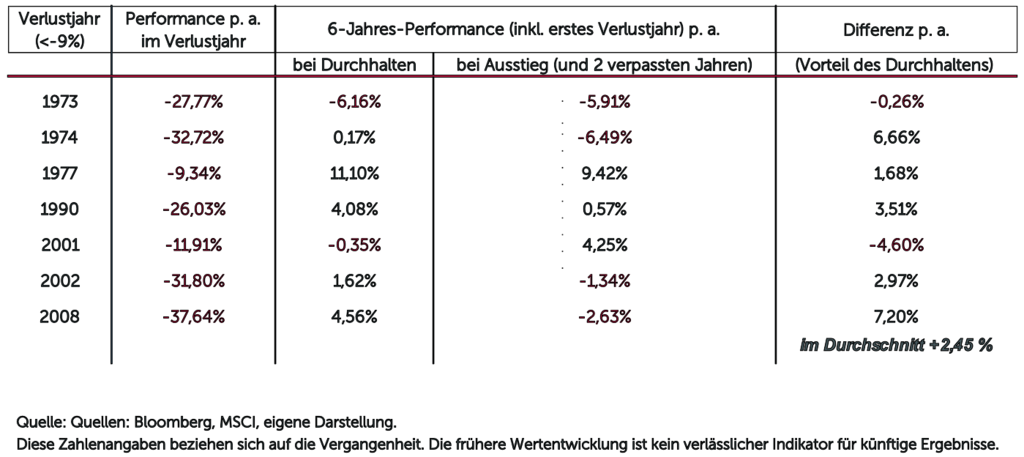
As the table shows, of the seven six-year periods considered, it would really have been worthwhile to any notable extent to exit completely after the loss year in only a single one. In five periods, by contrast, holding on was a clearly better strategy, and in one period it was relatively immaterial. Across the average of all six-year periods, the advantage of holding on amounts to 2.45% p.a. Extrapolated over the six years, that corresponds to an additional return of almost 15%! This proves once again that emotional (and rash) investment decisions are the greatest enemies of your wealth growth.
With the right investment strategy (that is: the level of the equity component) that suits your individual investment horizon and your appetite for risk, short-term (book) losses can be „sat out“ with a clear conscience. Over the longer term, patience and perseverance in investing have always paid off – and the coronavirus doesn't change that either!