
When it comes to the outlook for economic growth, Asia is once again moving into sharper focus. Here's why that is, and what role the continent's countries play in quirion's global portfolio.
Whether in the US or in Europe, the forecasts for economic development over the coming months are fairly muted. The outlook has at least brightened somewhat. The hope that the economy will experience only a small and short-lived soft patch is one of the reasons why share prices moved up quite noticeably into February. When it comes to economic growth, however, economists and investors are currently looking to a different region of the world, namely Asia.
One development in particular has buoyed hopes for economic growth in Asia: the end of China's strict COVID policy. "The constant, ongoing lockdowns there had led to a 'stop-and-go economy', with production and consumption being massively hampered," notes Philipp Dobbert, Chief Economist at Quirin Privatbank and quirion. In 2022, China's growth stood at just 3 percent. For 2023, the Kiel Institute for the World Economy is forecasting an increase of 4.6 percent.
China's development has far-reaching effects
Whether China's economy is running smoothly matters not only to its immediate neighbours, but to the global economy as a whole. China dominates many sectors of world production, textiles being one example. But China has long been more than an "extended workbench" — above all, it is also an enormous sales market. When demand from the Middle Kingdom weakens, it has an impact on the entire global economy. With a share of around 18 percent, its nominal gross domestic product (GDP) ranks second, behind that of the US (25 percent).
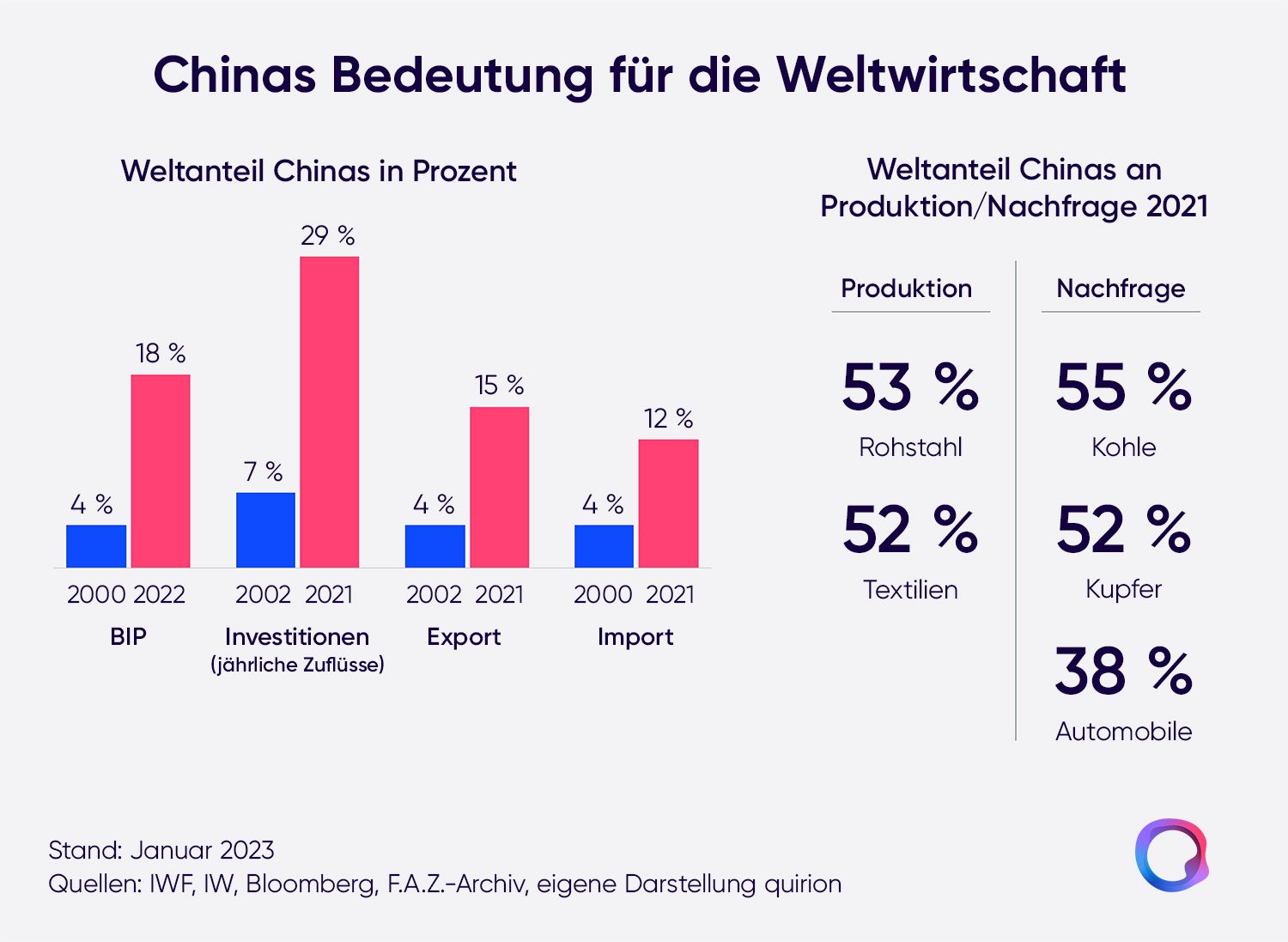
Of course, there are numerous risk factors weighing on the current growth hopes. An escalation in the smouldering conflict with Taiwan is a particularly big one. The repeatedly flaring tensions in the relationship with the US, as well as an ailing real estate sector, could also prove a burden. "There's no way to predict how things will unfold, but we currently assume that China will continue to make a meaningful contribution to global economic growth," notes economist Dobbert.
Asia in quirion's portfolio
In quirion's global portfolio, China ranks fourth, behind the United Kingdom and clearly ahead of Germany. That's because quirion's investment strategy is guided by market capitalisation — that is, the value of freely tradable shares — and not by economic indicators such as the size of gross domestic product. But China's stock market does not yet carry the weight within the global equity market that China's economy carries within the world economy.
"If we gave China more weight, that would mean betting on a particular growth in the market," Dobbert explains. But in its investment strategy, quirion deliberately does not rely on such forecasts. "The goal of our strategy is to represent the global equity market in our global portfolio as accurately as possible, over the long term." This approach, he says, also brings the return opportunities of Asian markets into the portfolio, while at the same time keeping the risks within bounds.
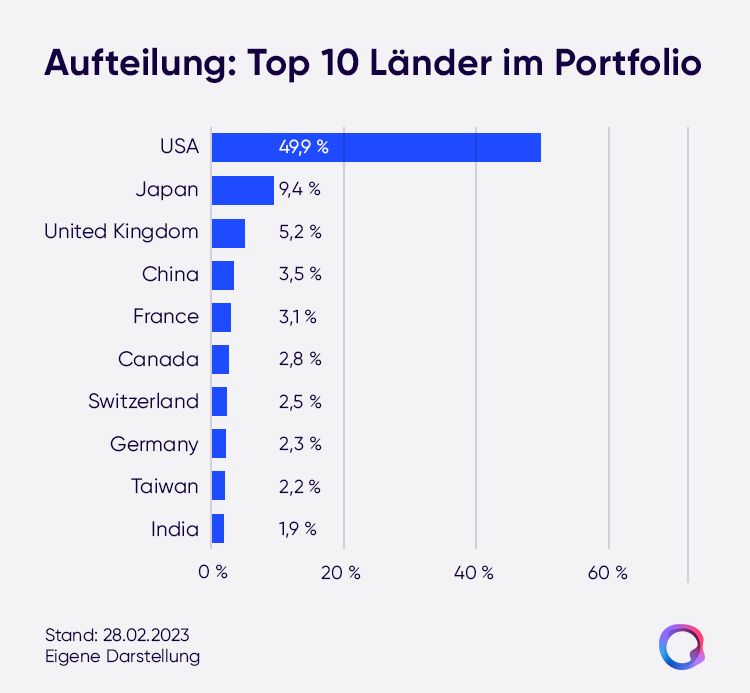
That's why Japan plays a bigger role than China in quirion's global portfolio. Measured by market capitalisation, the country's stock market carries considerably more weight. In the turbulent past year, Japanese equities in the portfolio tended to have a stabilising effect. The Japanese stock market couldn't fully escape the general downtrend, but it was less pronounced there than in many other places.
When it comes to the economic outlook, too, economists are reasonably optimistic about Japan. In December, the Japanese government assumed real economic growth of 1.5 percent in 2023. The Kiel Institute for the World Economy is more sceptical, expecting an increase of only 0.7 percent in Japan. By Japanese standards, though, growth on this scale is quite respectable. And the Institute for the World Economy's forecast for Japan is at least somewhat better than the ones for Europe (up 0.5 percent) and the US (down 0.4 percent).
A strong growth region
India, in turn, is another major growth candidate in Asia. The country is heavily oriented towards its domestic market, and thus not as dependent on developments in other regions. According to the International Monetary Fund's expectations, economic growth is likely to hold above the 6 percent mark in 2023 as well. quirion's global portfolio also shares in this growth, with India's weighting standing at just under two percent.
In smaller shares, quirion's portfolio is invested in many other Asian emerging markets. Their economic rise, too, opens up return opportunities. "For the foreseeable future, Asia is likely to remain the fastest-growing region in the world," Dobbert believes. "That's why Asia belongs in every well-diversified portfolio."