
Pure hype or revolutionary development: the debate about Bitcoin & co. plays out between these two extremes. But anyone who wants to form a picture of the situation quickly runs into „cryptic“ technical jargon. The following article by Prof. Dr. Stefan May, the head of our investment strategy, explains the key connections – and why so much energy currently has to be „invested“ in Bitcoin.
„You don't need any solid financial-mathematics knowledge; plain common sense is enough to recognise that, sooner or later, the price of Bitcoin will be zero.“ That was the verdict of Ulrich Bindseil and Jürgen Schaaf in the FAZ on 17 September 2021. „Bitcoin is like early electricity. Raw, dangerous, seems very volatile and hard to use. Over time it will feel safer, easier and more normal. Like electricity, it will inspire and power new, unimaginable industries.“ I recently came across this quote in an article on btc-echo.de. It comes from „Obi-Wan Kenobit“, the pseudonym of an anonymous Bitcoin „maximalist“.
The two quotes span the spectrum within which the new technologies surrounding well-known cryptocurrencies such as Bitcoin, Ether and many others are positioned. For some it's pure hype, for others one of the most revolutionary developments of all. Anyone who wants to follow the debate is quickly confronted with a mountain of technical terms.
Blockchain as a decentralised database
First things first: „blockchain“ is the term for a digital technology that makes it possible to record transactions and titles of ownership – right through to contractual obligations – in a tamper-proof way within a decentrally organised network (a „distributed ledger“). This is ensured by what's known as a consensus protocol. You can picture it as a kind of program, or a defined structure, that prescribes for everyone involved in a transaction a precise sequence of steps which are what make the decentralised transactions tamper-proof in the first place.
This is exactly where, for many blockchain and crypto enthusiasts, the revolutionary heart of the whole matter lies. Because transactions and agreements become possible between two parties who are complete strangers to each other, without any central authority – such as a bank – being interposed to check, for instance in the case of a money transfer, whether sufficient funds are even available. The entire network takes the place of the central entity, and every transaction has to be accepted and confirmed as correct by all participants in the network, the so-called „nodes“.
Cryptocurrencies as a „by-product“
A cryptocurrency is linked to every blockchain – except for purely private blockchain networks. The reason: the network participants who perform the verification and confirmation work within the decentralised network, thereby ensuring its tamper-proof operation, are rewarded in units of this currency. This reward, however, doesn't go to everyone, but only to those who emerge as the „winner“ of a selection process. Only they receive the so-called „block reward“ as well as the transaction fees. The ones who lose out come away empty-handed. Even so, they carry out the validation work in the hope that next time it might be their turn.
Against the backdrop just sketched out, the terms „blockchain“ and „block reward“ also become clear: because in the decentralised network, not every single transaction is verified on its own. Instead, the transactions arising within a certain period – with Bitcoin roughly every 10 minutes – are combined into so-called blocks and confirmed, in a sense, „en bloc“. The selected network participant, in turn, is allowed to attach the currently verified block as the latest link to the already existing chain of blocks. Hence the name „blockchain“. In return, they receive the „block reward“ as well as the transaction fees.
Tradability of cryptocurrencies
The selected participants of the network can, quite literally, „buy nothing“ with their crypto rewards as long as these remain merely in the digital sphere – with a few exceptions. That's why, very quickly, there emerged the option to exchange cryptocurrencies for „real“ currencies such as the US dollar or the euro. Cryptocurrencies are thus freely traded. This means anyone and everyone has the opportunity to acquire cryptocurrencies, even if they have no other interest whatsoever in the underlying blockchain technology. This is currently being used very actively by investors, trusting that the currencies they've bought will keep rising. Corresponding trading platforms are sprouting up right now like weeds. All you need for this is a so-called „wallet“, which you can picture as a kind of electronic billfold.
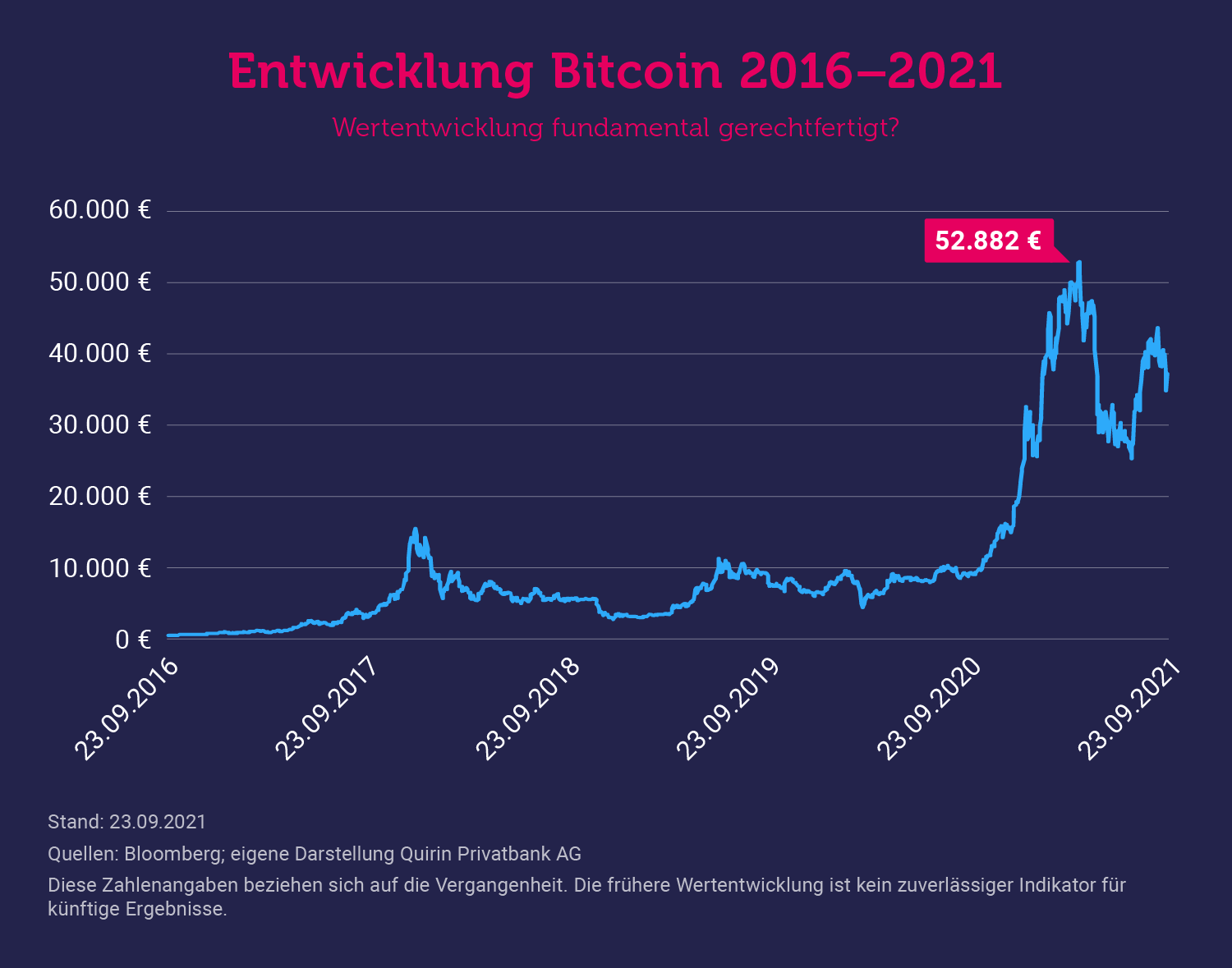
The ability to trade a cryptocurrency freely also means, however, that its performance can decouple from the rest of the transaction volume in the corresponding blockchain. In the extreme case, this can mean that a price multiplies without this reflecting any usefulness whatsoever of the underlying blockchain. Bitcoin's breathtaking performance, at any rate, is in my conviction to be classified in the category of a performance detached from any usefulness.
The „Proof of Work“ protocol
As already mentioned, the essential feature of a blockchain is the decentralised certification of all transactions, identities and agreements. Instead of a central entity, the certification work is performed by the entire network. The most important of these methods are called „Proof of Work“ and „Proof of Stake“. Bitcoin uses „Proof of Work“ and is so far absolutely dominant with it, while Ethereum, with Ethereum 2.0, has for some time been working on switching to „Proof of Stake“.
With „Proof of Work“, a „hash function“ plays a central role. The „hash function“ has the very special property that a given input, which can be of any length, always leads to a hexadecimal output comprising 64 characters. Hexadecimal means that it consists of the digits 0 to 9 as well as the letters a to f. This output value is referred to as the „hash value“ or simply the „hash“.
Here's an example of the „hash value“ of my first name „Stefan“ and that of the number 1:
Input: Stefan
Output: 80d80da802094e4abd5ed8612c725faf64f70f471c2e26778ff91a6a3e4c88597
Input: 1
Output: 6b86b273ff34fce19d6b804eff5a3f5747ada4eaa22f1d49c01e52ddb7875b4b
Important: if you were to enter the complete text of the Bible as the input, then the corresponding „hash“ would likewise be a 64-character hexadecimal output. Also important: even the tiniest changes to the input bring about drastic changes to the hash value, as the following example shows.
Input: Sabine versprach, ihrer Mutter einen Brief zu schreiben.
Output: 3054fae43dc9f4090443d6b051ebdd0106e6c395feeedb0d17c9d50b27735487
Input: Sabine versprach ihrer Mutter, einen Brief zu schreiben.
Output: 85fca4cb54d855cb837b0c3762388062a7951b16aeaab96b60c31a45d26a0266
Shifting the comma in an otherwise identical text not only produces a completely different meaning, but also results in a completely different hash value.
The two properties outlined ensure that a hash function cannot be traced backwards. It is practically impossible to infer the corresponding input from a given hash value. This, in turn, is an essential prerequisite for the entire network remaining tamper-proof and not being able to be manipulated.
To illustrate the „Proof of Work“ method, first picture a particular block of transactions that is, so to speak, waiting to be appended to the existing block history. This block consists of a complicated character string which represents all the relevant contents of the block. For the sake of simplicity, we'll take the simple character string QXYZ as an example. Since in a decentralised network the entire chain of blocks is located on every single computer of the verifying network participants, all those involved must in principle verify the block that is in the queue. To do this, they enter the relevant character string QXYZ into the hash function, which is of course the same for everyone. If there is even a single change to these character strings – for example through an attempted forgery – then there are no matching hash values and therefore no consensus either.
The matter of the leading zeros
But since not all the verifiers can be rewarded, the „Proof of Work“ protocol builds in an additional complication: in order for a hash value to be accepted by the consensus protocol, it has to begin with a certain number of zeros. The number of positions for which a zero is required (let's call it x) is not fixed, however. It depends on how large the number of those trying their luck is – that is, wanting to append the block: if this number is small, then x is also lowered; if it grows, then x rises too. In doing so, x is always set in such a way that roughly every ten minutes a new block is generated.
To meet the requirement of a certain number of zeros at the start of the hash value, the already existing and fixed input of the hash function – which of course corresponds to the content of the block to be appended – is extended by a random number that in technical jargon is called a „nonce“ (nonce = number used only once).
This makes it possible, despite the fixed block contents, to generate a different hash value for every new random number. If you now try around for long enough, or if just sufficiently many try, at some point a hash value also emerges that starts with the required number of zeros. Let me illustrate the whole thing using our extremely simplified example: all the relevant information of the block is compressed into the character string QXYZ, and let's assume the consensus protocol requires the first position of the hash value to be a zero. The hash value of QXYZ evidently does not meet this requirement:
Input: QXYZ
Output: b6e366de510f409f78c014f092e1fdb79c59cc0b9a7e9f1e800bcc1f76393b38co
We can try to meet the requirement by appending a randomly chosen number to the sequence QXYZ – for example the 3.
Input: QXYZ3
Output: c22d42b14fcba74716a2f712d8bcd28bbdf49925beb0e50308cf331d62b64e71
The requirement is evidently still not met, because the corresponding hash value unfortunately likewise has no zero at the start. But if you try out enough numbers, at some point you hit upon a number that produces the desired number of zeros. In our example, this is the 23.
Input: QXYZ23
Output: 0a6513cc1e0e2a79d2b8fc873b4e8f7d9e2f00912b0153fba61dcc985ec67756
The first person to have found the fitting random number attaches the block provisionally at first and publishes the blockchain extended by this block. The protocol now ensures that all network participants receive both its hash value and the random number that was found. If the character string QXYZ23 is now entered into the hash function by all network participants, then they must all obtain the same hash value. If that's the case, then consensus is established. All network participants agree on the entire blockchain including the only provisionally appended block. If that's not the case, then something is not in order at some point, and there may be an attempted manipulation. The new block is rejected and not appended to the existing chain.
A vast number of attempts required
Now, the chosen example is hopefully illustrative, but in terms of scale it's downright laughable. Because producing a zero in just the first position takes only a few attempts. That's why real blockchains require a high number of leading zeros. For example, the hash value of the somewhat older Bitcoin block no. 254,291 corresponds to the following sequence: 000000000000003cf55c8d254fc97d2850547e5b787a936bc729497d76443a89. It therefore has a total of 14 zeros at the start. Since the probability of finding a number that produces such a hash value is extremely small, you can imagine how many attempts were needed for this.
And with that we've arrived at a decisive point. By now the validation and verification of blocks is „big business“. Every second, vast quantities of „nonces“ are tried out, and each of those involved hopes to be the one who reaches the desired number of zeros first and is thus allowed to append the next block. One measure of this is the so-called hash rate. It indicates how many random numbers are fed into the hash function worldwide every second.
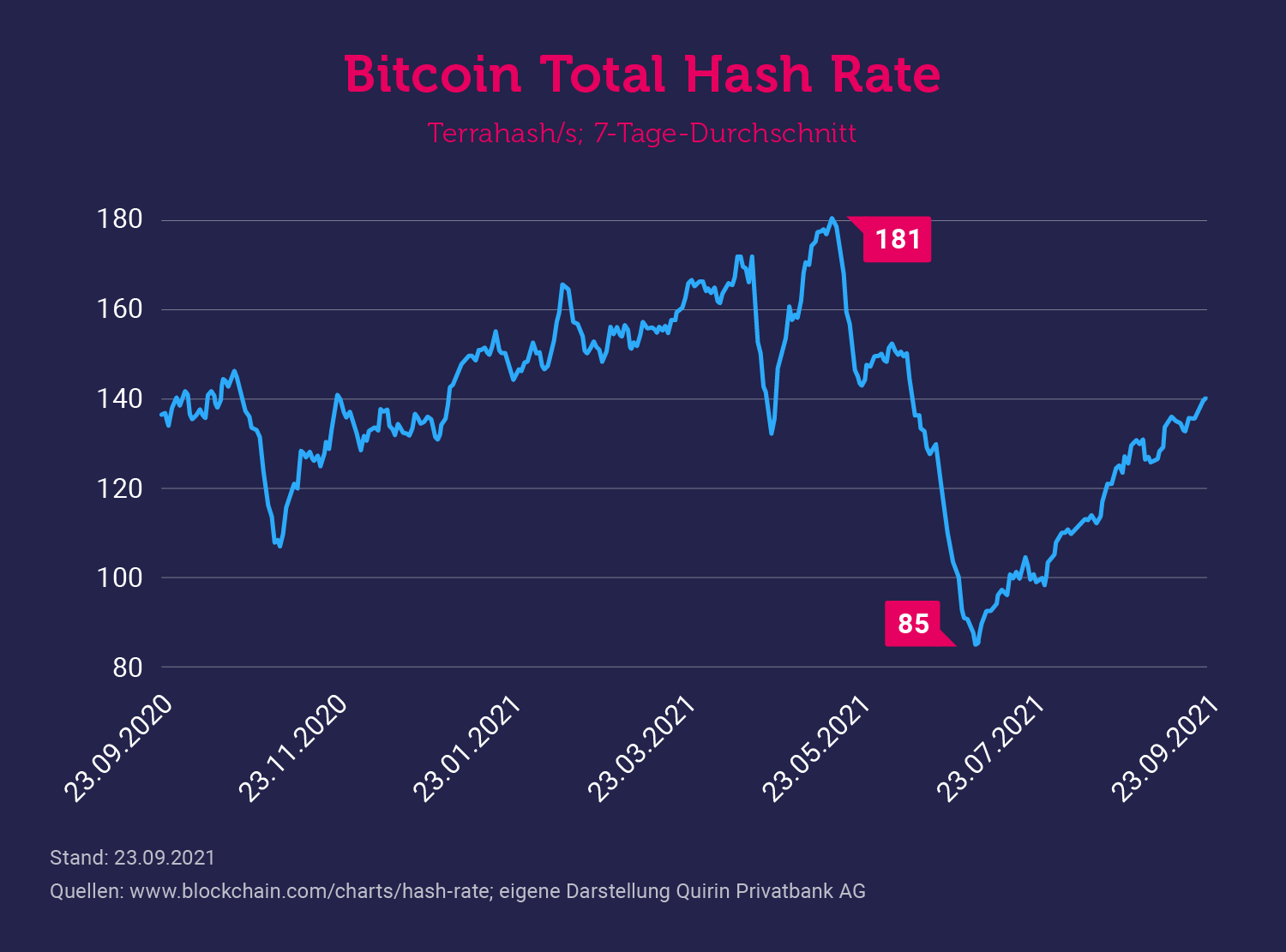
We're dealing here with orders of magnitude that defy all imagination. Currently the Bitcoin protocol requires that the first 19 positions of an accepted hash value must be filled with a zero. To find the corresponding random number, around 100 so-called exahashes per second are currently being tried out. One exahash corresponds to 10¹⁸ (one „quintillion“) random numbers tried. The following chart shows the development of the hash rate over time – that is, the number of hash values tried per second.
Let's note this: in order to be allowed to append just a single block to the existing chain, computers around the world run hot and produce trillions upon trillions of random numbers. Highly specialised hardware is used for this, which is of no use for anything else whatsoever. Once you picture this, it becomes clear why the whole thing is branded by many critics as pure energy waste.
„Proof of Stake“ takes a different route
The „Proof of Stake“ method is best understood in contrast to „Proof of Work“. Network participants who apply to be allowed to append the respective next block are here called not „miners“ but „validators“, which after all describes their actual task in the network rather well. However, the validators who ultimately get their turn are now not determined by their computing power, but selected at random.
To even be considered at all, however, a minimum amount of the corresponding cryptocurrency must be put up, which currently amounts to 32 Ether. Ether is the cryptocurrency of the Ethereum blockchain. In addition, there is the option to give chance a helping hand, so to speak, by increasing one's financial commitment (i.e. one's „stake“). The amounts put up are, however, also exposed to risks: they are seized if the validator does not carry out their duties correctly. This is the case when they certify faulty transactions or ones even created with fraudulent intent. A temporary absence of the corresponding computer from the network – for example due to a power outage – is also counted as misconduct.
Even these brief explanations of how „Proof of Stake“ works should make the essential difference from „Proof of Work“ clear: in a „Proof of Work“ blockchain, every network participant can increase their chance of receiving the „block reward“ by generating ever more random numbers and hash values per second. This causes the network participants to escalate one another in these efforts, in a sense, and the extreme computational effort described arises – and above all a correspondingly high energy consumption per confirmed transaction. In addition, the fierce competition forces all network participants to invest permanently in the very latest hardware, which otherwise cannot be used for any other purpose. Many hopes therefore rest on the „Proof of Stake“ protocol. Whether it will actually establish itself as an alternative, however, is still open.
The insights into the crypto world in summary:
- Blockchain technology offers the possibility of carrying out transactions between actors who are complete strangers to each other in a decentralised and yet tamper-proof way. The required validation is performed by the network itself, instead of – as is still customary – by an interposed central entity.
- Every cryptocurrency is a kind of „by-product“ of an associated blockchain, of which there are now thousands. Certain decentralised „verifiers“ are rewarded for their validation and certification work in units of the corresponding cryptocurrency (the „block reward“).
- Cryptocurrencies can be freely traded and exchanged for „real“ currencies largely independently of the transaction volume or the „usefulness level“ of the underlying blockchain. For this there are more and more exchanges that have specialised in precisely that.
- For selecting the „verifiers“ who are rewarded with the „block reward“ for their validation and certification work, there are essentially two procedures. One („Proof of Work“) has proven itself very well, but by its very design exhibits an extreme energy consumption. The other, by contrast („Proof of Stake“), is relatively new and not yet sufficiently tested. If it proves itself, though, it holds enormous promise for the future. Because the energy expenditure is significantly lower.