The ETF market in Europe has cracked the one-trillion-euro mark – another milestone in the still-young history of these now hugely popular investment instruments. For quirion, too, ETFs are the key to the markets. Here's why they simply fit so well, and what makes a strong case for the professional selection of ETFs.
„Don't look for the needle, buy the haystack!“ This piece of advice from John Bogle already captures much of what you need to know as an investor about ETFs (Exchange Traded Funds). And also much of the success story that Bogle, as co-founder of the investment company Vanguard, so decisively shaped. Offering the broad public index funds that are as low-cost as possible – that was Vanguard's declared goal. Today we can certainly say: goal achieved.
Over a trillion in assets held in ETFs
The rise of ETFs began in the USA back in the 1970s, even if they went by different names at the time – namely Cash Index Participations (CIPs) and Index Participation Shares (IPS). In Europe, exchange-traded index funds have only been offered since the year 2000. All the more impressive, then, that according to calculations by the analysis firm Refinitiv Lipper, more than one trillion euros in assets were already held in ETFs in Europe by the end of January 2021. Of this, equity ETFs (€690.1 billion) accounted for the largest share, followed by bond ETFs (€272.6 billion).
Capturing market performance
ETFs are traded on the stock exchange and track the performance of an underlying index, for example a bundle of shares or bonds. While many investors still go to great lengths to pick individual securities based on their price prospects, investors in ETFs aren't looking for the proverbial needle in the haystack. They participate in the entire „haystack“ at once. After all, price movements in the markets can't be forecast anyway, even if numerous „stock market gurus“ claim otherwise. Capital market research provides the evidence, such as that of the US economist and Nobel laureate in economics Eugene Fama. Analyses of the performance of actively managed funds also show time and again that they usually can't beat the market. This is especially true once you factor in costs – because those ultimately weigh on the returns investors see.
Investing cheaply and with broad diversification
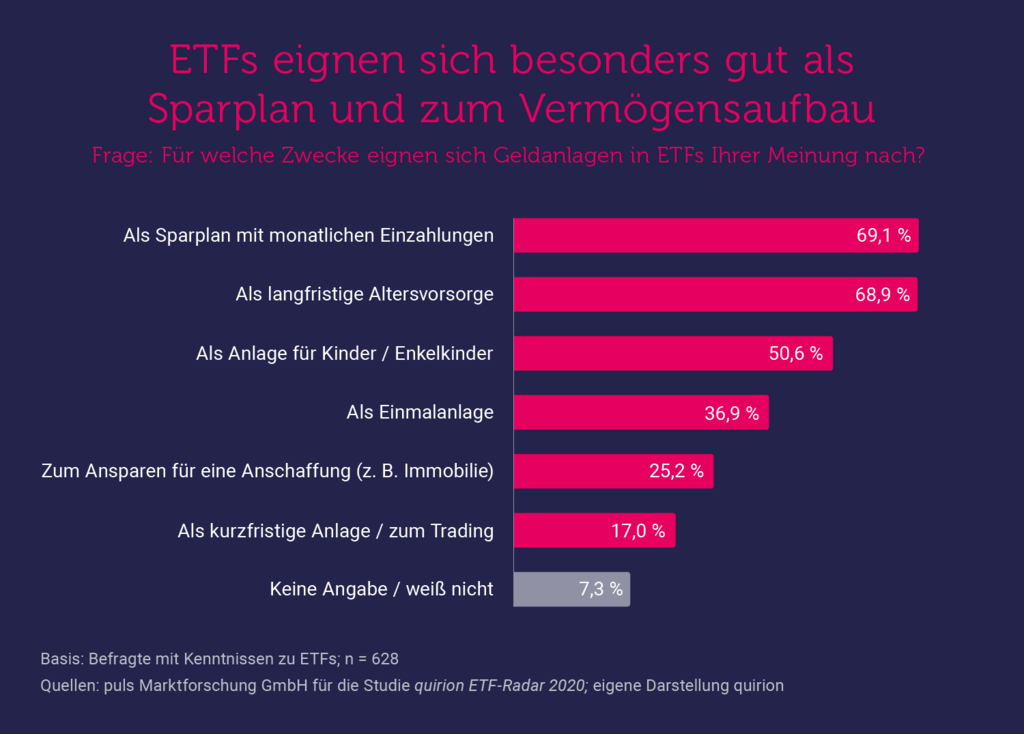
In a study we conducted on the subject of ETFs, we found that the low costs of ETFs compared with other securities investments particularly convince respondents. But they don't only praise the fact that ETFs are cheap (29 percent). Risk diversification (25.3 percent) and broad access to the markets (24.2 percent) are also highly valued. Thanks to broad diversification, price fluctuations – and with them the risk – are generally lower than with an investment in individual securities. According to respondents, ETFs are suitable above all for a long investment horizon: as a savings plan, as long-term retirement provision, and as an investment for children or grandchildren.
In the jungle of product variety
Something else our study reveals: some people know ETFs but don't want to take the plunge. Around a third of the respondents this applies to cite as the main reason: „I don't know enough about ETFs.“ One consequence of the rise of exchange-traded index funds is, not least, that the number of products on offer is growing immensely, which makes the choice ever harder. When Deutsche Börse started out in the year 2000, it initially offered two ETFs on the two equity indices EURO STOXX 50 and STOXX Europe 50. By now, more than 1,800 ETFs are listed on XETRA, Deutsche Börse's trading platform. In the USA, more index funds than shares are now listed on the stock exchange.
Professional selection by strict criteria
For investors at quirion, the selection is no problem: we select the ETFs and index-tracking funds in our global portfolios entirely without any effort on your part – professionally and according to strict criteria. For example, we take a very close look at the real costs as well as any deviation from the underlying index. As a matter of principle, we also invest only in ETFs whose issuers have passed our own rating. Because we are what's known as an institutional investor, we receive particularly detailed information from the issuers for this purpose. So we don't search the „haystack“ for the „needle“ – but we do analyse precisely which ETFs allow the market return to be „harvested“ especially well.
Advantages of an ETF savings plan