Investing actively in equities essentially means deliberately picking individual stocks or trying to find the supposedly best times to get in and out. Those who, like quirion, invest in ETFs instead take a “passive” approach based on stock market indices. But that doesn't mean all the thinking is done and the work is quickly finished. quirion's forecast-free strategy demands a great deal of activity.
The logic of active investing seems obvious: before I build an equity portfolio, I first study the individual companies intensively and think, for example, about how their future profits will develop. To do that, I also have to analyze industry trends and the economic cycle. On top of that, I look at the general situation on the equity markets. For all of this, I picture in detail exactly what the future will look like. That then shows whether a favorable moment for an investment has arrived. To make this assessment, you need a lot of expertise and, when in doubt, an expert who can tell you precisely when the investment is worthwhile. Right?
“There are forecasts that sound convincing, but that doesn't automatically mean they will come true,” says our chief economist Philipp Dobbert. The thought pattern goes like this: a carpenter knows how good tables are made. So surely an investment expert will know which way stocks will go. That is precisely where Dobbert sees the fallacy: a carpenter does know how good tables are made. But he does not, for example, make forecasts about when customers might need a particular table. “Capital market research proves it time and again: price movements on the equity market cannot be forecast. Things can always turn out differently than you think.” This is also borne out regularly by analyses of the performance of active funds, which only very rarely beat their benchmark — a comparison index.”
Forecast-free and diversified
So buy individual stocks and go to sleep? “That is precisely not what our concept of forecast-free investing is about. Forecast-free is only a strategically sound approach if I diversify systematically — in other words, if I don't bet on individual stocks,” Dobbert states. Because picking the “right” stocks only works very rarely and has a lot to do with luck. “Of course, you can succeed in catching a particularly lucrative stock once in a while. The problem, though, is that this can't be repeated systematically. And exactly the same applies, incidentally, to trying to find the optimal times to get in and out. That, too, is not possible on a lasting basis.” Anyone who wants to systematically capture the market return has to choose a broader approach. That is why, in its global portfolios, quirion invests in around 8,000 companies from more than 70 countries. This is only possible cost-efficiently via ETFs.
A multi-stage filtering process
But there are thousands of those worldwide, too. So here as well, careful analysis and selection are required. At quirion, ETFs are selected through an elaborate process in several stages. “In principle, we only invest in ETFs whose issuers have passed our own rating,” Dobbert explains. “We also take a very close look at the real costs, which show up above all in the deviation from the underlying index.” The work on this filtering process is not done once and for all. New ETFs, for instance, are constantly coming onto the market that may be even better suited to the global portfolios. That is exactly what we monitor on an ongoing basis.
Regular rebalancing
We also monitor whether the portfolios still match the investment profiles chosen by our clients. To achieve the risk gradation of the portfolio that is right for the investor, a stabilizing bond component is usually blended in alongside the global equity investment. Because the relative weights of equities and bonds shift with price movements, the weights within the portfolio are constantly changing as well. “To offset this, we regularly realign the portfolios with the target profiles through rebalancing,” Dobbert explains. This prevents, for example, higher risks from being taken on unnoticed due to a rising equity allocation driven by market developments. And, quite incidentally, gains are systematically locked in. The portfolios are rebalanced whenever there are excessive deviations from the target profile — but at least once a year.
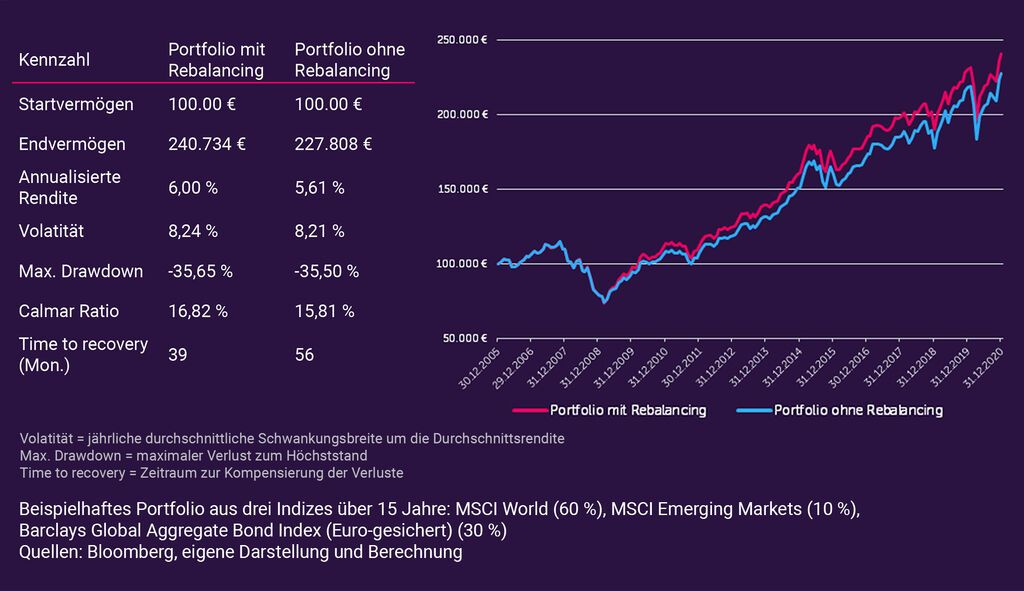
Last but not least: not only do the markets and the portfolios evolve — capital market research also keeps delivering new insights. “From time to time, we therefore adjust our strategy accordingly,” Dobbert explains. “Simply buy some ETFs and go to sleep? We clearly do a great deal more than that for our clients.”
You can find out more about our investment concept here.