Against the backdrop of climate change and social inequality, the market economy and its growth principle are frequently called into question. Yet growing economies can also meet societal challenges far more easily.
Picture the following entirely made-up scene from a fictional future: the Federal Statistical Office announces the gross domestic product figures. Economic output has shrunk by three percent. The news is met with great applause. The media speak of a remarkable success: after all, less economic activity means less harm to the environment. What is more, the rich are now a little less rich, and wealth is therefore distributed a bit more fairly overall. Does that sound plausible to you?
In Germany especially, many people feel uneasy about the escalating logic of economic growth. What is often emphasized is that the ever-increasing volumes of production will, sooner or later, deprive people of the resources — and thus the very basis of their livelihoods. This way of doing business, it is argued, also worsens social inequality.
“Questioning the way we do business is entirely legitimate,” says our chief economist Philipp Dobbert. “It has indeed placed excessive demands on our planet.” That said, concluding from this that we must abolish economic growth as a market-economy principle is far too short-sighted and simplistic. “In any case, it is a good deal easier to call for that when you live in prosperity.”
By prosperity, Dobbert does not necessarily mean having several cars in your garage. That happens, but it is not the essential point. “From the constant availability of food to being equipped with clothing or refrigerators: here in Germany we take that for granted, but it is not a given.” Far too large a share of the world's population, he says, still has no access, or too little, to such fruits of economic advancement.
Growth is not an end in itself
In Dobbert's view, the economy and its growth are often misinterpreted — namely as an end in themselves, as if both existed solely so that companies can generate the highest possible returns. “Ultimately, though, it is always about meeting needs.”
The fact that in our society many needs are met for most people does not mean it will stay that way without any further effort. Everyone knows this from everyday life: “When you clean your windows, you don't expect them to stay clean forever,” Dobbert points out. “You have to keep working at it again and again. A level of prosperity does not maintain itself either.”
But why growth? “The bigger the cake, the more I can hand out,” the economist stresses. Economic growth is therefore also a means of achieving social goals — for example, when it comes to a society providing financial support to people. “Without growth, I have to take something away from some in order to be able to give it to others.” Granted, economic growth does not solve the problem on its own. “But the more growth I have, the more easily I can reach social goals.”
“More” or “better”
As for conserving resources: contrary to what some assume, the market economy is not necessarily bent on producing “more and more.” It also grows when needs are met “better.” Growth, in other words, can be not only quantitative but also qualitative.
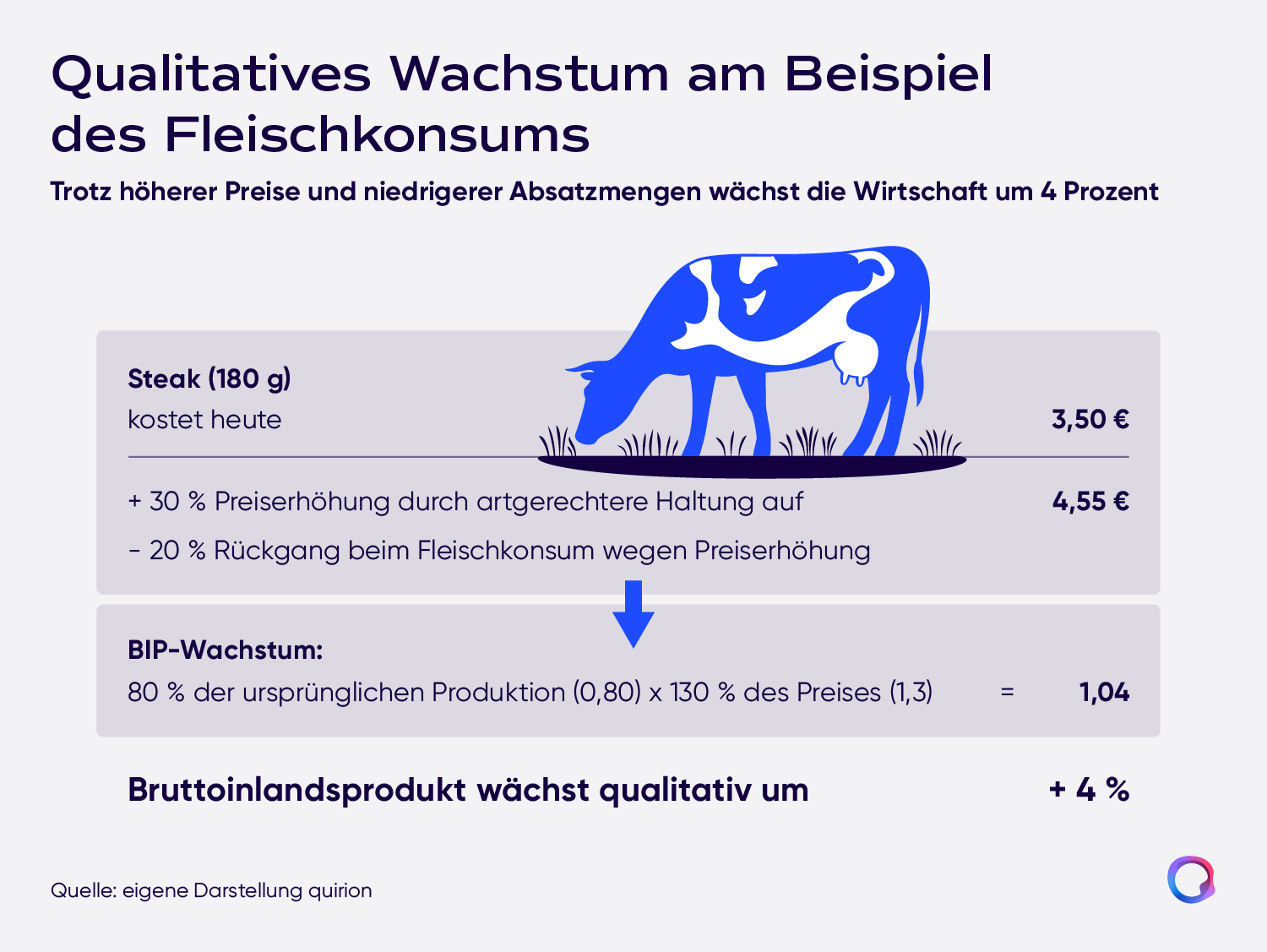
An example: at present, a great deal of cheap meat is still consumed in Germany. If society were to place even greater value on animal welfare and, in return, accept higher prices for meat from more humane husbandry, the volume of production would indeed fall. And yet gross domestic product could still grow.
Where and how the economy grows is dictated less by the economy itself than by society. As needs change, so does the supply on the markets, along with demand. After all, only those who find buyers for their products and services can expect a return.
The incentive of returns steers capital to where needs are intensifying. In this sense, the economy and its growth do not run counter to society's interests but align themselves with them. “Of course, one can argue about how efficiently an economy does this in any given case, and about which rules and mechanisms are needed to let as many people as possible share in the level of prosperity achieved,” Dobbert concedes.
Sharing in growth
Incidentally, one way to participate in economic growth is through systematic investing. Today this is far easier than it used to be. Not so long ago, for example, six-figure sums were a prerequisite for access to professional wealth management. At quirion, you can get it as a savings plan starting from an investment amount of just €25.
In its portfolios, quirion's investment management relies on the broadest possible global diversification. After all, it is impossible to determine in advance exactly which regions will show economic strength and when. But because the world economy is fundamentally geared toward growth, equity markets too have historically always risen over the long term and on average. “I am firmly convinced that this will remain the case in the future as well,” says Dobbert. “Economic growth is simply far too important for building and preserving prosperity for us to be able to do without it.”