The EU Commission is thinking out loud about a ban on commissions. The outcry in the German financial industry is loud. What bank customers think, and why regulation would be necessary here, is shown by a recent study from Quirin Privatbank.
In the German financial industry, sales commissions play a big role. They are baked into many investment products and finance the advice at most banks. Conflicts between customers' interests and sales targets are thus pre-programmed. In the course of the current debate about a new retail-investor strategy, EU financial services commissioner Mairead McGuinness has therefore come out in favour of a ban on commissions in the distribution of financial products. The goal: more independence in advice and lower product costs for investors. Experience in countries such as the United Kingdom and the Netherlands, where such a ban already applies, supports this expectation.
Quirin Privatbank, to which quirion belongs, abolished commissions right at its founding in 2006. It advises for a fee. In other advisory professions – such as lawyers or tax advisors – that is taken entirely for granted in Germany, too. In a representative study, Quirin Privatbank has now looked into the question of what consumers know about commissions and what they would think of a ban on commissions. Those surveyed were customers of institutions from across the entire German banking landscape.
A majority in favour of a ban on commissions
It turns out: 61 percent of respondents want independent advice. Only 26 percent believe they are already being advised independently. 63 percent are in favour of a ban on commissions.
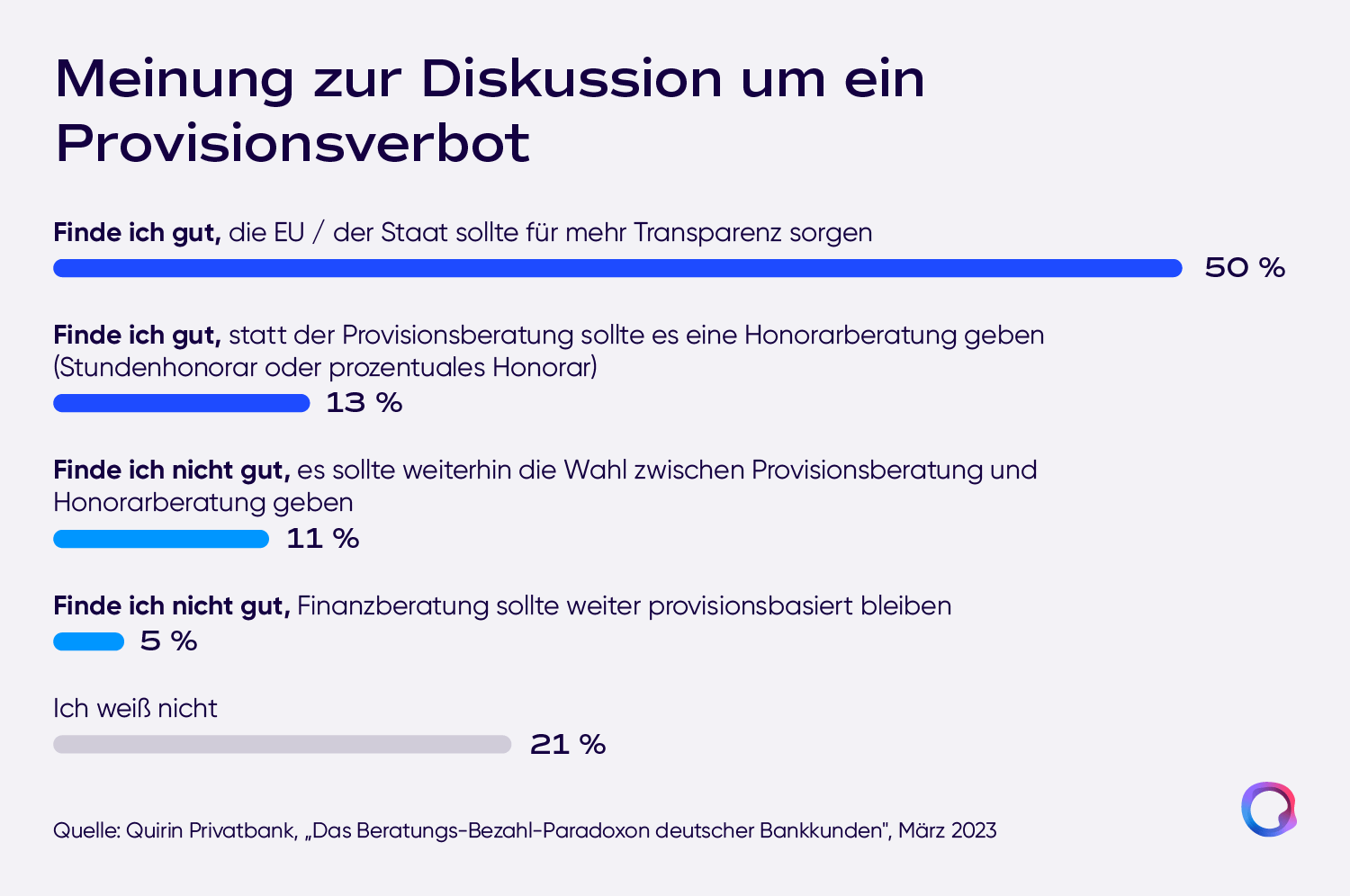
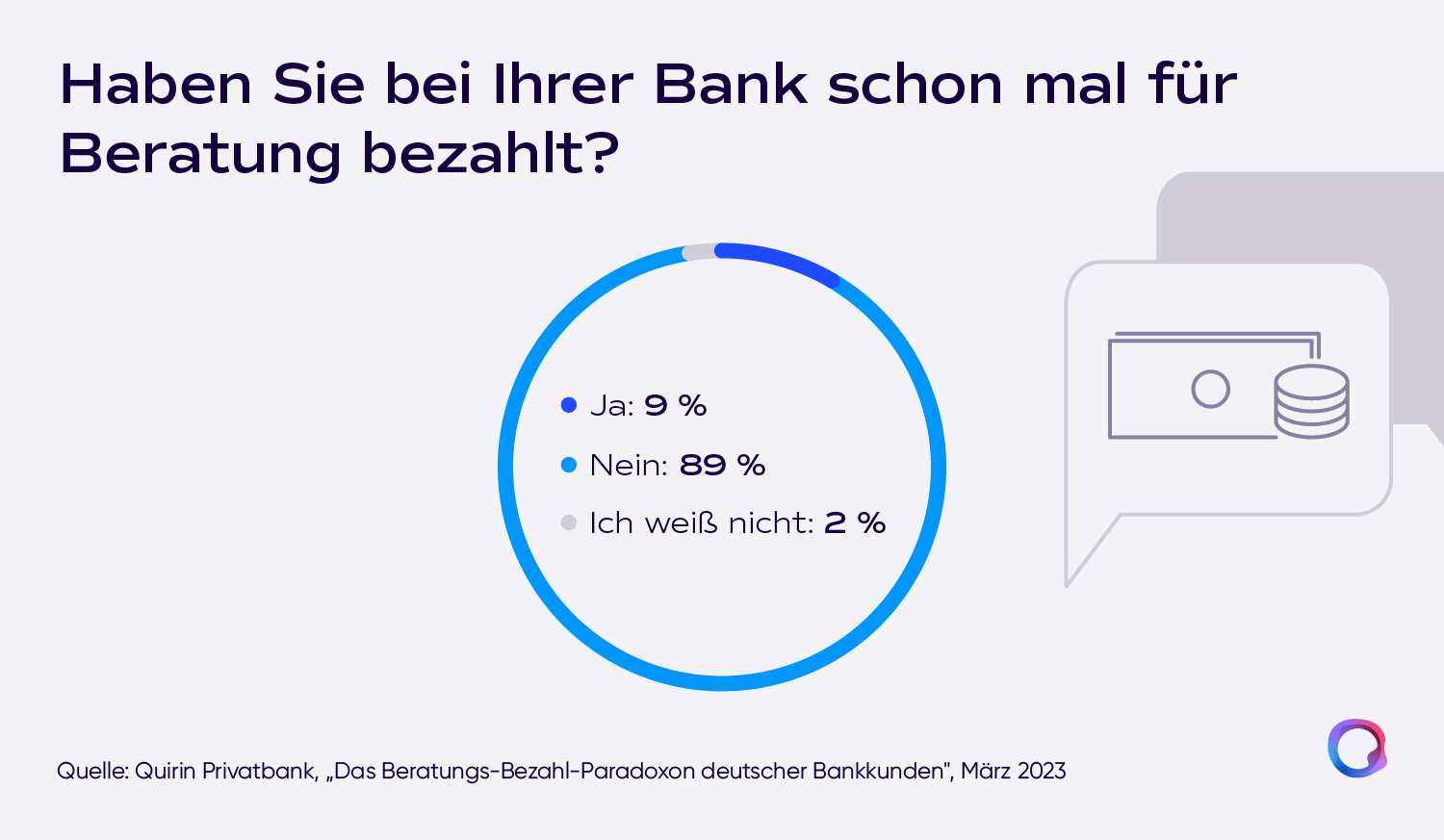
The verdict is clear. Less clear, at least at first glance, is why 69 percent of respondents nevertheless feel well advised by their main bank. On second glance it becomes apparent that many people are not aware of the connection between commissions and advice. So while 56 percent know that commissions are often built into the costs of investment products, 89 percent are convinced they have never paid anything for advice themselves. Following up with the note that commissions, too, finance advice does not help much: 69 percent are still sure they have never paid for advice. "But there is no such thing as free advice," stresses Martin Daut, CEO of quirion. "The only question is ever the way in which it is paid for."
Strengthening consumer protection
The vast majority of respondents do not know how the advisory costs at their own bank are made up (86 percent). The advisory documentation, which is meant to create more transparency, in fact contributes little to it. Only 24 percent of respondents say they even read the documents. And of those, 75 percent find the information "incomprehensible and complicated."
Beyond that: more than half of those who feel poorly advised draw no consequences and stay loyal to their bank – among other reasons because they do not expect any better service from others. "Many people simply do not know that independent advice exists as well," Daut states. A lot of educational work has to be done, he says. But that alone is not enough. "This is where regulation would really be in order. Consumers need to be better protected."
The need for clarification starts with the very word "advice." "Commission-financed advice is nothing other than selling," Daut makes clear. That is also why he does not see the danger of an "advice gap" that some warn of in the event of a ban on commissions. "There would be fewer sales conversations, but more advisory conversations in return."
Independent, transparent and cheap all the same
The term "fee-based advice" (Honorarberatung), which is customary in Germany, does, however, make the alternative appear less attractive. Because it draws attention to the cost aspect rather than to the value of independent advice. Internationally, the term "independent financial advice" is common. Such independent advice would be important precisely with investment products: "Consumer goods like a car I can at least try out once before buying; with investing that is not possible – there I only notice after many years what the product really delivers."
At quirion, commissions play no role. quirion does not receive so-called kickbacks. Were product providers ever to grant them, they would be credited to clients. "When it comes to products for the portfolios, our suggestions for a personal strategy and our advice, we can focus entirely on investors and their success," Daut stresses. "Our costs are still lower than those of active funds and certificates, which investors are so often advised into because of high sales commissions."