







Definition: What is a dividend?
A dividend is a distribution made by a public limited company (AG) to its shareholders. Whether and how much of a dividend is distributed is decided by the annual general meeting. Ahead of the meeting, the company's management board makes a dividend proposal – and the shareholders then usually approve this proposal. The dividend that is decided upon is paid out per share and is usually a portion of the profit generated in the previous financial year.
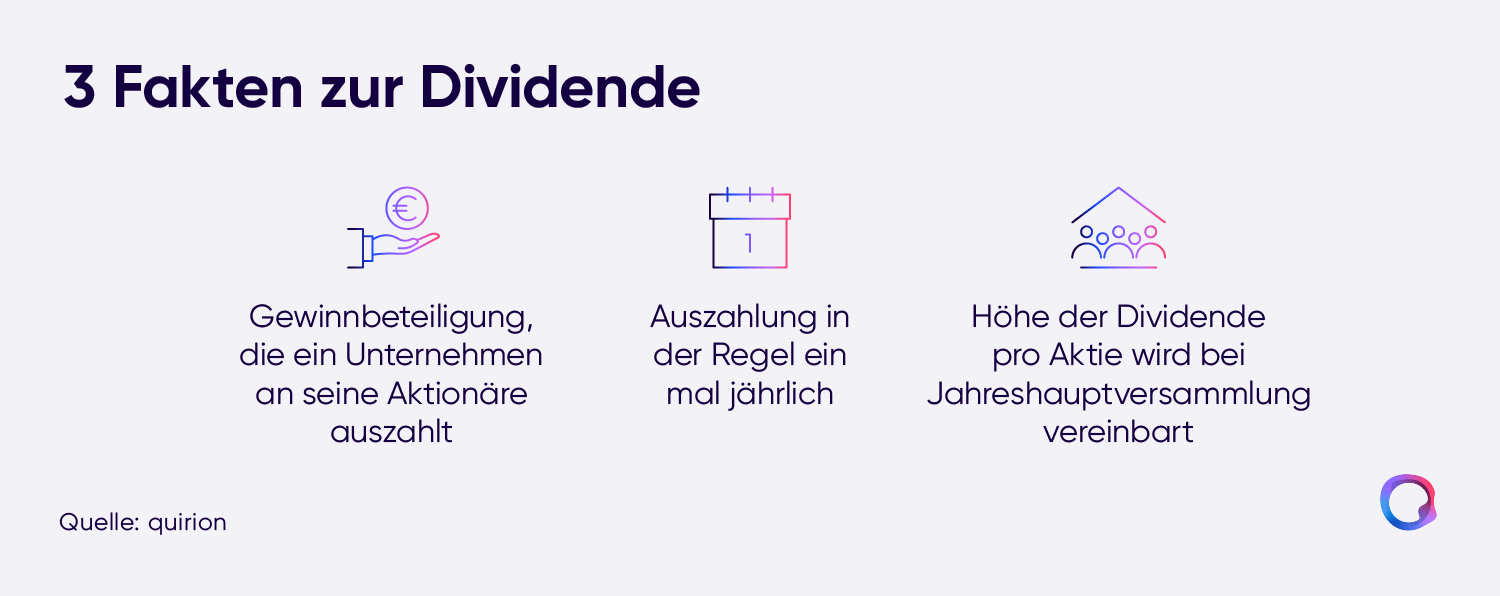
Fun fact: The dividend that is distributed does not necessarily have to consist of money (a so-called “cash dividend”). Some public limited companies distribute a so-called “dividend in kind”, although this is rather rare. The Swiss company Lindt & Sprüngli, for example, hands out chocolate to its shareholders at its annual general meeting (in addition to the cash dividend).
Who determines the size of the dividend?
Usually, the management board of a public limited company (AG) proposes which dividend is to be distributed to the shareholders. The annual general meeting must then approve this proposal by a majority.
Shareholders are the equity holders of a public limited company, because by purchasing shares they become co-owners of “their” public limited company. . This gives the shareholder certain rights, which as a rule include, for example, the right to attend the annual general meeting (AGM) and to a share of the net retained profits (dividend entitlement).
What are the advantages of a dividend?
By paying dividends, shareholders can benefit from the fact that a company is doing well economically. The higher the net retained profits for a financial year, the more generous the dividend is normally too. You receive ongoing income which, in the best case, rises from year to year. In addition, substantial dividend distributions can, to a certain extent, cushion price losses on the underlying share – high dividends therefore act as a risk buffer.
Shares with a regular dividend also have the advantage that shareholders can use the distributions for rebalancing purposes (bringing the portfolio back into balance) or to change their portfolio orientation. By immediately reinvesting the distributed dividend, they can benefit from a compound interest effect. Dividends as regular income are particularly advantageous above all when investors wish to live off these earnings – alongside other sources of income.
The selection is decisive: You should buy shares in companies that have a well-established business model and are not so easily displaced from the market. They should also be distinguished by a long-standing dividend history – meaning: over the years, continuously rising dividends and dividend payments even in less successful financial years. However, this advice cannot provide any guarantee of success when it comes to dividends, because a business model that is regarded as solid today, with continuous earnings, may already be outdated tomorrow.
Can dividends also be disadvantageous?
From an economic perspective, dividends are particularly sensible for a company when the amount distributed can be used neither for worthwhile investments nor for the repayment of existing debts. Companies that, by contrast, distribute profits to their shareholders even though they could use the money elsewhere for future investments thereby deprive themselves of promising growth opportunities.
Conversely, young, strongly growth-oriented companies are not an option for an investment if the size of the dividend payment is a significant criterion in the selection of shares. Because instead of distributing the surpluses generated to the shareholders in the form of dividends, at these firms it is invested entirely in further rapid growth. With a pure dividend focus, investors would, for example, not have invested in Amazon, Alphabet (formerly Google), Microsoft, Apple & Co. Yet these shares are among the most successful of recent years, and some of them now pay a dividend too – but only after the bulk of the price rise was already behind them.
In summary: Anyone who looks solely at the dividend inevitably avoids shares in companies that generate steadily rising profits but pay no dividend, or only a very low one. The reason is often likely to be that the company prefers to invest in its future in order to generate even higher profits in the coming years. If this (dividend-sparing) strategy succeeds, it usually goes hand in hand with sharply rising share prices.
For investors, dividends also have the disadvantage that they are not guaranteed. So anyone who is speculating on abundantly flowing dividends always takes on the risk that the dividend source may sometimes dry up.
A further drawback: When the dividend is paid out to shareholders a few days after the annual general meeting, the corresponding share price falls, namely by the amount of the dividend payment made (leaving aside other factors influencing the share price). And of course the taxman also demands his share of the dividend: on the dividend decided upon by the annual general meeting – if the saver's tax-free allowance has been used up – 25% withholding tax plus the solidarity surcharge and, where applicable, church tax are deducted. In the case of shares in companies that are based abroad, tax deductions of varying amounts apply to dividend payments.
A company's dividend policy can also become a problem on top of that. Some public limited companies pay out a comparatively high dividend even though they did not operate profitably in the past financial year. In that case, a generous dividend payment harms the company's economic situation, which not infrequently is reflected in more sharply falling share prices. The dividend that is distributed often cannot come close to compensating for these price losses.
Save with the test winner
When does the dividend payment take place?
Exactly when the dividend payment takes place also depends on the home country of the respective company. In Germany, the dividend payment is traditionally made once a year. The dividend is usually paid out on the third business day after the annual general meeting, which is of course what sets the size of the dividend (on the proposal of the management board). Entitled to receive a dividend are all shareholders who hold the share up to the end of the day of the so-called “dividend record date”. The first business day after the annual general meeting is regarded as the “ex date”. The share then receives the suffix “ex dividend” and is traded at a discount. This dividend discount is arithmetically exactly as high as the gross dividend, and thus makes it not worthwhile to buy the shares in question shortly before the dividend distribution. Anyone who acquires the share from the “ex date” onwards is no longer entitled to the dividend for the past financial year, but only for the current year. This is then distributed the following year (if the investor still holds the share by then). Dividends are consequently only paid out a few months after the end of the respective financial year.
In the USA, by contrast, dividends are usually distributed on a quarterly basis. Here too, the relevant record dates must be observed, on which you must hold the shares in order to enjoy the quarterly dividends.
Example timeline for a domestic dividend payment based on the Allianz dividend
The Allianz dividend for the 2021 financial year was €10.80 per share.
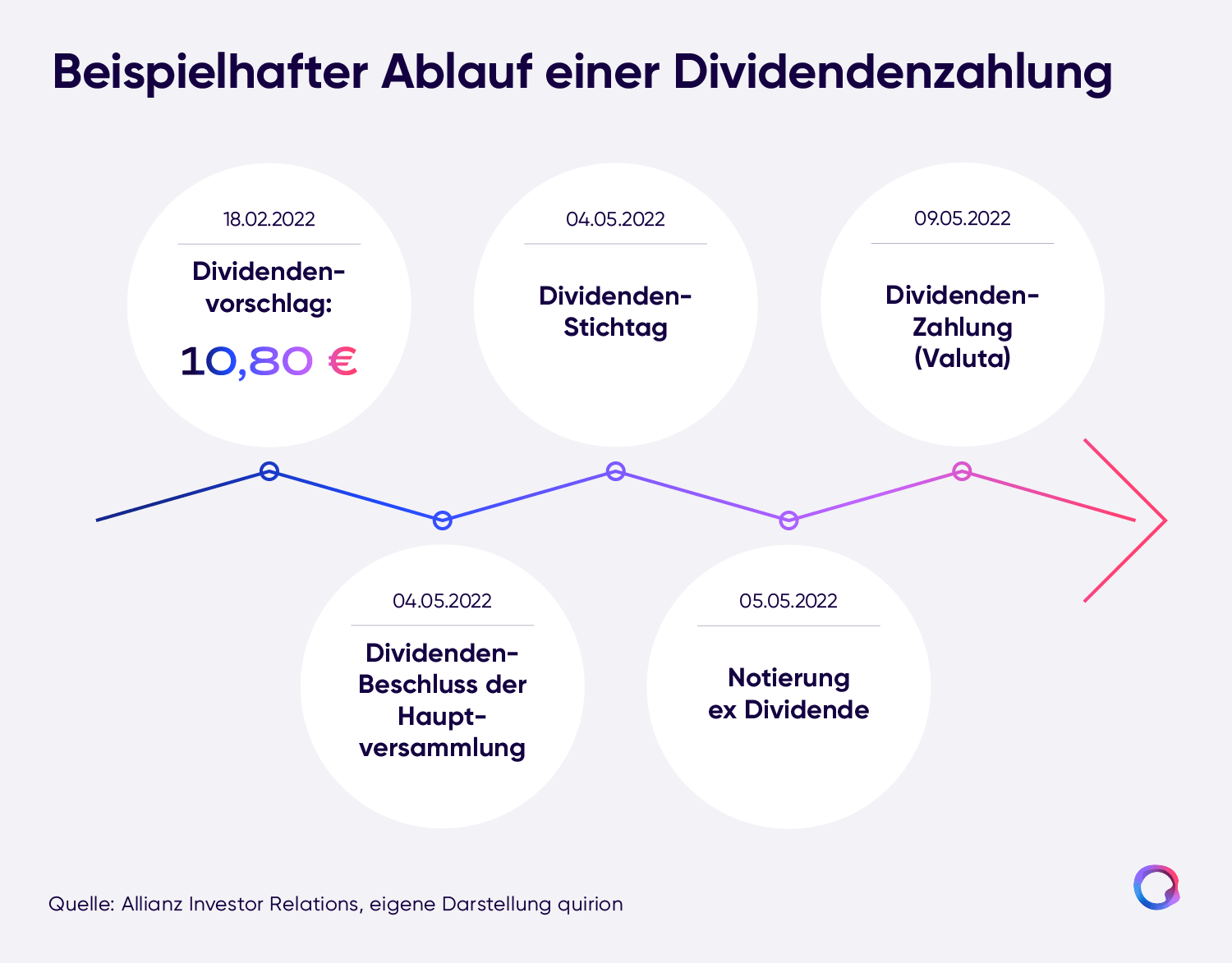
The dividend is paid out on the third business day following the resolution of the annual general meeting. This rule came into force on 01/01/2017 for the purpose of harmonising securities settlement within Europe. Previously, the dividend was due on the day after the annual general meeting.
What does “dividend yield” mean for shares?
The dividend yield expresses the ratio of the most recently paid dividend to the current share price. It is expressed as a percentage and tells shareholders what percentage return the share yields in the form of the dividend. Since share prices are constantly subject to fluctuations, the dividend yield only ever represents a snapshot in time. To calculate it, the most recently paid dividend is divided by the current share price. It is then multiplied by 100 to obtain a percentage figure.
Dividend yield formula:
Dividend ÷ share price × 100 = dividend yield as a percentage
This makes sense, because the absolute size of a dividend is not meaningful. This is shown by the following example:
- Company A distributes a dividend of €5 per share. The current price is €500. This means the dividend yield is 1% (calculation: 5 / 500 *100).
- Company B has paid out only €4 in dividends. However, the current share price is only €100. This means the dividend yield is 4% (calculation: 4 / 100 * 100).
The current dividend yield of Company B is therefore significantly higher, even though a seemingly lower dividend than at Company A is paid.
When do we speak of a high dividend yield?
Exactly when we speak of a high dividend yield cannot be determined precisely. This is due, among other things, to the fact that the dividend yield depends on the development of share prices. If a poor market sentiment prevails on the stock exchanges, share prices often fall as a result. Then the dividend yield is automatically higher (with the dividend remaining the same). In this case a high dividend yield is only cold comfort if the share price is simultaneously giving way more sharply. And who knows whether companies with a currently high dividend yield will not cut their dividends in future, or even let them lapse entirely.
In addition, there are considerable differences between the individual sectors when it comes to dividend yield. Traditionally higher dividend yields are shown, for example, by companies from the utilities, telecommunications or energy sectors (above all oil companies). The dividend yield in the technology sector, by contrast, is usually rather low. Here the money earned is preferably invested in financing further growth rather than in dividend distributions. With a pure fixation on the dividend yield, you as an investor would forgo shares in this sector entirely.
Last but not least, it comes down to the quality and consistency of the dividend distribution: is the dividend payment part of the profits generated, or is the company distributing dividends even though the business situation does not actually allow for it? Furthermore: is it a company with a long-standing dividend history in which, over time, the dividend has risen continuously, or a company with heavy dividend fluctuations (up to and including complete cancellations).
What are “dividend stocks”?
Dividend stocks are shares that have for many years been distinguished by a comparatively high dividend yield and by reliable dividend distributions rising over the years. Particularly popular are the so-called “dividend aristocrats”, which are often based in the USA. A company is considered as such if it has continuously increased its dividend over the last 25 years.
Tip: To achieve a broader diversification, investors can turn to funds / ETFs whose focus is on high-dividend shares.