




Definition: What are bonds?
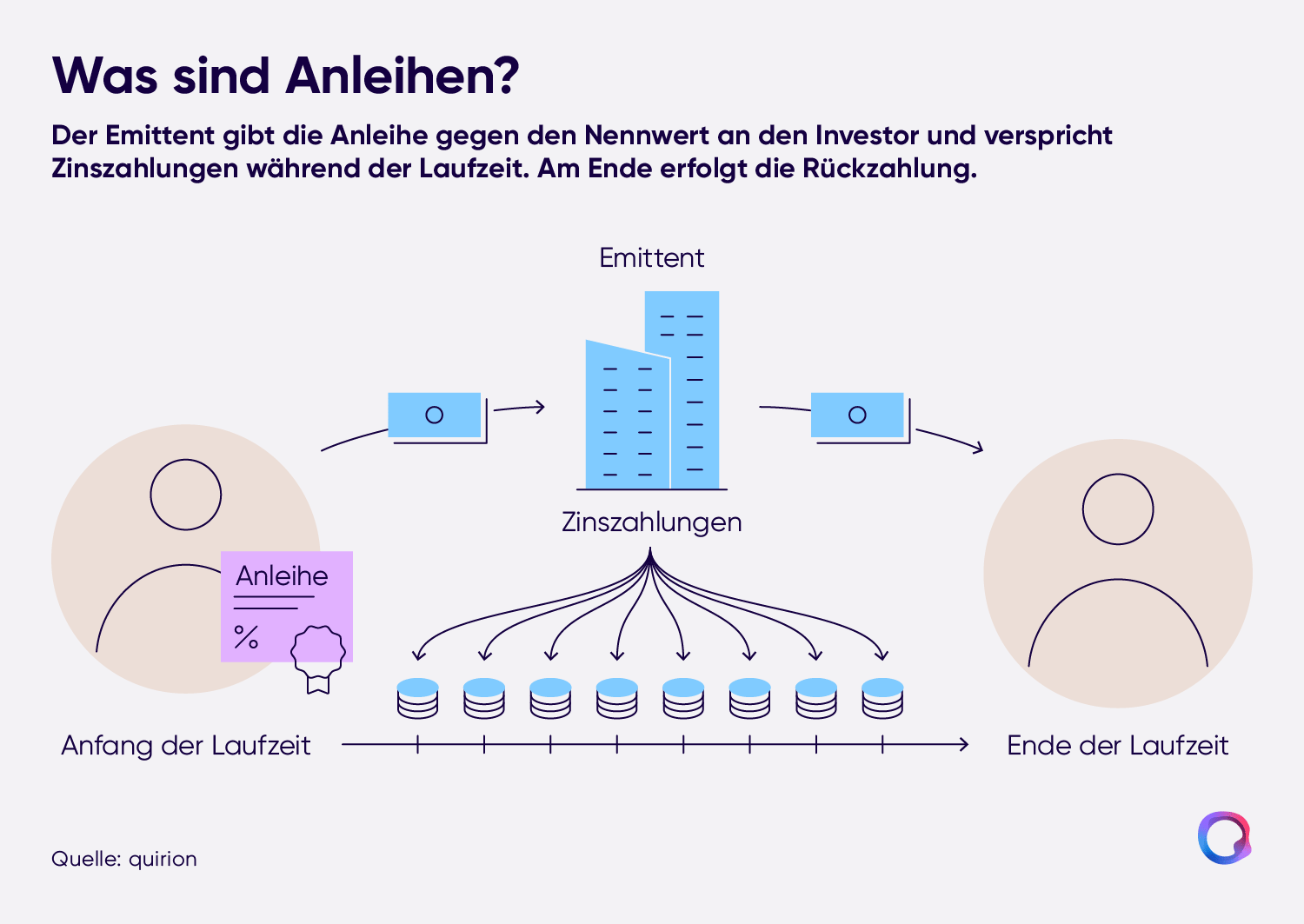
Did you know that there are considerably more bonds (German: Anleihen) than shares on the German stock exchange?
They have always been regarded by investors as a safe alternative to the more volatility-prone shares. They are fixed-income securities that usually have a term fixed in advance. Investors receive interest payments at a fixed point in time. Often this involves a fixed interest rate (coupon), but there is also the possibility of variable interest.
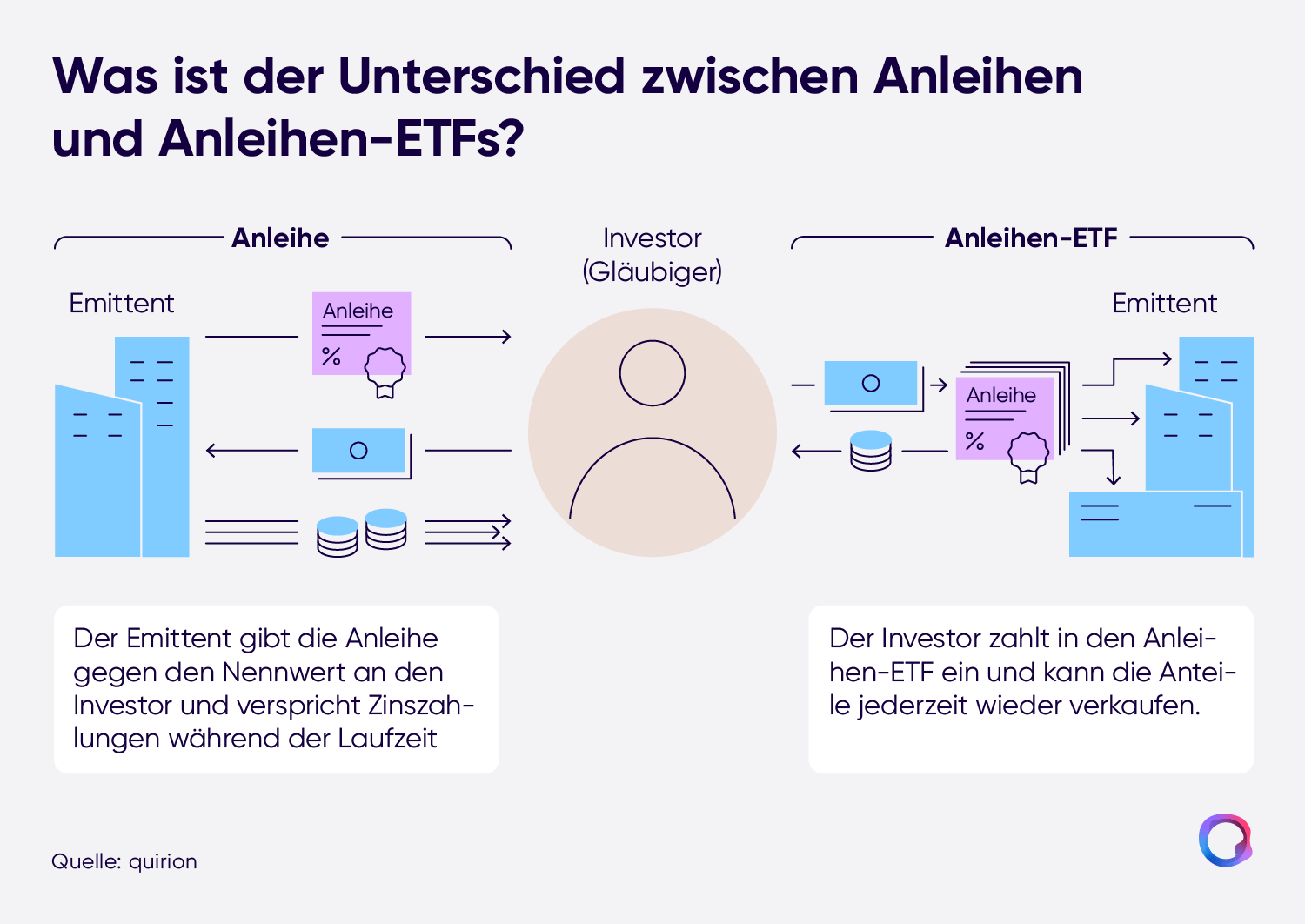
At the end of the term, the bond is repaid at 100 % by the bond debtor. Since many bonds are traded on the stock exchange, they have, like shares, a buying and selling price that is constantly recalculated and depends above all on general interest-rate developments. Unlike shares, bonds grant no co-ownership rights; instead, the bond buyer becomes a creditor of the bond debtor.
Bonds come in very different forms, including:
- classic bond with fixed interest
- with variable interest
- zero-coupon bonds, where the return arises from the difference between a low purchase price and a considerably higher repayment at maturity
- foreign-currency bonds, which are not denominated in euros
- subordinated bonds
- convertible and warrant bonds
Explained simply: How do corporate bonds work?
With corporate bonds, investors become lenders. By investing in a company's bonds, they lend the firm money. As with a loan, they receive regular interest payments and their money back at the end of the term. In this way they generate income – with bonds this is referred to as “yield”. The business relationship between creditor and debtor is defined by a security, the bond. Most bonds can be traded daily on the stock exchange.
Who can issue bonds?
Probably the best-known bond is the government bond. In this case, governments or their regional and local authorities issue bonds. In Germany, these are the federal government, the federal states, municipalities and public-law bodies. In this way they borrow money from citizens, but in some cases also from institutional investors (for example fund and insurance companies).
Even though it is often said that “companies issue bonds”, they are not the ones who sell the bonds directly to investors. When a company intends to issue a bond, it turns to a credit institution or an investment bank. These then initiate all the steps necessary for a successful placement of the bond. Banks can also act as bond issuers themselves, for example to raise money for their lending business or a business expansion.
What advantages do bonds offer investors?
One of the greatest advantages of investing in bonds is that this form of investment is comparatively easy to calculate, because the future cash flows are established in advance. Investors receive interest payments at regular intervals, which are moreover often of a constant amount. In addition, they get their invested capital back at a fixed point in time.
Trading in these securities is moreover quite flexible. Most bonds can be traded daily on the stock exchange. This means investors can sell their bonds at any time at the current market price. With other fixed-income investments, such as fixed-term deposits, this is often considerably more complicated.
What disadvantages and risks do bonds have?
The fundamentally lower risk of bonds also has a significant disadvantage: in the long run, the return usually cannot keep pace with that of shares.
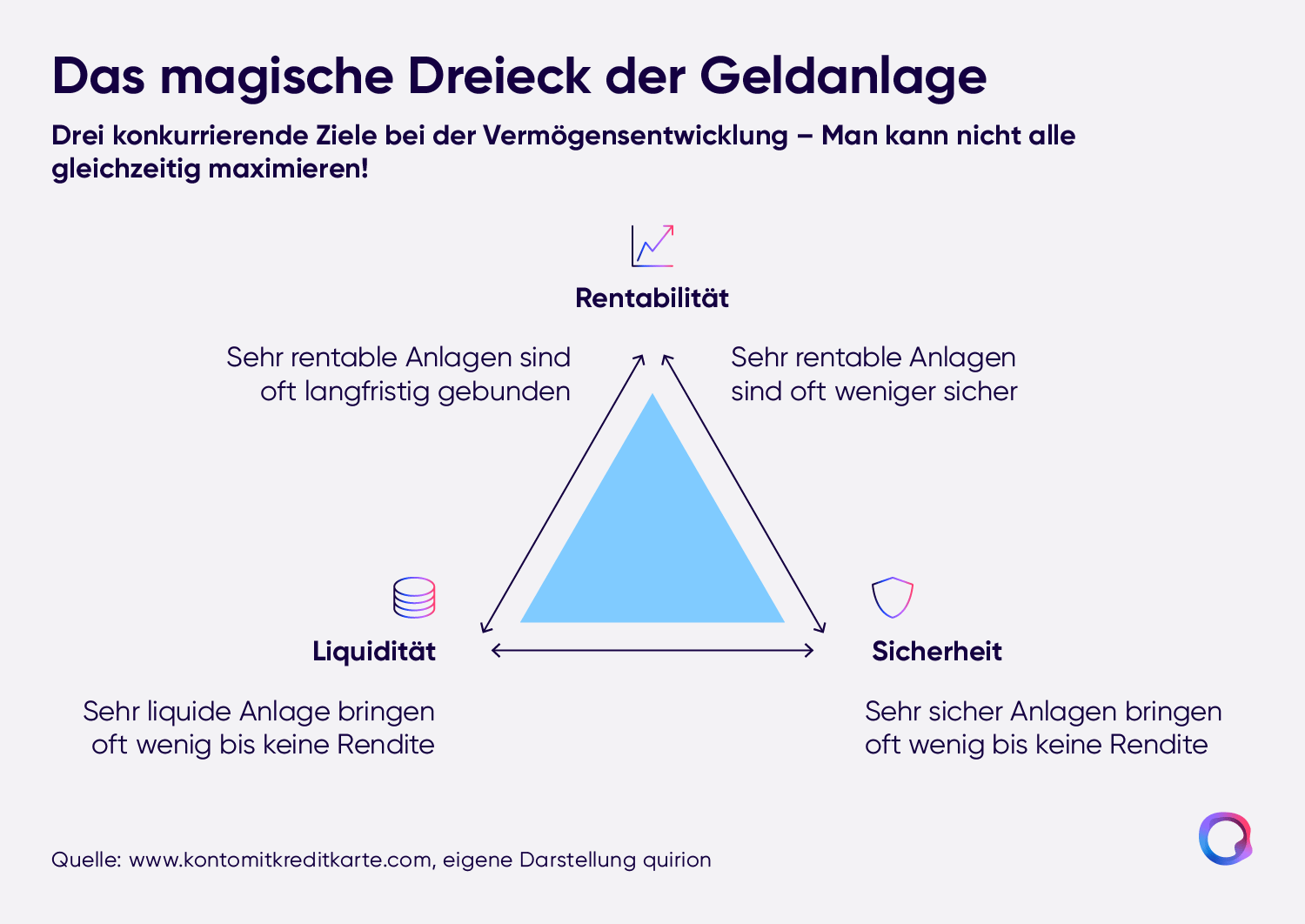
Moreover, a bond is not risk-free per se. If the issuer becomes insolvent, there is a risk in the worst case of a total loss of the capital invested. A broad spread of risk to cushion the default risks of individual bonds is quite laborious if investors do not use aids such as bond ETFs. And: bonds too are subject to price fluctuations during the term. Anyone who sells their bond before the end of the term may under certain circumstances have to book losses.
Why should investors not rely exclusively on shares, but also on bonds?
Anyone who invests exclusively in the stock market must expect strong fluctuations in the value of their portfolio. The development of bonds, by contrast, usually correlates only slightly with the development of the value of shares. In addition, the cash flows from bonds (interest, redemption at the end of the term) – unlike with shares (varying dividend amounts, no fixed term) – are precisely calculable. As a result, bonds stabilise the equity portfolio and are furthermore suitable for risk management. As a rule of thumb, a growing proportion of bonds in the portfolio results in smaller fluctuations in the value of the overall portfolio. However, investors then also have to select their bond investments to be correspondingly low-risk.
When is an investment in bonds worthwhile?
As already mentioned elsewhere, bonds ensure that a portfolio is less prone to fluctuation than if it consisted only of equity investments. How lucrative fixed-income securities are naturally also depends on how much interest they currently offer. How much interest a company or a government pays for a bond depends on a variety of factors (level of inflation, central bank policy, creditworthiness of the bond debtor, term of the bond).
What should investors pay attention to when selecting bonds?
Bonds too are characterised by risks of varying magnitude. The return–risk–flexibility triangle applies here too. This means: a short-term, low-risk investment in, for example, German federal bonds is often not particularly lucrative. Anyone who invests in high-yield bonds of companies that are currently in a difficult business situation, and who on top of that commits for a long time, can achieve noticeably higher returns. However, the risk of a payment default is at the same time considerably greater. As a rule of thumb, therefore: the higher the return, the higher the risk.
The relationship between risk and return can be optimised with bonds too, via ETFs. Anyone who invests via ETFs in hundreds of individual bonds can nevertheless achieve a good return at comparatively low risk (thanks to the very broad diversification) and at the same time stabilise their portfolio.
When do bond prices rise and when do they fall?
A general rise in interest rates initially means that newly issued bonds have to be equipped with better terms, i.e. higher coupons (adjusted to the increased interest rates). Bonds already in circulation, on the other hand, whose coupons were of course fixed before the rise in interest rates, must inevitably fall in price, so that they too – despite the comparatively low coupon – remain attractive to potential buyers.
Background: The interest coupon of a bond is generally fixed and consequently cannot adjust when the market interest-rate level changes. The only possible adjusting lever is the bond's price.
Put simply: a newly issued bond adjusted to the increased interest-rate level has a comparatively high interest coupon as well as an issue price of 100 %. Older bonds already in circulation, by contrast, have a comparatively low interest coupon, which is offset in value terms by a bond price of below 100 % – after all, at maturity repayment is made at 100 %.
For bonds already in circulation, rising market yields thus lead to price losses. These losses are all the greater, the longer the remaining term of a bond is. Conversely, this state of affairs means that the price of older bonds rises when the general interest-rate level falls.
This gives rise to the rule of thumb that investors who expect interest rates to fall soon should rather invest in investments with long terms (in order to secure the high interest rates for as long as possible). Anyone who, by contrast, expects rising interest rates should rather use short-term bonds. Once the short-dated bond has been repaid, the reinvestment can then be made in higher-yielding bonds.
Get started today!
Why do companies issue bonds instead of taking out loans from a bank?
When a company takes out a bank loan, it must in return accept the terms of the financial institution. These are, however, often quite strict. Companies may, for example, not take on any further debt capital and must provide collateral. Through clauses, the bank often draws up the loan agreements in such a way that it greatly reduces its own risks, thereby restricting the company's freedom of action. Through corporate bonds, the management therefore remains considerably more flexible, which can be quite advantageous with bond terms of several years.
In many cases, financing via bonds is moreover also possible at a more favourable interest rate than a corresponding bank loan. However, this option is not open to every company. To issue bonds, it should already be a larger amount (so that the associated effort is worthwhile), and the company should also have a certain level of name recognition. After all, you want to know whom you are lending your money to via the bond purchase.
How can I tell how safe a bond is?
A good yardstick for assessing the default risk of a bond is the so-called “rating”. It is produced by various rating agencies (the best known: Standard & Poor's – S&P for short – and Moody's), which for this purpose thoroughly examine the respective government or the respective company in detail. In this way it is often possible to make a fairly precise, if not infallible, assessment of how stable an issuer is financially. For one question is always at the forefront of bond investments: can the issuer service the bond properly, i.e. make the interest payments and the repayment of the bond on time?
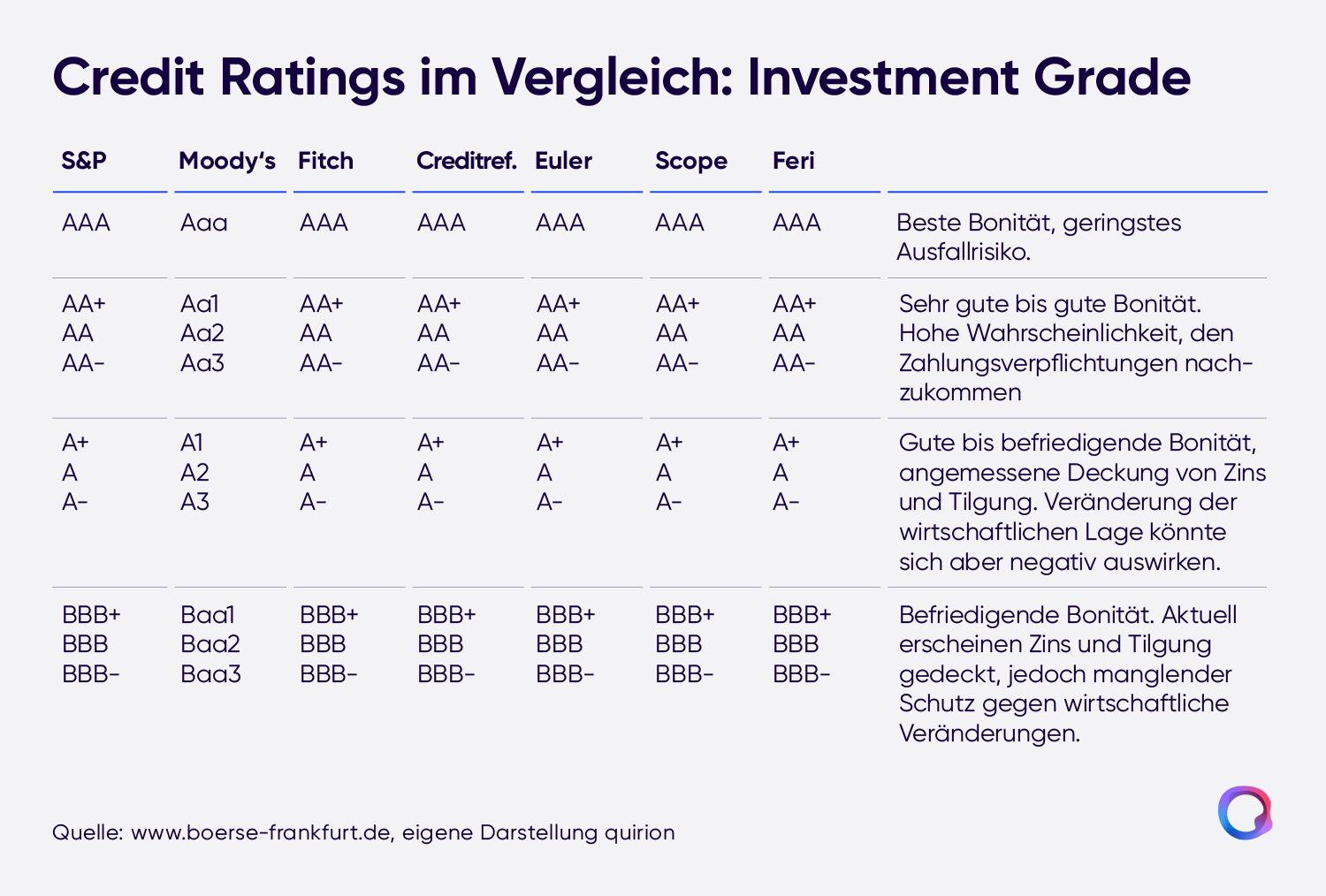
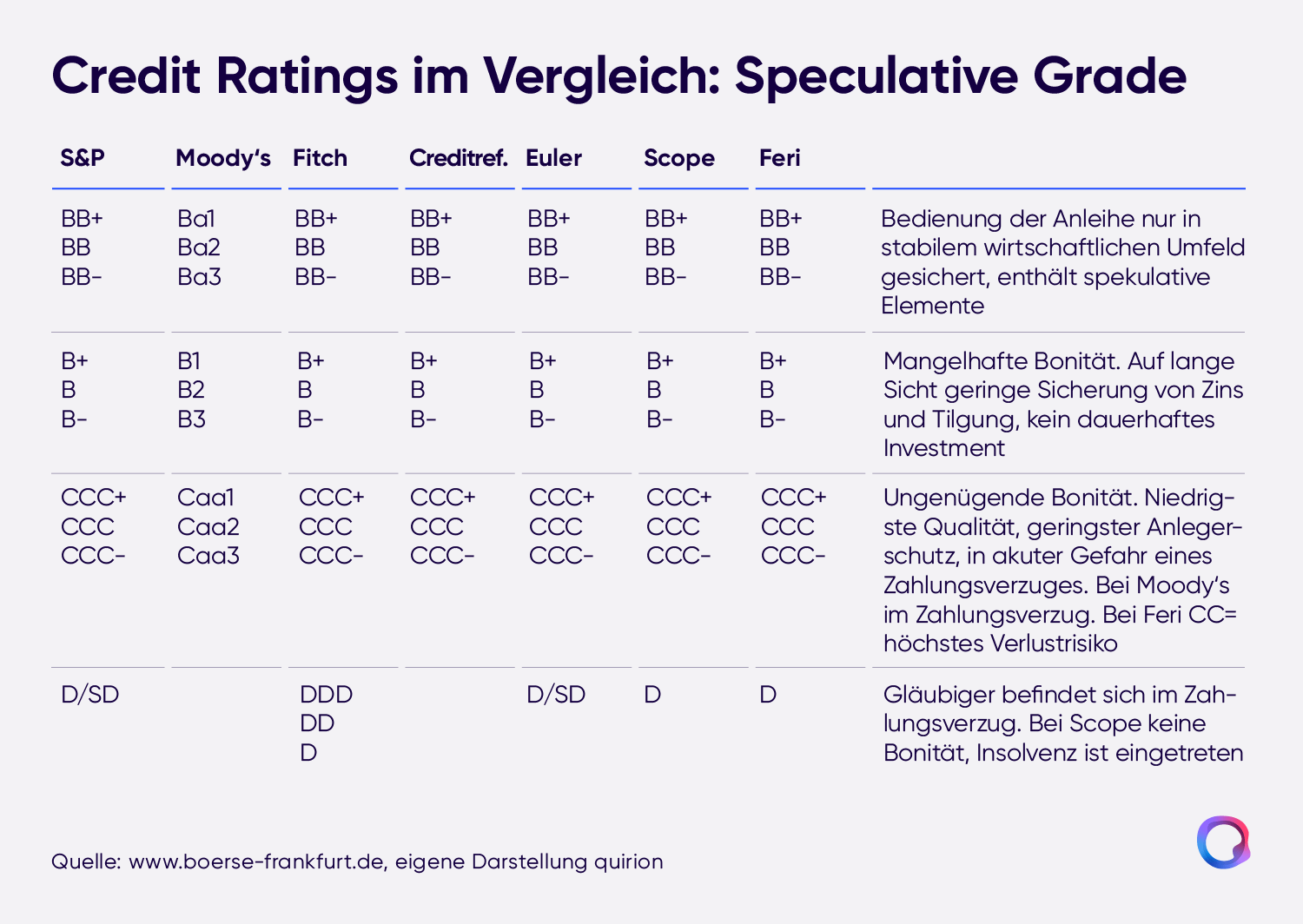
Unfortunately, the rating agencies do not use uniform scales to define creditworthiness. However, they are defined very similarly, and all have in common that AAA (triple A) represents the highest creditworthiness (lowest default risk). Any deviation from this is consequently a deterioration. Companies rated only with a simple “B” often already have a fairly high default risk. The worse the creditworthiness, the higher the risk. It is therefore logical that bonds with a higher risk or a poor rating have to pay a higher interest rate to compensate than comparatively safe bonds. Bonds with the best or medium creditworthiness are grouped under the umbrella term “investment grade”. Bonds in this segment have ratings from AAA to BBB- (or from Aaa to Baa3). Bonds with poorer creditworthiness (rating worse than BBB-/Baa3), by contrast, fall under the “non-investment grade” category (also called “speculative grade”). Bonds of speculative creditworthiness are also commonly known as high-yield bonds or junk bonds (High Yield Bonds or Junk Bonds).
Institutional investors such as pension funds are, by law or by their own statutes, obliged to acquire only bonds from debtors that have a certain minimum rating, i.e. of investable creditworthiness (investment grade). If the rating of a debtor now falls, after a renewed review by a rating agency, from the investable (investment grade) into the speculative range (non-investment grade), the price losses on these bonds are usually particularly severe.
Background: In such an event, many institutional investors are obliged to sell the securities they hold in their portfolios. As a result, rating changes not infrequently lead to sometimes sharp price swings on the bond market.
Bonds with best to satisfactory creditworthiness: Investment Grade
From a creditworthiness worse than BBB- or Baa3 onwards, the non-investment grade range (speculative grade) begins:
What is the difference between government and corporate bonds?
As the name already suggests, on the one hand a company acts as the bond issuer and on the other hand a government. Corporate bonds quite often have higher interest rates than many government bonds. This is because governments (at least most industrialised countries) generally have more economic strength and financial resources than companies and are therefore regarded as safer and more stable. Even though there are a few exceptions, such as Argentina in the past, it is considered fairly unlikely that a government will file for insolvency and consequently fail to service its bonds.