




What exactly is a stock index?
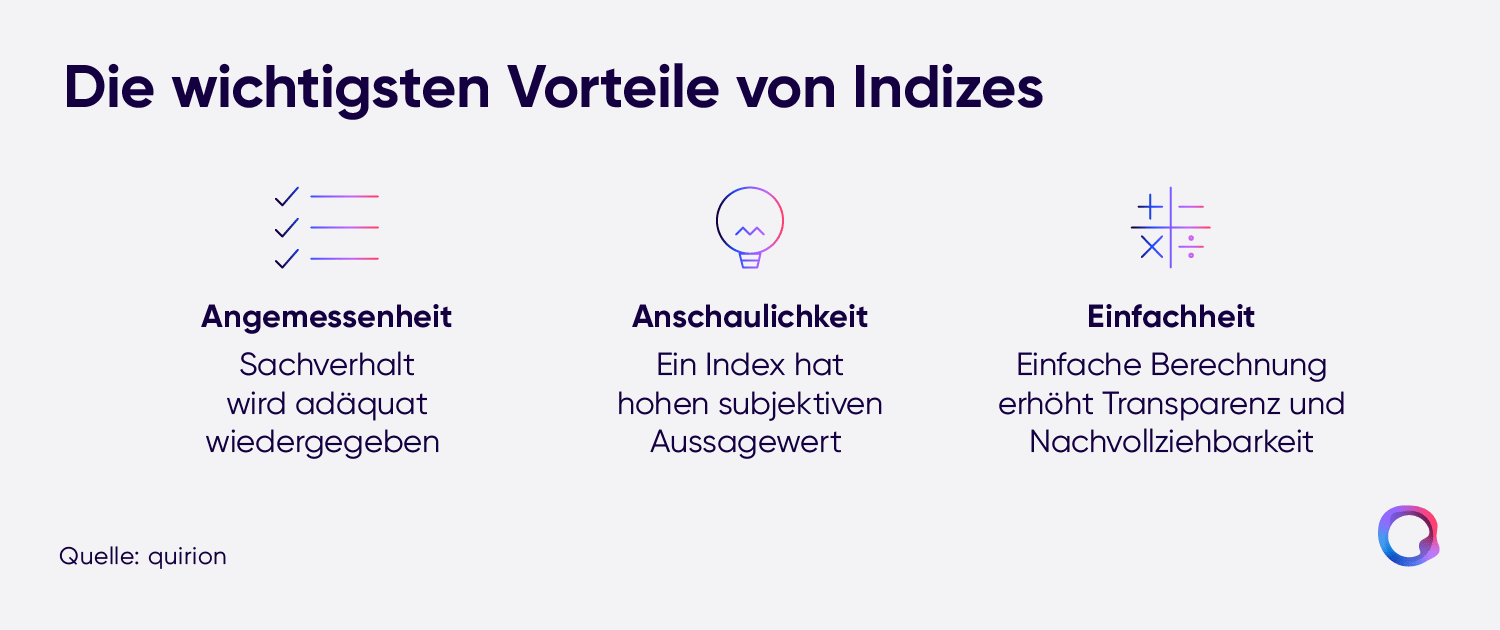
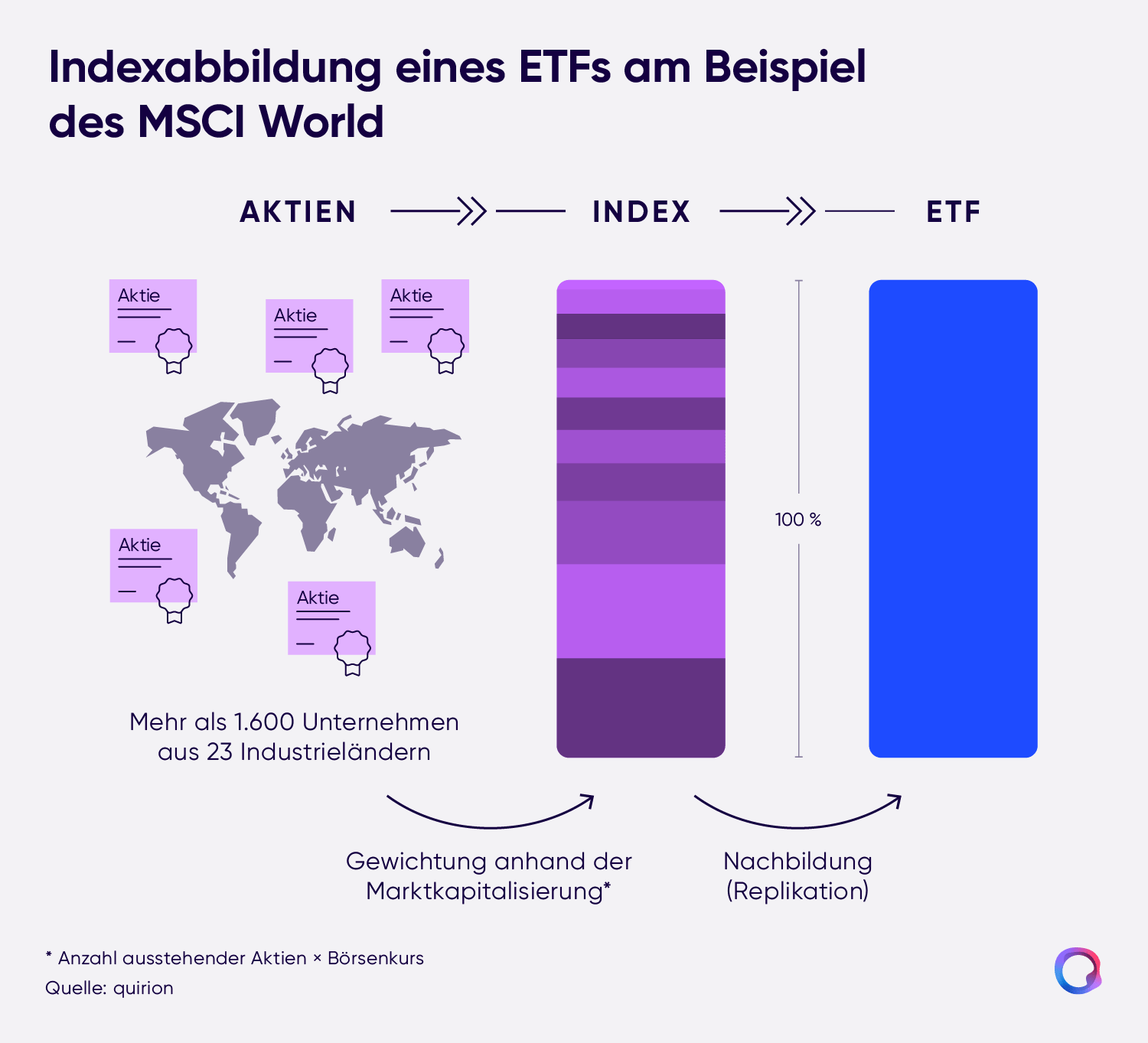
A stock index is a figure that reflects the performance of a precisely defined selection of shares. Often the individual shares are weighted within the index according to their market value (known as “market capitalisation”: the number of shares in circulation multiplied by the current share price).
In this way, index providers seek to track the share price performance of a country, a region (developed / emerging markets), a particular sector, a specific segment (large caps / small and mid caps) or the global stock market . Their calculation provides a good overview that lets market observers quickly know how the relevant markets (on which the index is based) have performed (on average) in the past.
Important to know: The term index is not, however, limited to stock indices. There are, for example, price indices that are intended to indicate how much the cost of goods and services changes on a year-on-year and month-on-month basis. The current inflation rate is then calculated from this. In addition, there are numerous indices in the bond and commodity investment segments.

What exactly does a stock index tell us?
A stock index tells us how the shares it contains perform in terms of price. This performance is usually calculated from a particular starting point. The index base or level is determined differently by the issuers (who calculate the index every day and, where necessary, replace shares in the index). The calculation of the DAX – probably the best-known stock index in this country – started, for example, at a round 1,000 points (as at 31 December 1987). For what is probably the world's best-known stock index – the Dow Jones (strictly speaking: Dow Jones Industrial Average) – the arithmetic mean of the initially twelve constituent shares (today there are 30) was simply calculated. The Dow Jones accordingly came into the world with an index level of 40.94 points in May 1896 - around 125 years later it stands at almost 34,000 points.
However, timeframes as long as those of the Dow Jones index are usually of little relevance to investors. What tends to matter more is performance over a medium- to short-term period. An index is then a good indicator of whether the underlying market is currently trading at a very high or rather a depressed price level. This allows conclusions to be drawn about the market sentiment prevailing at the moment and whether market participants are currently investing more heavily or rather cautiously in shares, whether they have recently favoured a particular country or a particular sector, or how the markets are reacting to certain developments (for example on the interest rate front) and important world-moving news.
Index – simply explained using the well-known MSCI World Index
The MSCI World is one of the most important indices – if not the most important of all – for getting a picture of the performance of the global stock markets. It contains around 1,500 shares of companies from 23 different developed countries, with the USA making up the lion's share of the index at almost 70 %.
The MSCI World Index is named after its issuer MSCI (Morgan Stanley Capital International). “World” also denotes the aim of covering the world's largest listed companies – which are often headquartered in the USA. It is, however, limited to developed nations. Its counterpart, the MSCI Emerging Markets Index, by contrast contains exclusively shares from the emerging markets (also referred to as emerging markets).
Performance indices vs. price indices
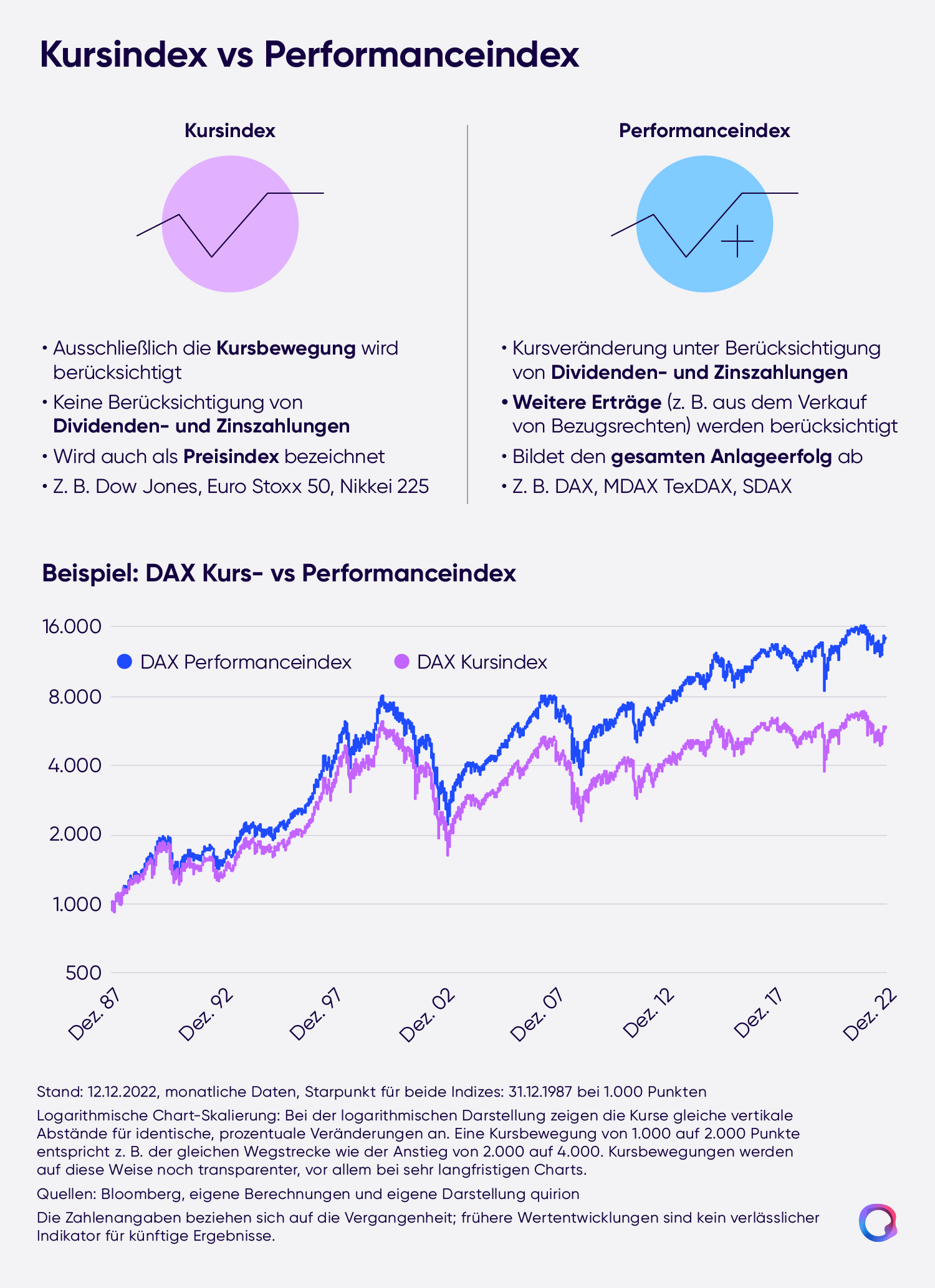
Indices can be calculated either on the basis of their pure price movement or their total performance, which also takes into account interim dividend distributions of the index shares. In the case of a performance index the dividend distributions that arise are fully reinvested into the index for calculation purposes. The price index, by contrast, ignores dividend payments completely and is based solely on the price movement of the individual securities it contains. Most well-known stock indices are designed as price indices, so the performance-index DAX is an exception in the international index concert.
The circumstance described can have a considerable effect on the performance of the corresponding index over the years. This becomes clear in the example of the DAX, where the performance index has for years stood significantly higher than the price index. The DAX does indeed exist in both index variants – but only the DAX performance index is known from the press, radio and television.
What is the German stock index (DAX)?
The German stock index (DAX) contains the 40 largest and most heavily traded listed companies on the German stock market. It brings together around 80 % of the market capitalisation of all German public limited companies listed on the stock exchange and is regarded as the most important barometer for the domestic stock market.
The composition is reviewed quarterly, so that the DAX always contains the largest companies with the highest turnover on the stock exchange. A strictly regulated review procedure decides whether a company may have to leave the DAX and which one is newly admitted.
The DAX is calculated both as a price index (without taking dividends into account) and as a performance index (with dividends). But only the DAX performance index is known from the press, radio and television – the DAX price index, by contrast, is rarely mentioned.
Save with the test winner
What are the world's best-known stock indices?
Major indices that attract a great deal of attention worldwide are:
- MSCI World (developed countries worldwide)
- MSCI Emerging Markets (emerging markets worldwide)
- Dow Jones (Industrial Average) (USA)
- S&P 500 (USA)
- NASDAQ Composite (USA)
- NASDAQ-100 (USA)
- Euro STOXX 50 (Euro zone)
- STOXX Europe 50 (Europe as a whole)
- Nikkei 225 (Japan)
- DAX (Germany)
- CAC 40 (France)
- FTSE 100 (United Kingdom)
- Shanghai Composite (China)
Why does the Dow Jones index play such an important role?
The US Dow Jones (Industrial Average) is regarded as the best-known stock index worldwide. It also owes its reputation to its biblical age: it has been officially calculated since the end of the 19th century. This made it the very first real stock index of all and it remains to this day a mirror of by far the largest stock market in the world. Its fame is surely also helped by the fact that its inventors Dow and Jones were the founders of the Wall Street Journal.
It is a pure price index (without taking dividends into account), which moreover does not meet the modern standard. The index is price-weighted, which favours shares with an optically high price in terms of index weighting. In addition, its composition is not strictly regulated and is not oriented, for example, towards clear criteria such as market capitalisation. Instead, its composition is determined by an independent committee of the Wall Street Journal. Despite these weaknesses, the Dow Jones index has lost none of its popularity to this day.
How do I buy indices?
Investors cannot buy the index itself. Investors can, however, invest cost-effectively in stock indices, for example via ETFs. These are exchange-traded funds (“Exchange Traded Funds”) that are intended to track the performance of the underlying index as accurately as possible. Depending on their construction, the fund companies either invest directly in the shares of the index (physical replication) or use derivatives, in whole or in part, that track the performance of the relevant index (synthetic replication).
Tip: From the point of view of spreading risk, investors should not rely on just a single stock index (particularly if it relates only to a single country or a single sector), but on several with different target markets. Equity ETFs are also excellently suited to long-term savings plans.