Even though our investment strategists don't rely on gazing into a crystal ball, we do want to set the tone for the new investment year: which trends particularly shaped quirion's global ETF portfolios in 2021 — and why forecast-free investing will pay off in 2022 as well.
Which themes will drive prices, and which stocks will be especially in demand? And where exactly will the DAX, S&P 500, or MSCI World end up at the close of 2022? Analysts and investment experts once again have answers to questions like these in abundance. It is the high season for annual forecasts. No sooner has the investment year ended than many people want to know, as concretely as possible, how the next one will play out.
We at quirion are convinced that no long-term investment strategy can be derived from forecasts. However precisely data from the past may be analyzed and projected into the future via mathematical models: things can always turn out differently. There is hardly any doubt about this, even among those who produce forecasts. That said, the developments of 2021 do allow for a few conclusions about what could be in store for investors in 2022.
A brilliant year for stocks
"What can be said is that in 2021 we saw an exceptionally strong year for stocks," notes our Chief Economist Philipp Dobbert. "This performance is also reflected in our portfolios — especially, of course, in those with the highest equity allocations, which posted gains of over 20 percent."
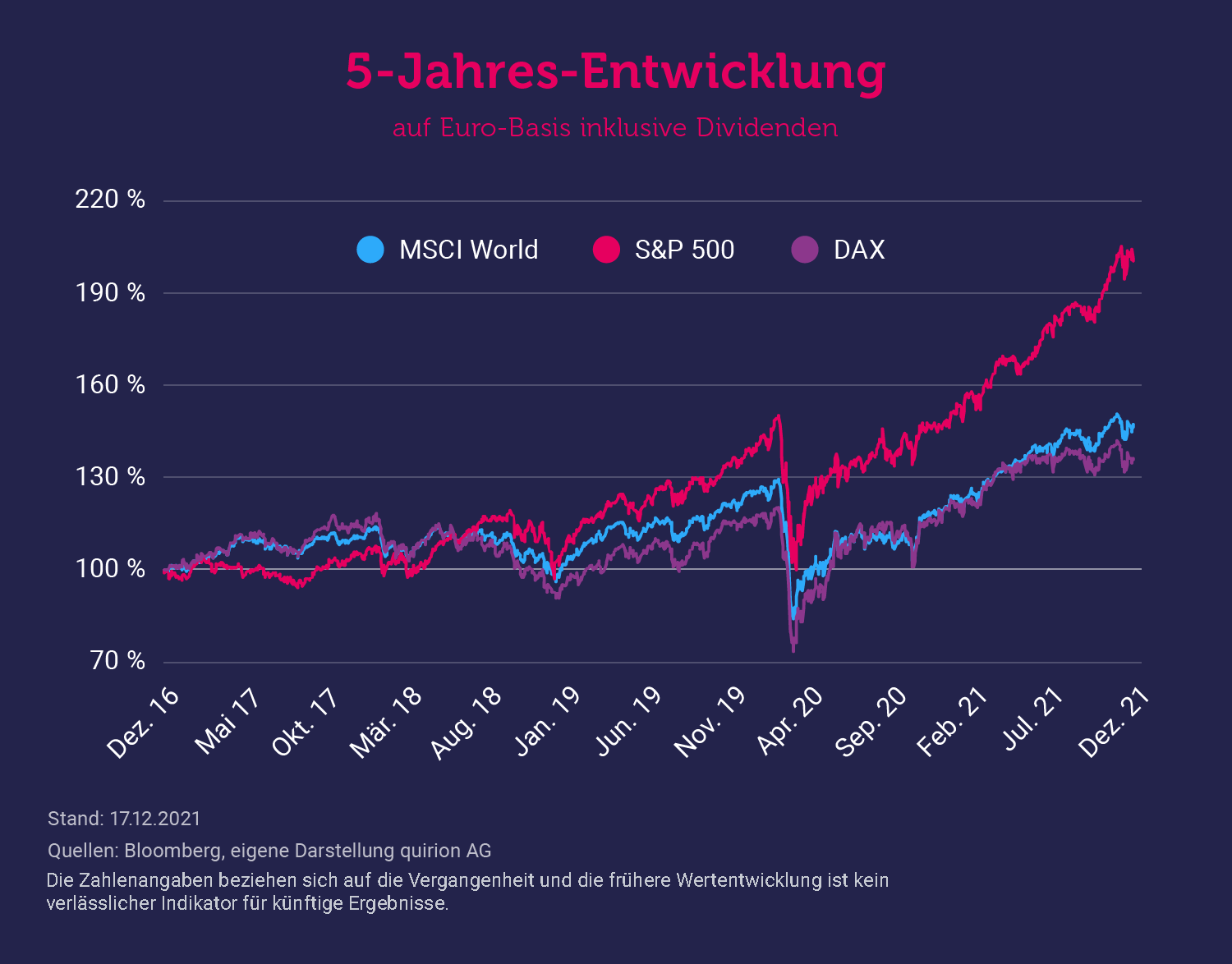
What does that mean for 2022? "Good developments always raise high expectations — and with that, the risk of disappointment grows," Dobbert emphasizes. He points to the long-term average for stock market returns, which is around seven to eight percent per year. "So if prices rise a little less dynamically this year, that still works out to a spectacular return on a two-year average."
Between the pandemic and monetary policy
From Dobbert's perspective, two themes above all shaped the stock markets in 2021: the coronavirus pandemic and the monetary policy of the central banks. "When news about the Delta coronavirus variant spread over the summer, there was a slide in prices in the markets." In the industrialized nations, prices then recovered quickly. The emerging markets were no longer able to properly build on their upswing from the start of the year. "No one can say precisely yet what effects the Omicron variant and the further course of the pandemic will have."
The behavior of the central banks will also be a source of uncertainty in 2022. "Despite sharply rising inflation, the ECB has continued its zero-interest-rate policy, just like the Fed in the U.S." The result: the best financing conditions for companies. "Together with the catch-up effects from the first year of the pandemic, this has driven the economy very strongly," the economist notes. It will now be intriguing to see how inflation develops further and whether anything changes in monetary policy in Europe. For the U.S., Fed Chair Jerome Powell has already signaled three interest-rate steps in 2022. But the answers to the question of how inflation and monetary policy will affect prices in the capital markets likewise remain in the subjunctive. Many scenarios are conceivable.
Into 2022 forecast-free
What is certain is that quirion will stick with a forecast-free investment strategy — and with ETF portfolios that capture returns all around the world. That paid off again in 2021. Anyone who gave in to the "home bias" and bet only on the domestic DAX, for example, certainly missed out on quite a bit of return. The main reason: "The U.S. markets once again showed a particularly strong performance," Dobbert states. Though the asset manager qualifies that the momentum in the S&P 500, for example, is driven above all by a handful of companies — among them the "usual suspects" such as Amazon, Apple, Google, Microsoft, and Tesla. The fact that only around ten stocks in total carry a broad index like the S&P 500 is yet another source of uncertainty for the coming year.
That the performance of the tech sector once again dominated the stock markets in 2021 may have surprised only a few. Less well forecast was the performance in the energy sector. "Riding the tailwind of oil prices, quite a few companies in the sector managed to impress with brilliant returns. Hardly anyone had expected that in this form."
Many question marks and the expectation of surprises could unsettle more than a few investors.
"A few months ago, at one of our client events, I once laid out just how many uncertainties there are right now regarding the further development of the economy and the markets," the economist recounts. An investor asked whether one can invest in such a situation without relying on forecasts. Dobbert's reply: "Precisely then."
More about the performance of quirion's portfolios can be found here.