These days, the capital markets too are being shaken by the current crisis hotspots:
- war in Ukraine
- the energy crisis
- the inflation this has fueled
- ongoing supply-chain problems, including in areas beyond energy supply
- the economic soft patch resulting from all of this
All of these factors are weighing on the equity markets in the current investment year, although in an internationally broadly diversified portfolio such as quirion offers, the US dollar - strong this year - has a loss-cushioning effect for euro investors.
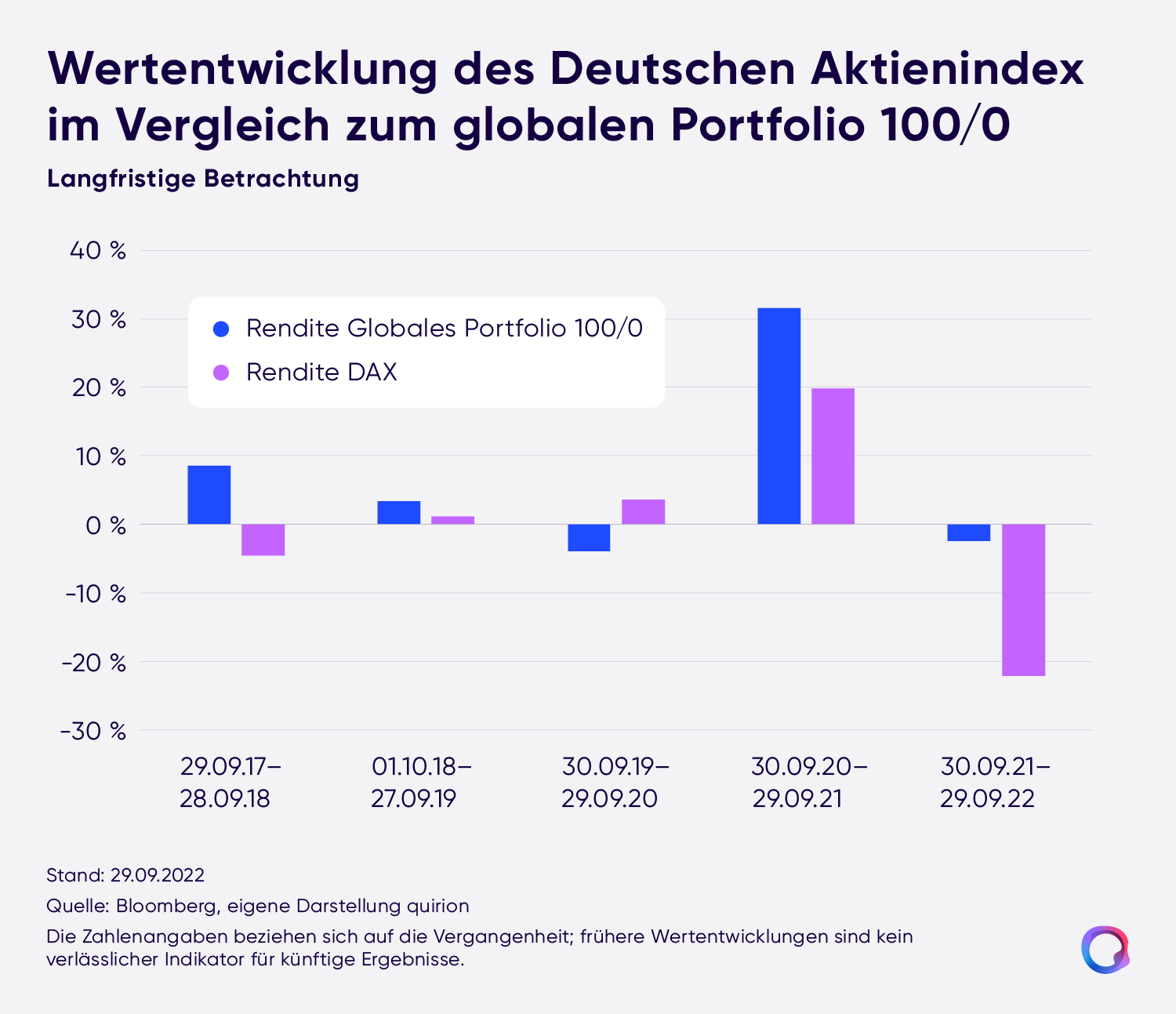
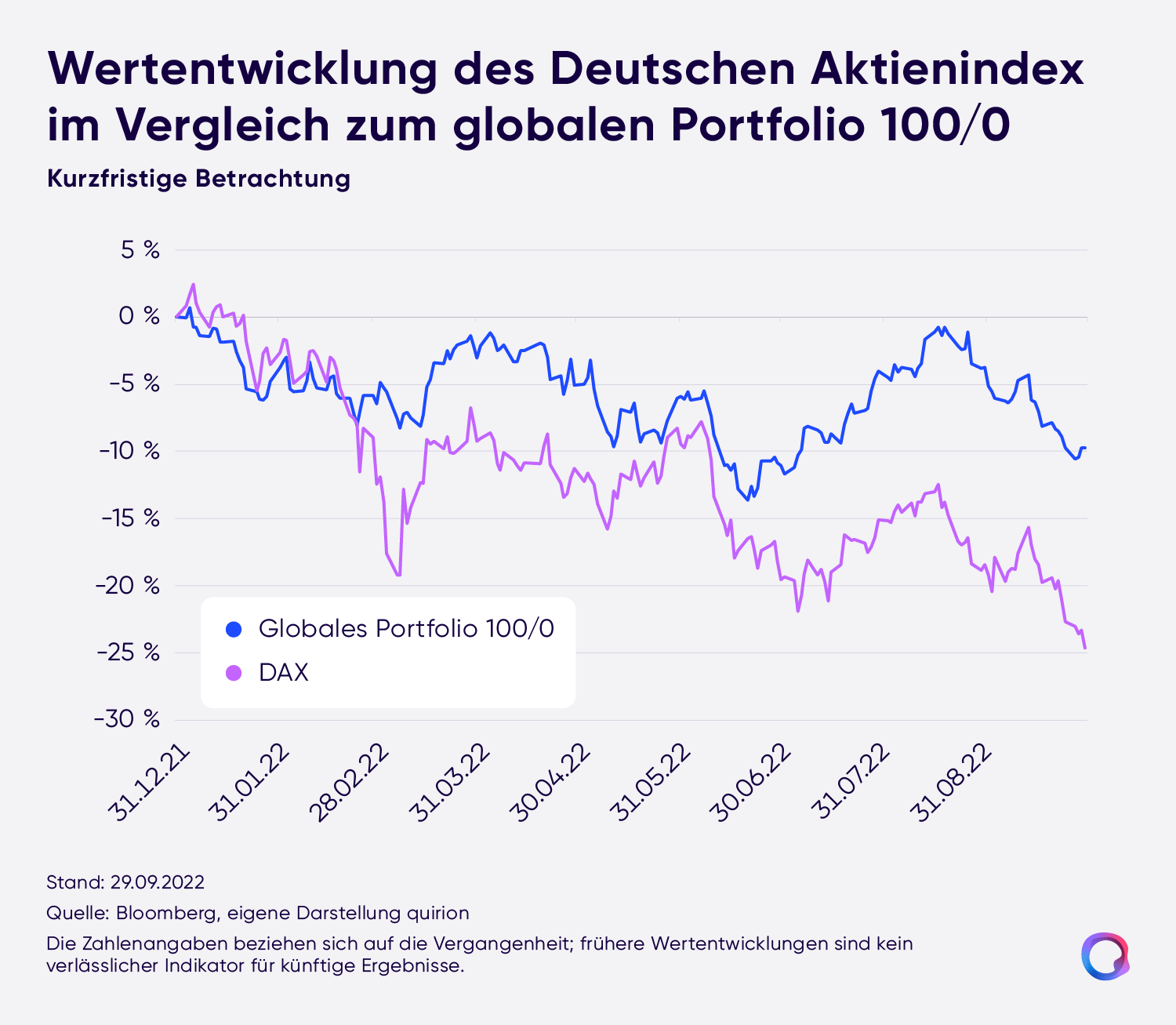
By contrast, the bond allocation has so far failed this year to perform its usual stabilizing function. It, too, is under relatively heavy pressure in the current situation. The main reason is the interest rates that the central banks have sharply raised to combat inflation. This, in turn, puts pressure on the prices of existing bond holdings.
This confluence of factors, together with the barrage of bad news that is currently coming thick and fast, is making many investors extremely nervous. On top of that, once again the voices are growing louder that advise getting out - above all of the equity markets. So what should unsettled investors do?
Even at the risk of repeating ourselves on this point:
A hasty exit or a change to your chosen strategy is the wrong course of action, in the current situation too.
Instead, we advise staying true to the investment strategy you chose for good reason, with the equity and bond allocation that suits you individually, and maintaining your investment with discipline - even if, admittedly, that represents a mental challenge.
We are fully aware that the recommendation to stay invested even during crises runs completely counter to intuition. It feels far more sensible to get out during a market phase like this, to wait until the dust has settled, and then to get back in with a reasonably good feeling.
As important and valuable as intuition may be in many areas of life, when it comes to investing in securities it is a poor guide. The facts speak an unambiguous language here. There is a wealth of scientific research that proves beyond any doubt that the deliberate attempt to be invested only during the best market phases ultimately does not work. Staying invested leads to better performance over the long run.
Recovery potential after crises
But why is that? Time and again it turns out that equity markets often move up most strongly precisely during crises - that is, in phases when the most negative scenarios are being drawn and the gloomiest outlooks are being painted on the wall. This is illustrated by the following chart, which shows the recovery moves of the MSCI World Index after the five major economic and equity-market crises of the past 50 years.
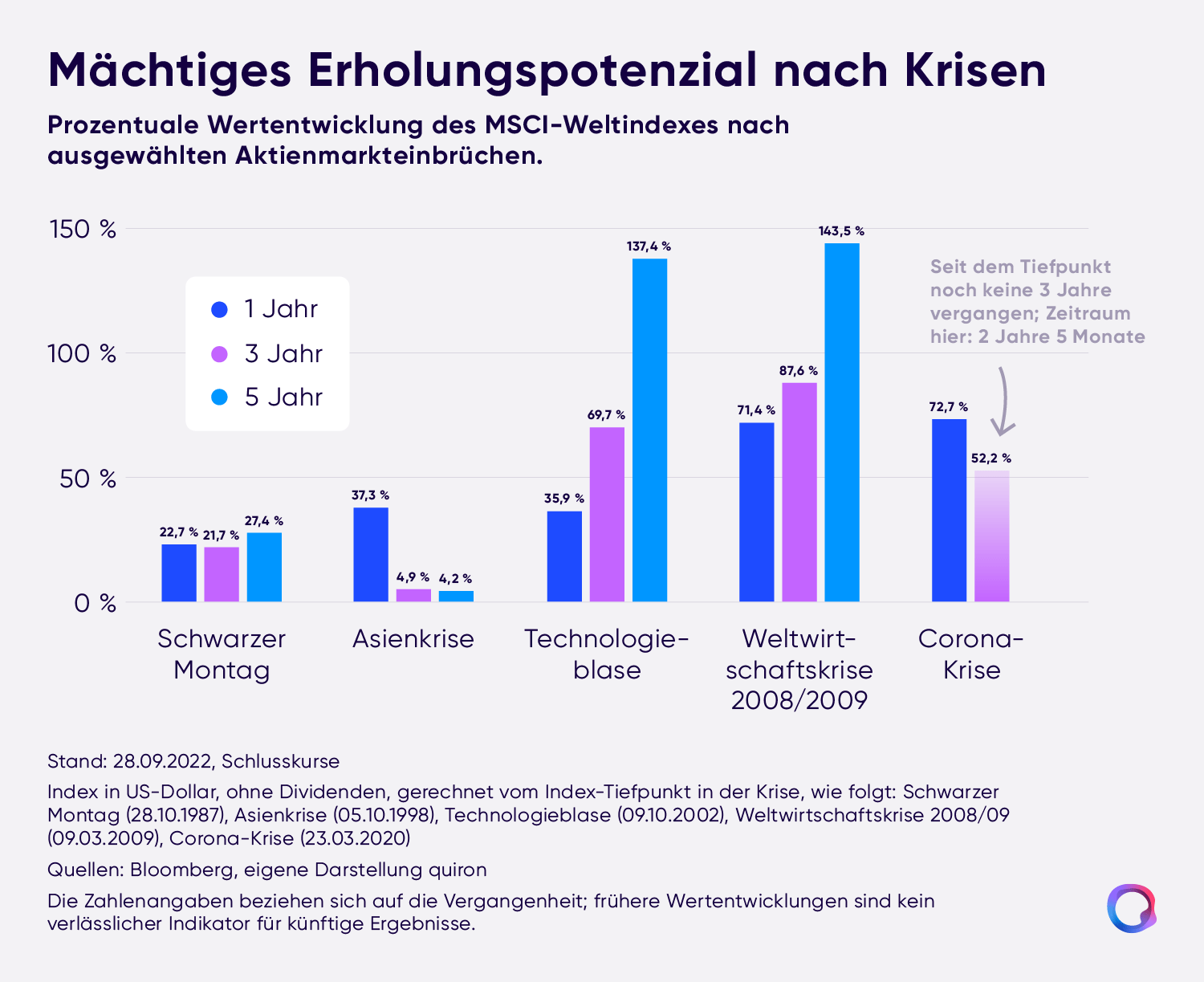
When interpreting this chart, it is worth bearing in mind that throughout all of these crises, the outlook for the equity market was painted in the gloomiest colors over an extended period. So the situation was essentially the same as today. It was never the case that on a particular date the end of the crisis could be declared and the markets then rose. If anything, the opposite was true: the market recoveries shown here essentially came as a complete surprise to everyone involved - right in the middle of the storm, as it were.
This also makes clear why the aforementioned efforts at so-called "market timing" - that is, the attempt to be invested only during the good market phases and to largely avoid the at times considerable downward moves - ultimately do not work. The problem here is not the exit, but getting back in. Investors, and even professional portfolio-management teams, who get out now will be unable to resist the pressure of the negative news and gloomy prospects with which they are practically inundated in times of crisis, and they will fail to get back in at the right moment. In doing so, however, they miss out on decisive return points. This is the deeper reason why investment discipline is perhaps the single most important success factor in long-term equity investing.
Our recommendation to investors
These interrelationships, together with the conviction that a free market economy and the financial markets will recover, through dynamic adjustment processes, even from the deepest crises, are the reason why we stand behind our global market strategy even in the currently extremely difficult economic and political situation. We are convinced that staying the course is rewarded over the long term.

Do you have questions?
Feel free to reach out to our client support team.
Feel free to send us an email at info@quirion.de.