ETFs have enjoyed a meteoric rise. And they are displacing traditional funds — for good reasons. Lately, however, more and more active ETFs are being launched onto the market. Here's what's behind the trend and the products.
„Active ETFs on the rise“, „The best of both worlds“: headlines like these can be read more often of late. The trend comes from the US. And it isn't entirely new: active ETFs have been on a growth trajectory there for some time. The number of products in particular has recently surged again. At the end of June, with more than 2,200 different products, there were for the first time more active than passive ETFs in the US. It's a different picture when it comes to assets under management. At that point „only“ 1.1 trillion US dollars were invested in active ETFs, compared with over 10 trillion US dollars in passive ones.
The ETF success story began in the 1990s with index funds tracking well-known equity indices. Tracking an underlying index as closely as possible, very cheaply: this idea of passive investing is what made the product category big. As it succeeded, the range of products grew immensely. There's hardly an investment theme or capital-market segment you can't now invest in via ETFs. Yet the abbreviation „ETF“ initially says only that it's an exchange-traded fund („Exchange Traded Fund“).
Unlike passive ETFs, active ETFs don't aim to replicate the return of a market or market segment as precisely as possible. Like traditional active funds, they aim to deliver a better return — through targeted selection of securities and the best-possible timing of entry and exit. Active ETFs are usually somewhat more expensive than passive ones, yet as a rule they are still far cheaper than traditional active funds. Hence the talk of the supposed best of both worlds.
Tempting, but misleading
The promise of beating the market sounds very tempting. But there's a big catch. It's a myth that you can identify exactly which securities or market segments will perform best in the future. Whether with a crystal ball or with a particularly good knowledge of individual companies and markets, there's no way to determine in advance whether — and by how much — individual prices will rise or fall. Even if, now and then, you might get lucky with a forecast.
Whether traditional funds or ETFs: all active strategies share this fundamental problem. To be systematically successful with targeted selection and market timing, you'd have to be able to predict the future reliably. It's fairly clear that no one can do that. Comparisons of active funds with passive ETFs have proven this many times over. The weaknesses reveal themselves above all over the long term.
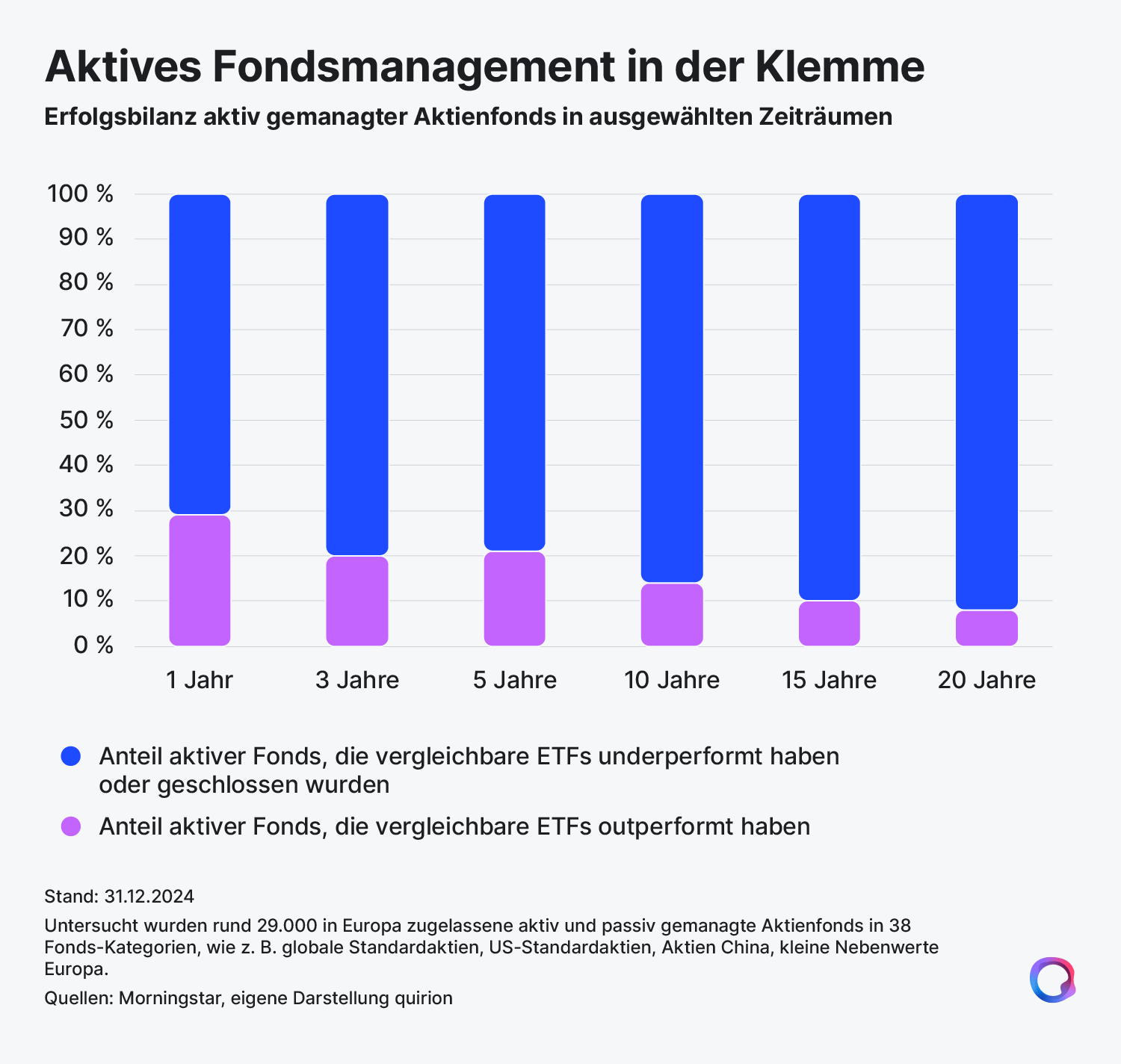
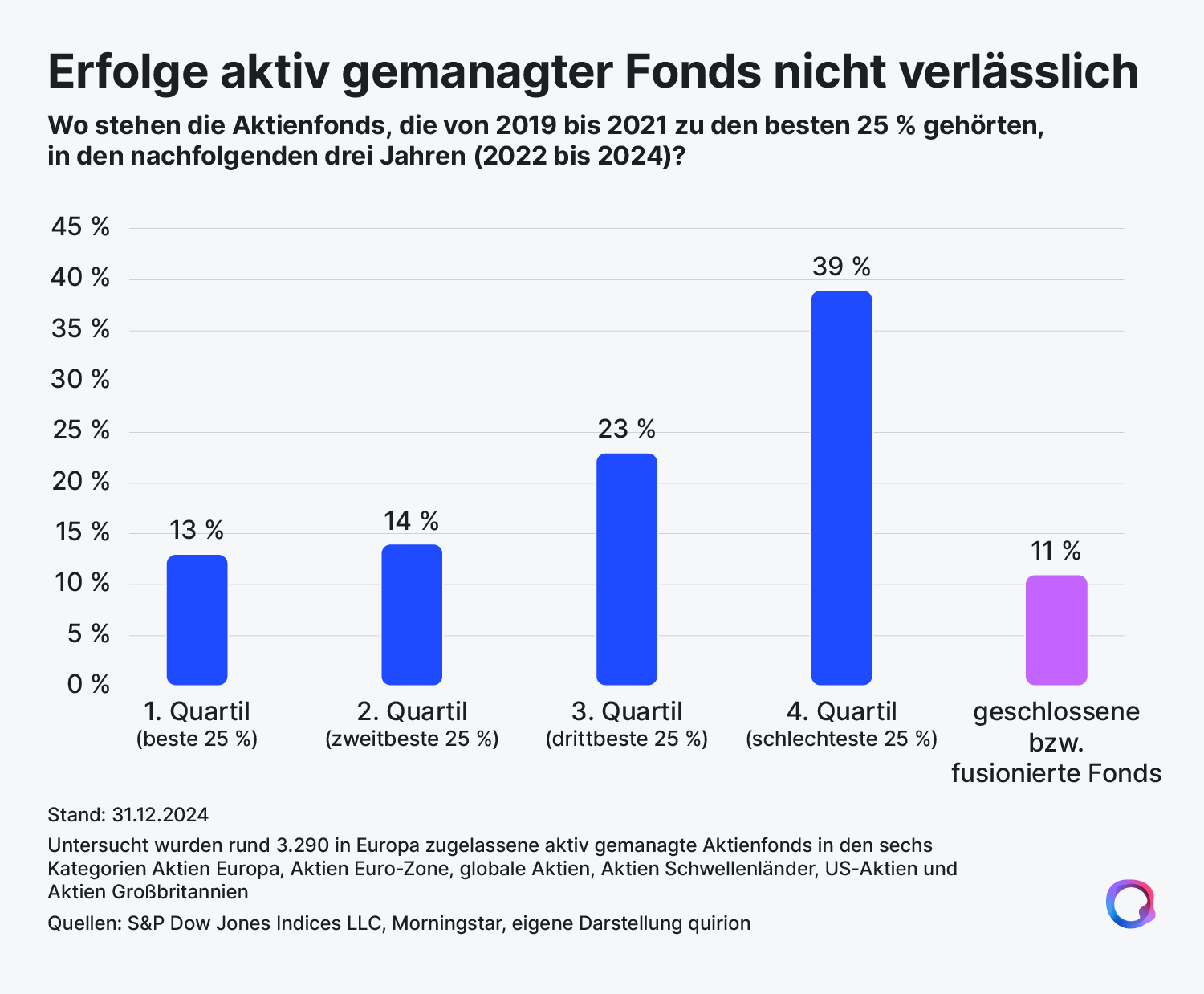
Now, you might object that at least some active funds do, after all, outperform comparable passive ETFs. So it seems you just have to back the „right“ active strategies. Yet as a rule, the top funds in the rankings change after a relatively short time — an additional sign that the success of active strategies has above all to do with luck. Given the sheer number of active strategies, you can always find a few in hindsight that paid off. Which doesn't yet mean they'll be right in the future too.
Invest forecast-free instead of actively
A core investment in the stock market must therefore take a different approach. Because the future is unknown, your investment strategy should steer clear of uncertain forecasts. And it should rest on the broadest possible diversification. Along the way, you should stay consistently invested rather than constantly chasing after individual trends. Activity of that kind tends to do more harm than good. The more broadly a portfolio is set up, the better the balance of return and risk.
An optimal stock-market portfolio in this sense contains every stock in the world. But that would be far too expensive. An efficient route to a global portfolio runs through low-cost ETFs, as in quirion's Automated ETF Portfolio. Here the investment strategists rely exclusively on passive ETFs. The goal is the long-term average market return.
Stocks give you a stake in companies, and an equity portfolio a stake in the value creation of the economy. This connection is entirely fundamental. Over the long term, the trend on the „global stock market“ points upwards, because the world economy is geared towards growth. With the global ETF portfolio, you as an investor can benefit from the return opportunities of the world's capital markets. And you don't have to take any unnecessary risks to do so.
Find out more about quirion's Automated ETF Portfolio here.