After the sharp interest-rate hikes, bonds once again offer greater return potential. This also means they can play their role in our portfolios more effectively - as a complement and, above all, as a risk buffer for an equity portfolio. That said, they are still not an alternative to equities.
As a girl's name, "Tina" was especially popular in the 1970s and 1980s. On the markets, "Tina" only came into fashion in recent years, as shorthand for "There is no alternative." The acronym captured the idea that, in a zero-interest-rate environment, there was no alternative to the equity market. Recently a new girl's name has been making the rounds on the markets - namely "Tara," short for "There are reasonable alternatives." As interest rates rise, the speculation goes, bonds are becoming an alternative to equities once again.
Over the past year, key interest rates have already risen sharply in many currency areas. And they are likely to climb further still. For the eurozone, our investment strategists expect an increase into the range of 3.5 to 4.0 percent in 2023.
Equities offer greater return potential
Newly issued bonds, with their higher interest coupons, do finally look more attractive again. "But to expect now that the return potential of bonds is greater than that of equities would be very short-term thinking," emphasizes Philipp Dobbert, Chief Economist and Head of Asset Management at Quirin Privatbank and quirion. This applies even more to savings deposits and time deposits. "Over the long term, the return potential of equities is considerably greater."
Studies back up this assessment. According to a 2022 analysis by Credit Suisse and the London Business School, over the period since 1900 equities have outperformed money-market instruments and bonds in all 35 markets studied. On average, equities outpaced money-market instruments by 4.6 percent per year and bonds by 3.2 percent.
What's more, it is not settled when the phase of interest-rate hikes will come to an end. "I don't expect rates to fall again anytime soon, but you can't rule it out either," Dobbert notes. Against the backdrop of a possibly sharper economic downturn, in the US, for example, there was at times heavy speculation once again about a possible about-turn toward rate cuts.
Bonds as a risk buffer
"Assumptions are no foundation for an investment strategy," Dobbert stresses. Rather than relying on uncertain forecasts, rely on broad diversification: that is the foundation of quirion's investment strategy - for equities and for bonds. Within this, bonds play a special role in the portfolios. "We give every client a share in the return potential of the equity markets. By adding bonds, we calibrate the equity investment to the different risk profiles," Dobbert explains.
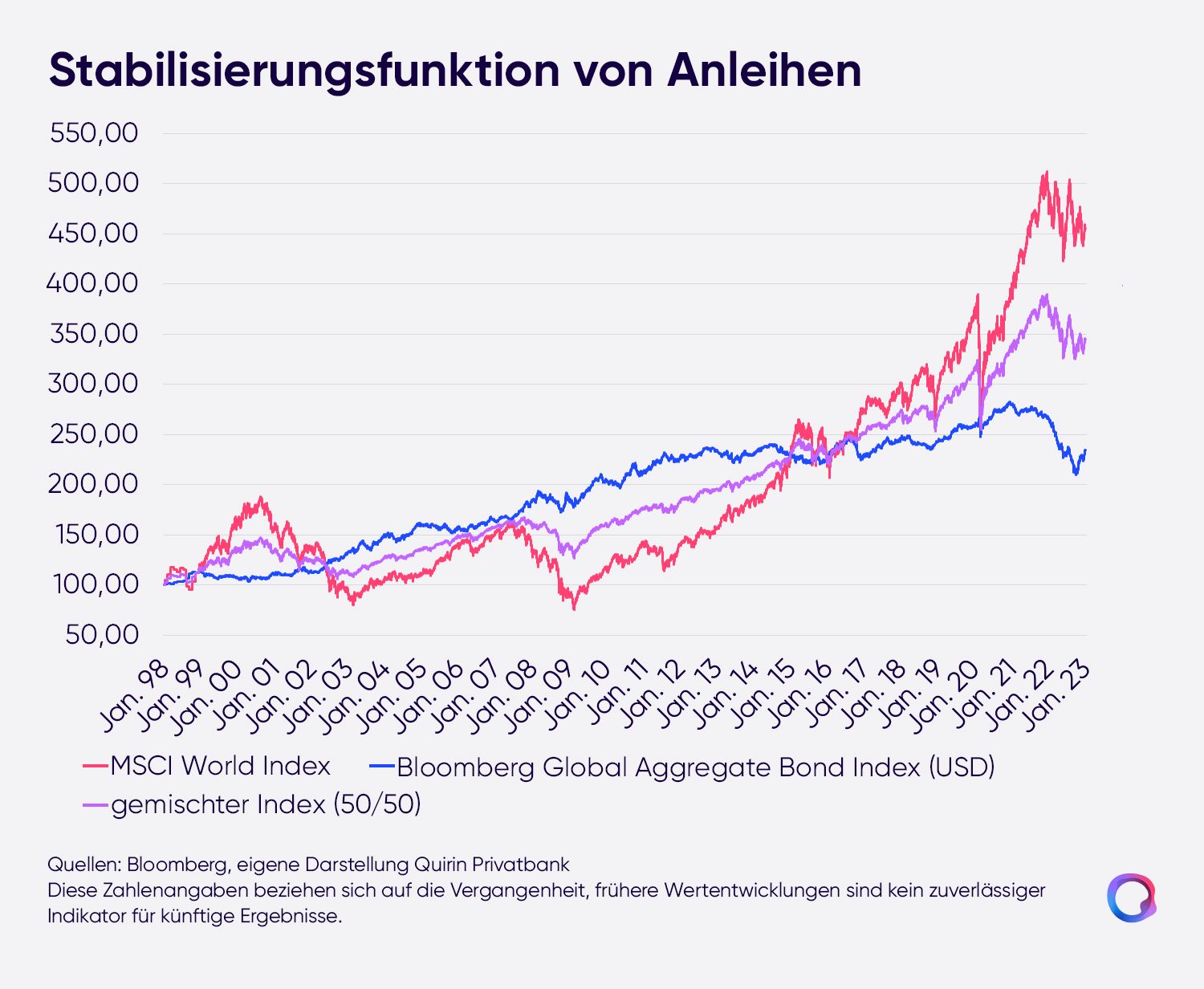
So first and foremost, bonds serve as a risk buffer at quirion. That's because their prices generally fluctuate far less than those of equities. This stabilizing function can be illustrated, for example, by a long-term comparison of the MSCI World equity index, the Global Aggregate Bond Index, and a hypothetical portfolio made up of equal parts of both indices.
An exceptional situation last year
In 2022, some began to doubt whether bonds still fulfil their function as a risk buffer. In the wake of the interest-rate turnaround, there were exceptional dislocations. A decline of around 22 percent in the ten-year German government bond and 16 percent in the ten-year US government bond: "For the prices of otherwise so stable bonds to slump that sharply, and at the same time as equity prices, is something we haven't seen in this form for many decades," Dobbert explains. "Over the long term, however, there is no other asset class that delivers stabilization as reliably."
For 2023, the economist expects a calmer year on the bond markets. As interest rates rise, new investments become attractive again. quirion's ETF portfolio benefits from the "reinvestment effect" in the process. Older bonds, whose prices came under pressure, are replaced upon maturity by new bonds that carry a higher interest coupon. "Step by step, last year's price losses are being made up again."
An additional source of returns
The role of bonds in quirion's portfolios is not limited to the stabilizing function. The bond portfolio provides exposure, via ETFs, to more than 3,000 individual bonds. These include emerging-market bonds and high-yield corporate bonds as well. In exchange for taking on higher risks, these promise greater return potential. "Our bond portfolio is broadly diversified across issuers, maturities, and credit ratings," Dobbert emphasizes. At the end of last year, he adds, several adjustments were made as part of the scheduled rebalancing, in the global as well as in the sustainable portfolio. "That leaves us feeling extremely well positioned for 2023 and beyond."