As part of the regular rebalancing of the global portfolio, we made a few further adjustments at the same time. This allows us to pursue our objectives even more precisely.
quirion's investment strategy is built on clear proportions – in the ratio of equities to bonds, which reflects investors' personal risk profiles, as well as among the individual ETFs in the global portfolio. Everything is deliberately coordinated with everything else. But as the markets move, the weightings shift gradually yet continuously over time.
To keep the portfolio from permanently drifting off course and ultimately heading toward entirely different goals, quirion regularly carries out a realignment, a so-called rebalancing. In practice, this means reducing positions that have performed above average. Others are topped up so that, in the end, the weightings are back in line.
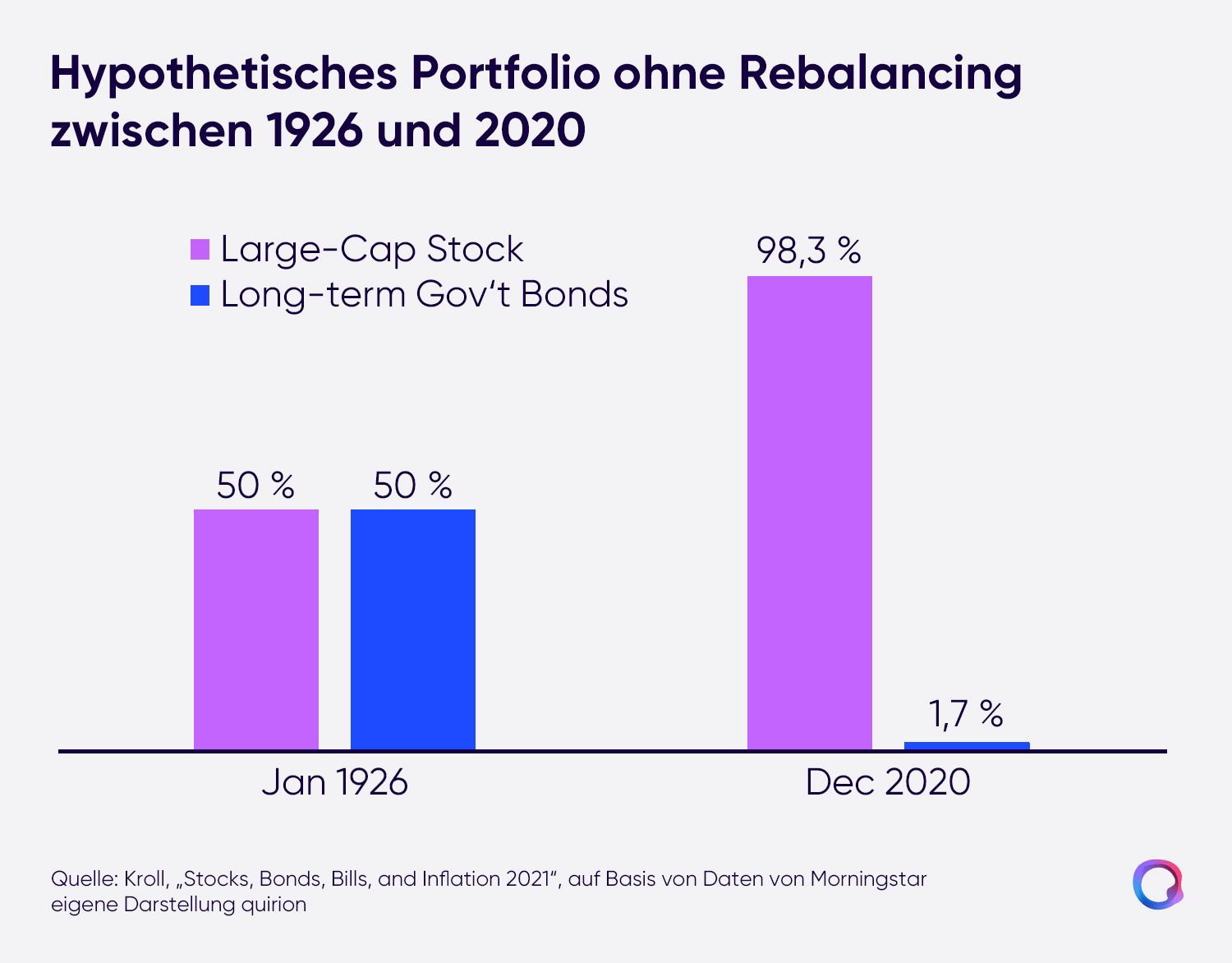
What would happen over the long term without rebalancing is vividly illustrated by a hypothetical portfolio that starts out split evenly between equities and bonds.
"These regular corrections to the weightings are necessary in order to stay true to investors' risk profiles," emphasizes Philipp Dobbert, head of asset management at Quirin Privatbank and quirion. "Over the long term, they have a big impact." But that wasn't the only respect in which quirion brought the global portfolio back on its intended course in mid-November. Along with the rebalancing, a few products in the portfolios were swapped out as well.
Better quality, lower costs
Bringing the "global equity market" into the portfolios: to achieve this goal, quirion relies on five return factors. One of them is company size. Small caps should play an appropriate role. To capture this even better going forward, the iShares MSCI World Small Cap ETF is replacing a previously used product from State Street Global Advisors. "The newly added ETF tracks the index's performance more accurately and is also cheaper," Dobbert points out.
Another advantage: the ETF now in the portfolio also captures the important return factor "momentum" (price dynamics) very well. That's why the MSCI World Momentum ETF was sold. To stay on the desired course in the interplay of all factors, the Xtrackers MSCI World Minimum Volatility ETF was additionally reduced by two percent and the Xtrackers MSCI World Value ETF topped up accordingly.
Less interest-rate risk
For the bond building blocks of the global portfolio, Dobbert and his team took a particularly close look at interest-rate risk. The background: the prices of long-dated bonds react especially strongly to changes in the interest-rate level, precisely because they tie investors to a specific interest rate for a particularly long time. In recent years, however, there have been numerous new issues, especially among long-dated bonds. "This trend was also reflected in some ETFs," Dobbert explains. "Their duration – the average length of time capital is committed – has risen." This made them somewhat more susceptible to price fluctuations.
That's why, in the bond portfolio, quirion has added the Invesco Euro Government Bond 1-3 Year ETF, among others. In addition, the Lyxor Euro Government 1-3 Year ETF was swapped for the Amundi Euro Government Investment Grade 1-3 Year ETF, which tracks the index more closely and is cheaper. "With these adjustments, we've lowered the average duration of the bond portfolio from around four to around three years," Dobbert reports. That matches the target value of the investment strategy. In addition, the average product costs of the bond portfolio fall from 0.14 to 0.12 percent per year.
Securing favorable terms
Costs play a major role in swapping products, just as they do in rebalancing. A swap doesn't happen, for example, simply because one ETF tracks its index a touch more accurately. What matters is weighing costs against benefits. This is also the reason why rebalancing takes place when certain thresholds are reached, or at least once a year – but not more often. "That would be too expensive and would at least partly negate the benefits," Dobbert notes.
Speaking of trading costs: when rebalancing and making product changes, quirion often moves several hundred million euros in individual ETFs all at once. So how do you secure the best possible terms? "You can't simply trade positions that large on the exchange – the prices would come under considerable pressure," Dobbert explains. "To make the switch happen all at once, our trading desk asks various institutional brokers – that is, large professional providers of securities transactions – in advance for prices at which they would provide or sell an ETF in a certain volume." At first, you don't reveal whether you're planning a sale or a purchase. "After all, the goal is for prices to stay close to current quotes and for us to get the best terms," Dobbert underscores. "That keeps the price corrections as favorable as possible for our clients."