The dividend season has begun. As always, reports about investment strategies that put payouts front and centre are once again piling up. But focusing on dividends or dividend yields quickly leads down the wrong track.
Being crowned a “dividend aristocrat” is something only a few companies manage. Admittedly, there are no universally valid criteria for joining this illustrious circle. But a common definition is that the dividend must rise for at least 25 years in a row. When companies pay out ever-higher sums to shareholders for such a long time, though: doesn’t it seem natural to think that these are reliable earners and therefore a lucrative investment?
As plausible as that may sound, there is no systematic link between dividends and long-term investment success. The example of Fresenius shows this. Until recently, the DAX company was still a “dividend aristocrat”. In 2023, the payout stagnated. This year there is now no dividend at all. That’s because Helios, the hospital operator belonging to the healthcare group, drew on state aid, which rules out payouts. On 12 February, the share price stood at €25.70, around 45 percent lower than five years earlier. The loss in value is not offset by the dividends paid – a total of €4.36 per share since 2019.
The example shows two things: first, dividends are not permanently guaranteed, even among the dividend aristocracy. Second, weak price performance can seriously spoil the joy of the dividend. Conversely, dynamic price performance can make up for missing payouts: Amazon, for example, has never paid a dividend in its corporate history. The value of the stock has more than doubled over the past five years.
Payouts reduce a stock’s value
Dividends aren’t a cherry on top that comes on top of the price performance. After all, the paid-out portion of the profit is missing from the company. Shortly after the payout, the stock “ex dividend” is therefore usually traded at lower prices, at least for a short time. To “give something back” to investors, US companies in particular more often resort to the alternative instrument of share buybacks. This route isn’t undisputed. But a buyback usually gives the share price a positive boost, because the company’s reported earnings are spread across fewer shares.
In any case, the size or the consistency of dividend payments doesn’t provide grounds for sustained price increases. Payouts always relate to profits that have already been achieved and therefore say something about the past. For price performance, however, expectations of future profits are decisive. Growth companies in particular often forgo dividends and prefer to use their profits to drive the expansion of their business.
Diversification instead of a dividend strategy
But what about the dividend yield? This metric sets the dividend in relation to the share price. Yet it too isn’t a reliable filter for successful stocks. The dividend yield rises not only when the dividend increases, for example. But also when the price falls sharply while the dividend stays the same.
Diversification serves your investment strategy considerably better. This is shown by a comparison of the more broadly positioned MSCI World with stock indices that focus on dividends and dividend yields.
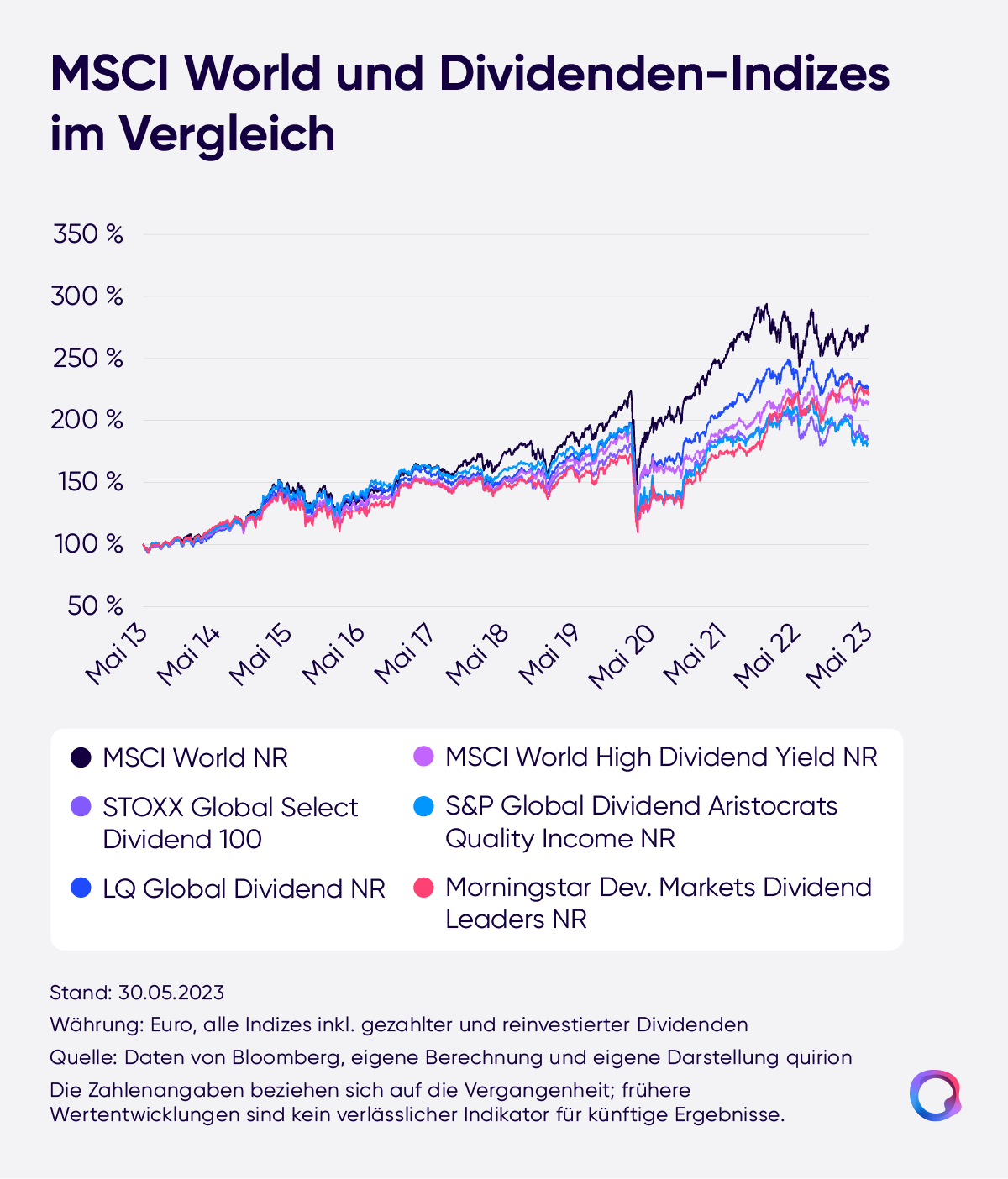
It’s true that with a targeted selection, additional aspects can be taken into account alongside criteria such as the size of the dividend or the dividend yield. But then, under certain circumstances, even fewer companies qualify for a portfolio. And the more concentrated a portfolio is, the worse the balance between return opportunities and expected risks. But even in a very broadly diversified portfolio without an explicit focus on high-dividend stocks, attractive dividend yields can arise.
Dividend yield in the global portfolio
The dividend yield of quirion’s global ETF portfolio was 2.9 percent at the end of 2023, and thus significantly higher than that of the popular MSCI World (1.9 percent). In a portfolio that, through ETFs, invests in more than 8,000 stocks worldwide, you’ll of course also find numerous companies with – relative to their share price – comparatively high payouts, and even a few “dividend aristocrats”.
quirion’s global ETF portfolio relies on the broadest possible diversification. In selecting the ETFs, neither dividends nor dividend yields play a role. The investment strategists focus on other factors that, according to findings from capital-market research, are relevant for optimising the balance between return opportunities and risks.