When investors from Europe put money into US stocks, their performance isn't reflected one to one in your portfolio. The reason for this is the exchange rate movements between the dollar and the euro. Here's why it's advisable to simply accept them.
After the brief slump in April, US stocks quickly reached new records again. But investors in Europe couldn't really enjoy the upswing. The reason was the weak dollar. When you invest in US stocks from Europe, the rule of thumb is: if the dollar rises against the euro, that adds extra return. But if the dollar falls, that has a negative effect.
By mid-July, the US currency was down around 11 percent against the euro. “The scale of it isn't all that dramatic,” explains Philipp Dobbert, Head of Wealth Management at quirion and at Quirin Privatbank. “But the speed of the movement really has been extraordinary.”
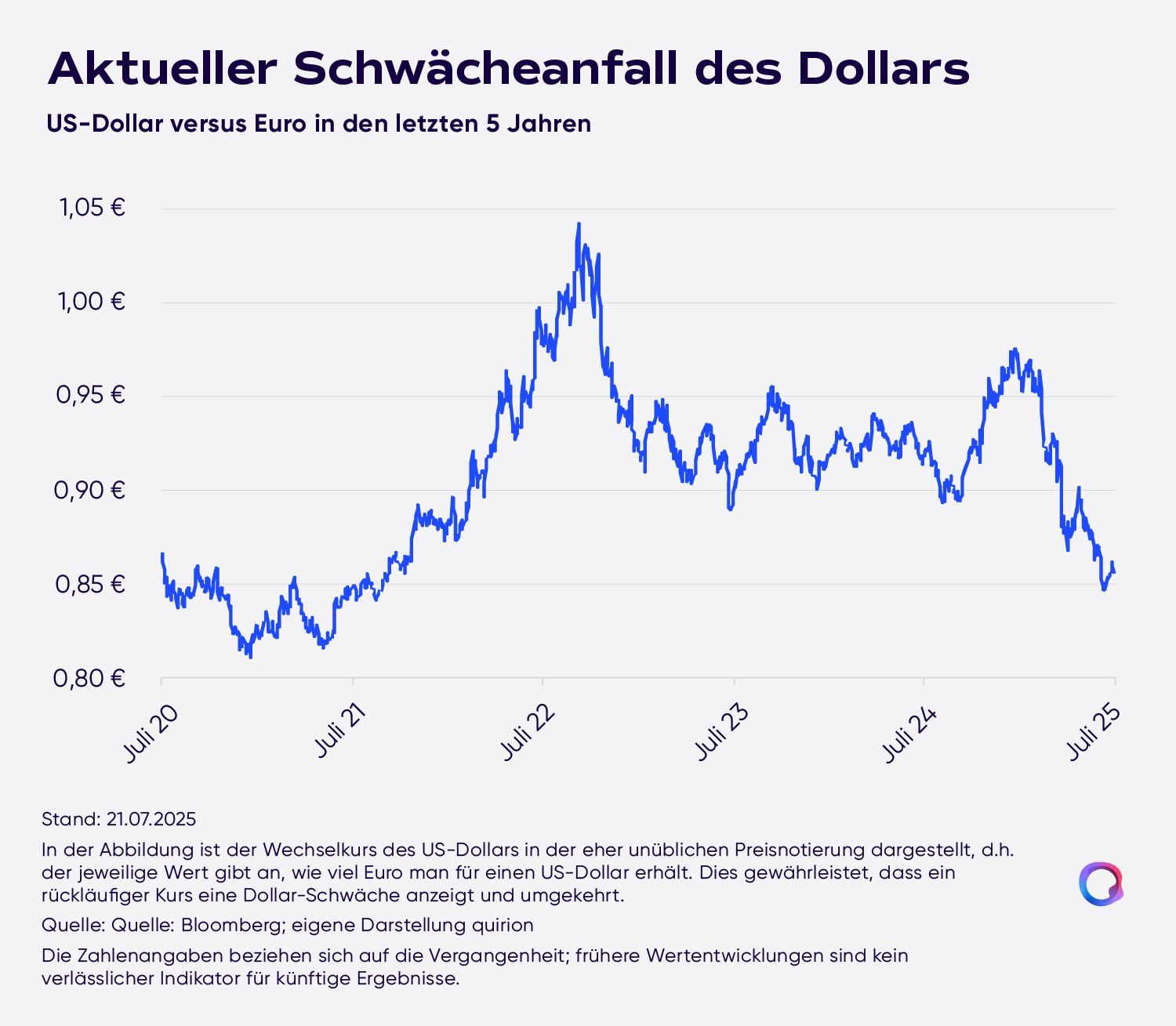
The dollar's weakness can be traced above all to the policies of US President Donald Trump. “When you publicly muse about whether foreign creditors could retroactively be forced into 100-year maturities, that naturally leads to mistrust,” Dobbert observes. The high level of government debt, which is expanding even further as a result of the “Big Beautiful Bill”, doesn't make US government bonds any more attractive either. And high tariffs restrict trade. All of these factors dampen demand for the dollar.
So now one person or another is wondering whether it might make sense to steer clear of US stocks. Or at least to hedge the portfolio against currency fluctuations. “What may seem obvious to some would actually be fundamentally wrong for building wealth over the long term,” says Dobbert.
Hedging with many uncertainties
Currency movements depend on many factors. And, like all other price movements, they can't be forecast. No one can reliably predict how they'll unfold. A look back shows that it goes back and forth again and again.
But because you can never say exactly when and how strongly exchange rates will change, you'd have to set up currency hedging comprehensively and permanently. Only then would the portfolio really be protected during downward movements of the US dollar. That, however, has major drawbacks: “For one thing, currency-hedged portfolios don't benefit from currency gains. For another, the cost of hedging permanently eats into the return,” Dobbert explains. On top of that: currencies usually fluctuate less strongly than stock prices. “So the risk of a globally positioned portfolio doesn't change significantly through currency hedging.” That's why quirion's equity portfolios aren't hedged against currency fluctuations.
US stocks are indispensable
Because quirion's investment strategists don't rely on forecasts, they also don't change the weightings in the portfolios based on any market expectations. What counts for them is market capitalisation. “The US equity market is by far the most important in the world, and nothing has changed about that,” Dobbert points out. “In a diversified world portfolio, it should play a corresponding role.”
In quirion's global ETF portfolio, US stocks currently have a weighting of around 50 percent. For comparison: in the popular MSCI World, the US share is around 70 percent. “This index's high concentration in the US has always been a risk, not just since the start of this year,” Dobbert explains. But reducing the US weighting in the global ETF portfolio even further now because of current market developments wouldn't lower the portfolio's risk, quite the opposite: “Every concentration is a bet on a particular market development.” That would increase the danger of being caught on the wrong foot.
“If I want to build wealth with stocks over the long term, looking at the performance of a few months is irrelevant,” Dobbert emphasises. “Trends in individual stocks, industries or regions change constantly. But no one can reliably say exactly when that happens.” Trying to find the most favourable moment to get in and out is pure luck, even for investment professionals. “There's nothing to be gained from chasing individual trends,” Dobbert underlines. “The most sensible path to investment success remains broad diversification that you stick to consistently.”
You can find out more about the advantages of a diversified portfolio here.