When prices reach high levels, it comes down to companies' balance sheets. And when gross domestic product weakens, the stock index falls too. That is what you might think. Yet the connections are not that direct.
Worth more than all DAX 40 shares combined: in early January, Apple became the first company in the world to briefly command a stock-market capitalisation of around three trillion US dollars. Then came the setback in tech stocks, which took a toll on Apple too. The market value of the tech icon fell by several hundred billion dollars within just a few days. At least temporarily.
When you read figures like these, one question quickly comes to mind: how can any of this be justified? What do such market values have to do with a company's fundamentals, that is, with metrics like revenue and profit? Are the prices just "hot air"? A look at Apple's balance sheet: annual revenue in the 2020/21 financial year came to 366 billion US dollars. That is certainly impressive. But the DAX companies with the highest revenue, Volkswagen and Daimler, at least together tipped the scales at more in 2021, according to analyst estimates, namely the equivalent of around 467 billion US dollars. Profit is a different story: compared with Apple's net income of 95 billion US dollars, the combined net profit estimated for Volkswagen and Daimler in 2021, at around 30 billion US dollars, looks rather slim.
Profits, profits, profits
The comparison of figures already reveals quite a bit about what the markets find so interesting in balance sheets. "Apple is a company with far-above-average earnings growth," explains our chief economist Philipp Dobbert. And it is profits that count on the stock market. Though what counts precisely is not the corporate successes already achieved: "It may sound like a bit of a cliché to say that the stock market trades in the future, but it is true," Dobbert notes. A high valuation, he says, shows that the market has very high expectations of a company's ability to deliver strong profit growth in the future. This is what made technology stocks, and large platforms in particular, the engine of the markets for a long time. Their valuation metrics, such as the ratio of prices to profits, have soared to dizzying heights in recent years. That now makes them more vulnerable to corrections.
"If you look at the trend over the long term and on average, prices are tied to the fundamentals," Dobbert explains. "At the level of individual stocks and over the short term, though, the connection is far less inevitable." Market prices reflect expectations and thus, in a sense, bundle together the forecasts of market participants. Those participants pile into what they believe to be the most promising stocks. Overshoots and undershoots occur. "That is precisely one key reason for the short-term fluctuations, which even out again over time and on average."
Are the economy and the markets decoupling?
Dobbert sees the same kind of connection that exists between individual prices and balance sheets when it comes to the economy and the financial markets as a whole, too, even if a decoupling is sometimes claimed for these. "That does happen in phases, but it is always temporary," the economist is convinced.
The S&P 500 and US GDP compared
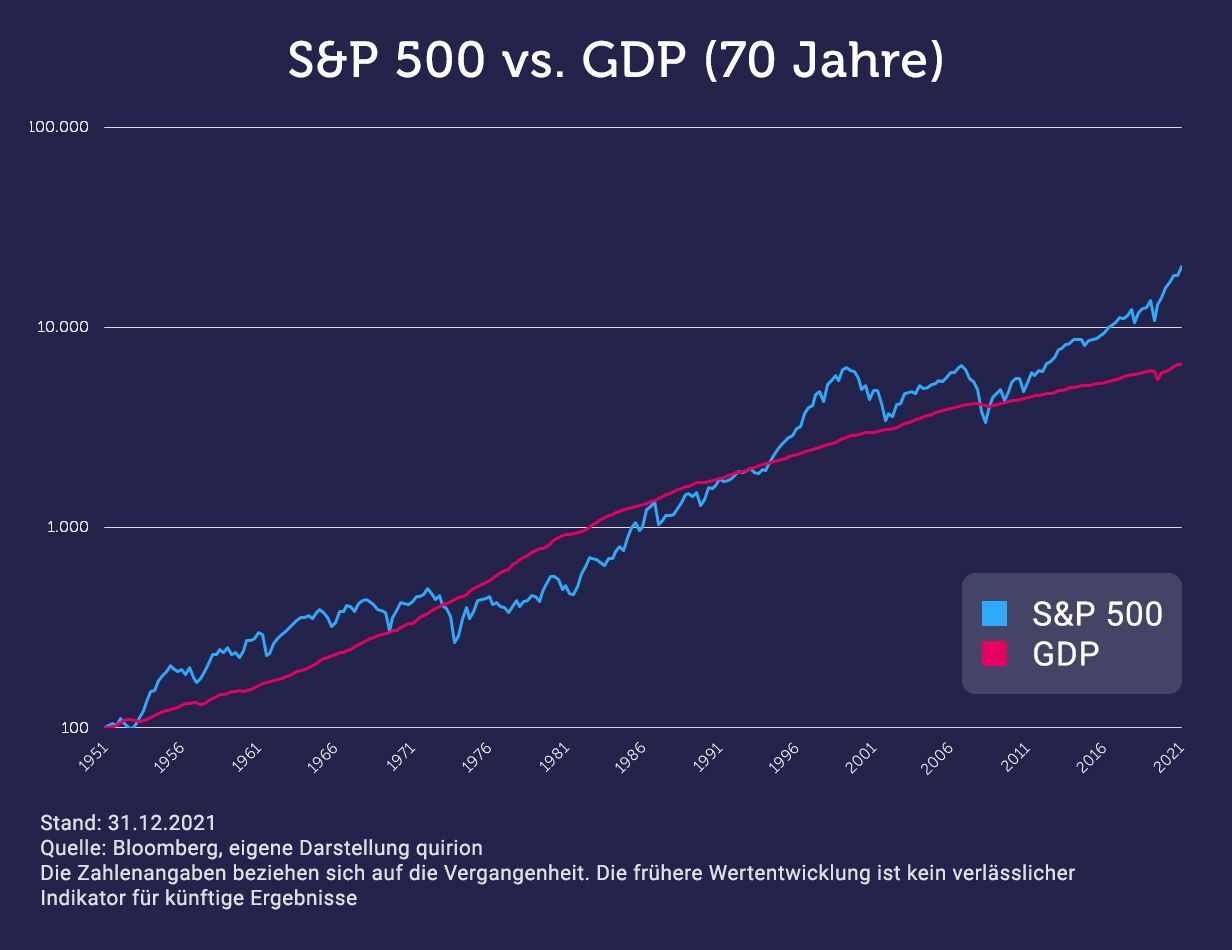
"Over the long term and on average, the stock market mirrors economic developments - but only in the sectors that are strongly represented on the market," the economist emphasises. In Germany alone there are around 3.4 million companies, and only very few of them go public. "In Europe especially, entire branches of the economy are barely represented on the stock market." That applies, for example, to the restaurant and hospitality sector, which has suffered particularly badly under the coronavirus pandemic in recent years. Meanwhile, prices on the stock markets climbed to new record highs. "That sometimes gives one person or another the impression that there is a party going on in the market while the economy is actually doing badly." But the stock market does not represent the entire economy.
Invest for the long term and broadly diversified
And there is more: indicators of economic strength such as gross domestic product show the economic situation in the rear-view mirror. "The market, however, asks what things will look like tomorrow or the day after," Dobbert observes. There is correspondingly strong interest in what are known as leading economic indicators, such as the purchasing managers' index in the US or the ifo Business Climate Index in Germany. The expectations built on these are fraught with uncertainty - much as companies' profit expectations are. What does all of this mean for investors? "Anyone who is invested for the long term and broadly diversified does not need to worry about short-term overshoots or undershoots in prices," Dobbert is certain. "Because over the long term and on average, the stock market has so far always risen."
More on quirion's market assessment can be found here.