Along with our regular rebalancing, we also swapped out some of the ETFs in our global portfolio. Together, these two measures keep your investment aligned with your profile over the long term and as efficient as possible.
With our global ETF portfolio, we at quirion pursue a steady-handed investment strategy. The combination and weighting of the various investment products is designed to strike the best possible long-term balance between return potential and risk. The particular investment mix should be tailored to each investor's personal risk profile. But to keep both of these on track, we have to fine-tune one thing or another from time to time.
Simply because prices are constantly fluctuating, the weightings within portfolios shift over time. Some prices rise more strongly than others, while others fall. Correcting for these fluctuations, known as rebalancing, returns the portfolio to its intended starting position.
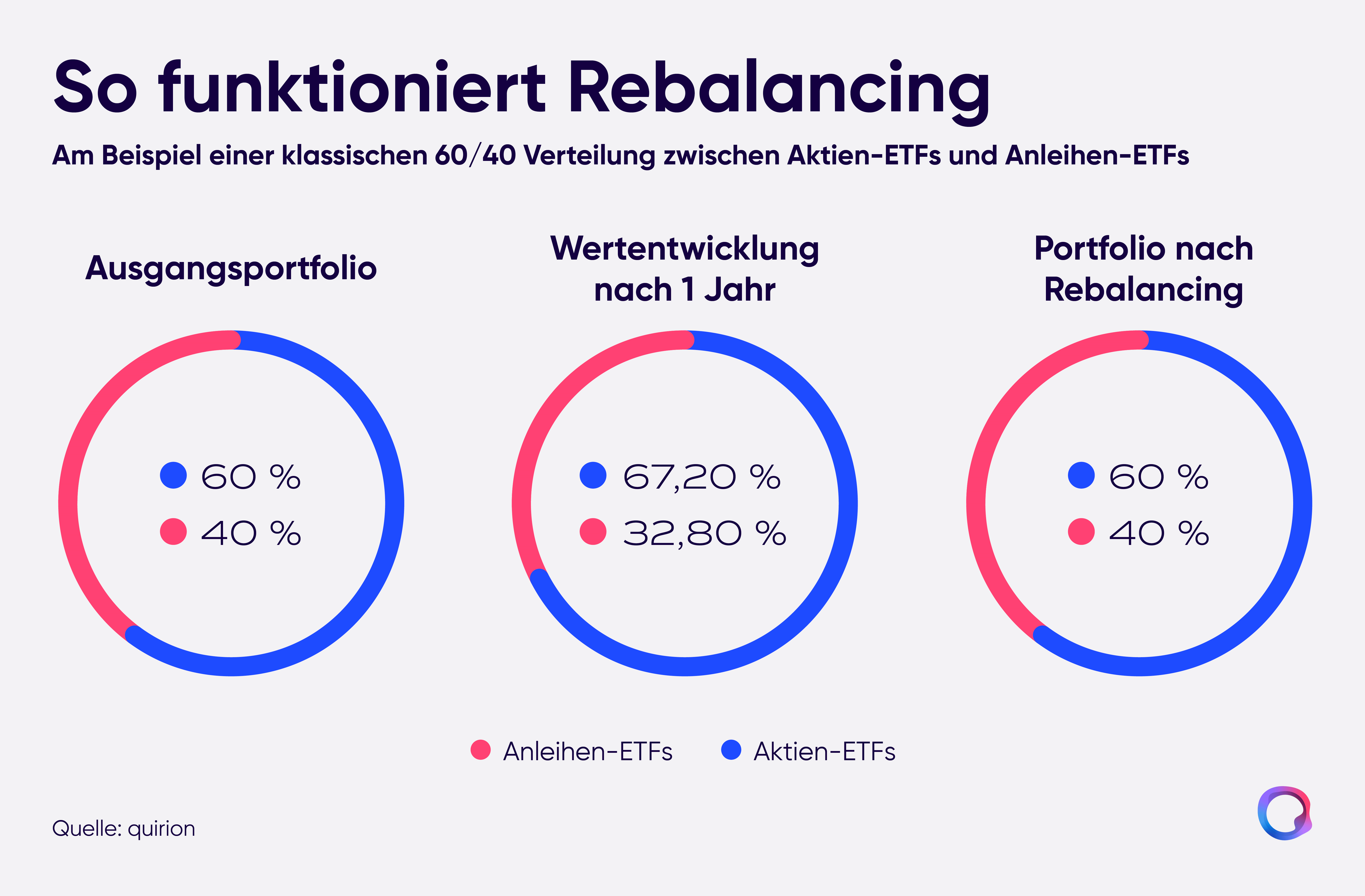
In doing so, quirion looks not only at the ratio of equities to bonds; every single position is examined closely and adjusted where necessary. If positions have grown too large through price gains, shares are sold. Others are topped up. „The investment mix should match the intended risk profile precisely,“ explains Kai Hattwich, Lead Portfolio Manager at Quirin Privatbank and at quirion. „With rebalancing, we make sure it stays that way.“ When securities have risen especially sharply, he adds, they are also especially prone to setbacks. „If their weight in the portfolio then becomes disproportionately large, that can have painful consequences.“
Greater efficiency
In early November, as part of the rebalancing, we also adjusted the portfolio's line-up somewhat. In the developed-markets segment, for example, we sold the Xtrackers MSCI World Minimum Volatility. In its place, we increased our holdings in the SPDR MSCI World, the iShares MSCI World Small Cap and the Xtrackers MSCI World Value. „In the current capital-market environment, this lets us cover the five return factors that matter to us even more efficiently,“ explains Hattwich.
Among emerging-market equities, the SPDR MSCI Emerging Markets Small Cap replaces the iShares MSCI EM Small Cap. „The newly added ETF has a slightly lower total expense ratio, and it also tracks the underlying index even more closely,“ Hattwich notes. A total expense ratio that is 0.19% cheaper may not seem like much. „But especially in long-term investing, even small differences can have a noticeable effect on the outcome.“
Keeping an eye on real costs
There has been some movement in the bond portfolio as well. Instead of the iShares Global Aggregate Bond EUR-hedged, we now use the SPDR Bloomberg Global Aggregate Bond EUR-hedged. In terms of the total expense ratio (TER), there is no difference between the two. But this figure does not capture the „real costs.“ Those include, for instance, any deviations in performance from the underlying index. The SPDR product tracks its index more closely.
After these adjustments, the bond portfolio's duration remains at a low level, at just over 3 years. Duration says something about how long capital is tied up, and therefore about the average remaining term within the portfolio. „We still feel very comfortable with our target figure,“ Hattwich emphasizes. „A longer duration would increase risk without promising an adequate return.“ A shorter one would too severely limit the range of the bond market available for investment.
Diversification—that is, broad spreading—plays an essential role in quirion's investment strategy, for both equities and bonds. Bonds are used first and foremost to make investing in equities possible even for those for whom a pure equity portfolio would not be suitable. Their comparatively low price fluctuations make bonds a reliable stabilizer over the long term. „With the latest adjustments, the global portfolio is optimally positioned on both the equity and the bond side,“ Hattwich is convinced. „And after the rebalancing, all strategies are back on their intended course.“