Many investors attach great importance to dividends. But as a criterion for selecting stocks, the payouts companies make are not particularly useful. Here's why that is, and what role dividends play in quirion's portfolios.
"Cash windfall for shareholders," "The best dividend stocks," "Passive income through dividends": headlines like these regularly peak in Germany between March and May. That's when annual general meetings once again decide on the size of the payouts from the profits of the past financial year.
According to a study by the German Association for the Protection of Securities Holders (DSW) and the Institute for Strategic Finance (isf), German public companies will distribute around €75 billion to shareholders this year. It would be a new record. Worldwide, the investment firm Janus Henderson expects payouts of 1.64 trillion US dollars in 2023, likewise a record.
Big numbers always attract attention. And a dividend is "cold hard cash" – unlike the prospect of price gains. But to conclude from this that you merely have to bet on companies with strong dividends and can thereby quickly book a safe investment return is a fallacy.
Beware of thinking errors
It's true that there are individual companies that have paid regular dividends for decades. But hoping for a "passive income" is highly speculative. There is no obligation to pay dividends at all, let alone at a certain level. The size of the payouts often fluctuates sharply. The success of an investment on the stock market depends crucially on price performance – and that applies to "dividend stocks" too.
The dividend doesn't simply come "on top" of hoped-for price gains. Around the payout date, the share price usually falls by roughly the amount of the dividend. After all, the value of the company drops as well. What's more, the size of the dividend doesn't reveal much about earnings potential – it only reflects the past. Growth stocks and young companies in particular prefer to invest their profits back into the business rather than pay them out.
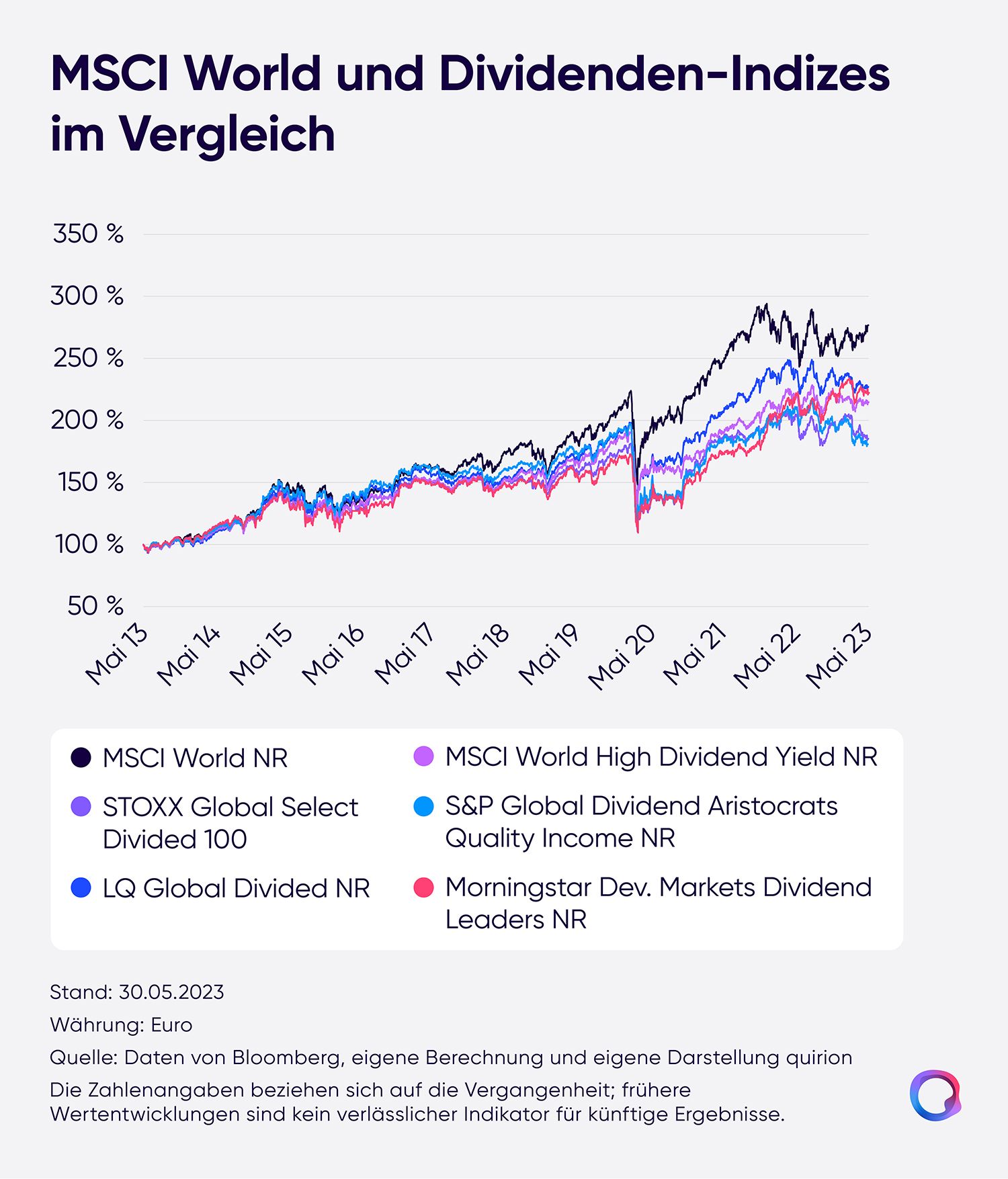
The dividend yield – the ratio of the dividend to the share price – is also no sign of a company's earnings or price prospects. This figure doesn't only rise when the dividend increases. It also rises when the share price falls sharply while the dividend stays the same. In any case, if you compare the performance of broadly diversified indices with those that focus on high dividend yields, the result is clear: diversification does more for long-term investment success than dividend strategies.
Dividends at quirion
Among the more than 8,000 stocks in which quirion's global ETF portfolio gives investors a stake, there are many with high payouts. That is an effect of the especially broad diversification. As a selection criterion, however, dividends or dividend yields play no role at quirion. The investment strategists rely on the findings of capital market research. From numerous scientific and empirical studies, five relevant return factors can be derived. Dividends are not among them.
When companies in quirion's global ETF portfolio pay dividends, investors benefit in one of two ways. That's because quirion's portfolios contain both accumulating and distributing ETFs. Accumulating ETFs reinvest dividends immediately into their own holdings. This increases the value of the ETF. If ETFs distribute dividends instead, quirion automatically invests these earnings in the chosen strategy, following the principle of rebalancing: underweighted positions are topped up.
Betting on rising prices over the long term and reducing risk with the broadest possible diversification – that's how you build wealth systematically. If, beyond this investment goal, you want to keep money available yet still collect regular interest: our clearing account now offers 2.75 percent (as of 07/06/2023) annual interest.