In December, the European Central Bank (ECB) cut key interest rates for the fourth time this year. Even so, the interest rate level is still quite high. How key interest rates influence inflation, the economy and the markets.
More or less interest on overnight deposits, a brake or a boost for the economy and prices: changes in key interest rates can have numerous effects. But their influence is not as immediate as you might think.
In focus: inflation
The ECB wants to keep the price level at around 2 percent over the medium term. And in October, inflation in the eurozone stood at pretty much exactly 2 percent. Two years earlier it had still been 10.6 percent. Through massive interest rate increases, the ECB tried to curb inflation lastingly. Mission accomplished, then? "We cannot be entirely sure about that yet," explains Philipp Dobbert, Chief Economist at quirion and Quirin Privatbank. "That will only be decided in the coming months."
The background: the ECB cannot influence prices directly. With its instruments, above all the key interest rates, it tries indirectly to slow down or stimulate overall demand. The reasoning: with higher interest rates, it is less attractive to finance consumption on credit, to build, to buy new machinery or to expand. If demand falls, prices usually fall too. With lower interest rates, by contrast, households and companies are more inclined to turn to loans, an incentive for more demand.
A delayed effect
Economic relationships, however, are not as reliable and inevitable as the laws of physics. You never know exactly whether and when households and companies will adjust their behaviour and how this will show up in prices. "The most important thing is that the expectation of rising prices must not become entrenched. Otherwise inflation becomes entrenched," Dobbert emphasises.
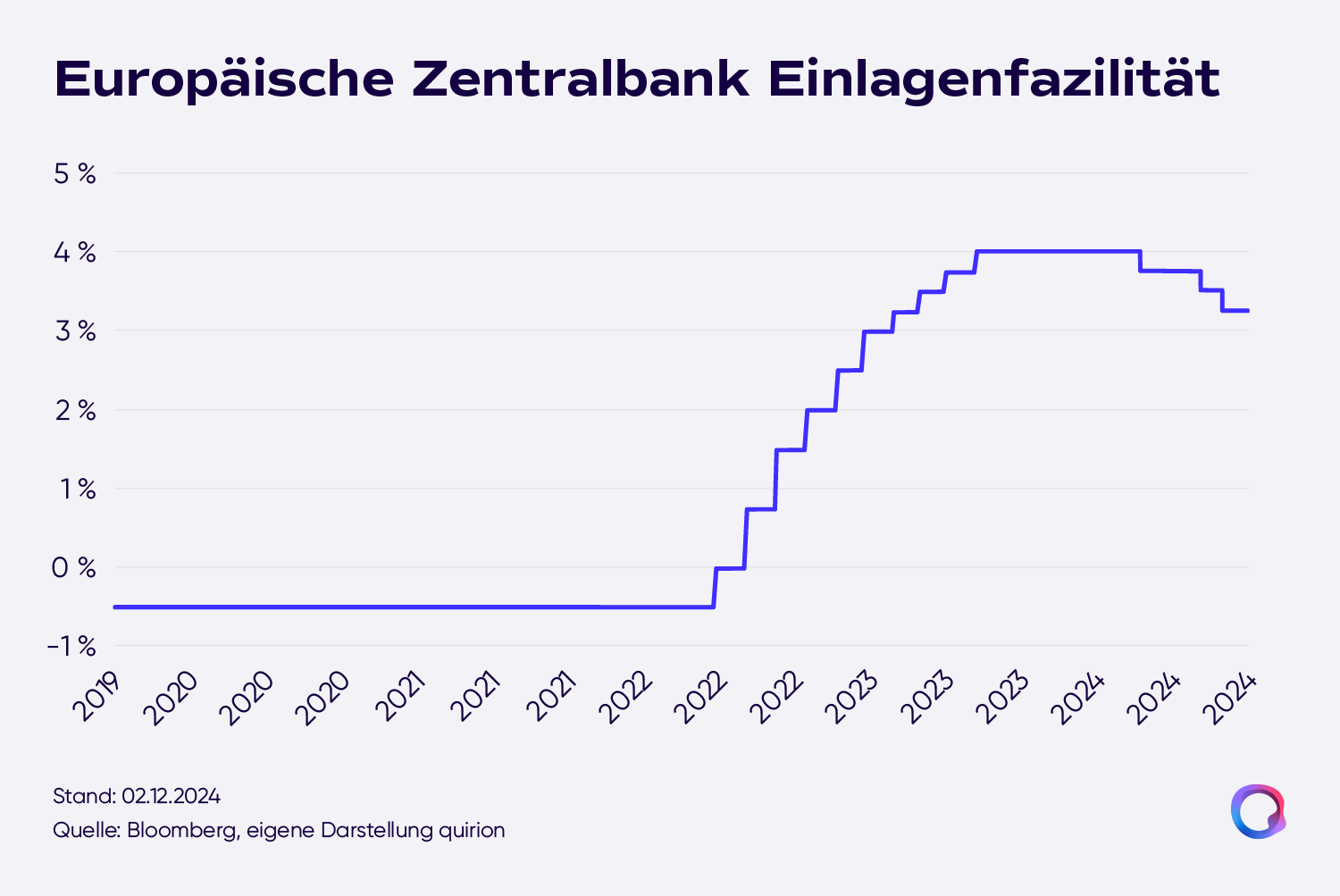
In October 2023, eurozone inflation had a 2 in front of the decimal point again for the first time. Then, in June, the ECB began cutting interest rates once more. It does want to prevent inflation from flaring up again. But step by step it is thereby easing its foot off the brake on economic development.
The money market: right up close
The first to be directly affected by key interest rates are the banks. For them, the terms for parking money overnight at the ECB change (the "deposit facility rate"). Key interest rate steps show up especially quickly in the money market, where banks obtain money short-term or invest surplus funds.
Savings and lending rates: the banks decide
Key interest rates set a framework for savings and lending rates. In their business policy, however, banks are free to decide whether to pass individual rate decisions on to customers. As a rule, they do not fully exploit what would be possible, particularly with savings rates.
One example: according to a study by the consumer portal Verivox, in mid-July supraregional banks were paying on average just 1.69 percent annual interest on overnight deposits. At savings banks, the average interest rates were even as low as 0.62 percent per year. The ECB's deposit rate stood at 3.75 percent at that time.
If you want to benefit from the currently still high interest rate level: a clever alternative to overnight deposits is quirion Cash-Invest. This portfolio combines ETFs on various segments of the money market.
A guide for bonds
When new bonds come onto the market, their interest rates are usually based on the interest rate level prevailing at the time. This is all the more true the shorter the maturities are. A rising interest rate environment usually pushes down the prices of older bonds, which then become less attractive. A falling interest rate environment, on the other hand, tends to give bond prices a boost.
Here too, though, the same applies: relationships like these are not set in stone. Interest rate expectations also play an important role for bond prices. These, in turn, are shaped not only by interest rate decisions or statements from central banks, but also by inflation and economic data.
For shares, one factor among many
For the stock markets, changes in key interest rates are only one of a great many factors that can influence how prices develop. If interest rate decisions turn out as expected, not much usually happens. If, on the other hand, the markets are surprised, prices move more sharply too. And beforehand it is never clear in which direction, because there is always room for interpretation. "If, for example, a rate cut turns out bigger than expected, you can read that as a positive or a negative signal," Dobbert explains. "A large rate cut makes financing easier. But it can also be seen as a warning signal that the central bank sees greater dangers for the economy."
How prices will develop can never be estimated precisely in advance. In your investment strategy, you should therefore not get drawn into speculation in the first place, not even about how interest rates will develop. "It is better to keep your investment strategy free of forecasts and to spread the invested money as broadly as possible," Dobbert emphasises. "This principle makes sense in any interest rate environment."