In Germany, the DAX is the most popular stock market barometer. Some people even equate the performance of this index with the development of investments in the stock market in general. Why that is misleading, and how stock market trends show up in the global portfolio.
Up around fifteen percent: from January to mid-May, the DAX put in a remarkable performance. The fact that Germany's leading index even outpaced the US S&P 500 and the MSCI World attracted a lot of attention. That is because the DAX has a special symbolic power in Germany. For many people it is, in their minds, a "benchmark" against which the appeal of stock market investments is measured in general terms.
But beware of hasty comparisons and conclusions. They quickly lead you astray. A time horizon of four months is very short for a stock market investment. What counts for building wealth systematically are longer investment horizons. And over those, the comparison already looks quite different.
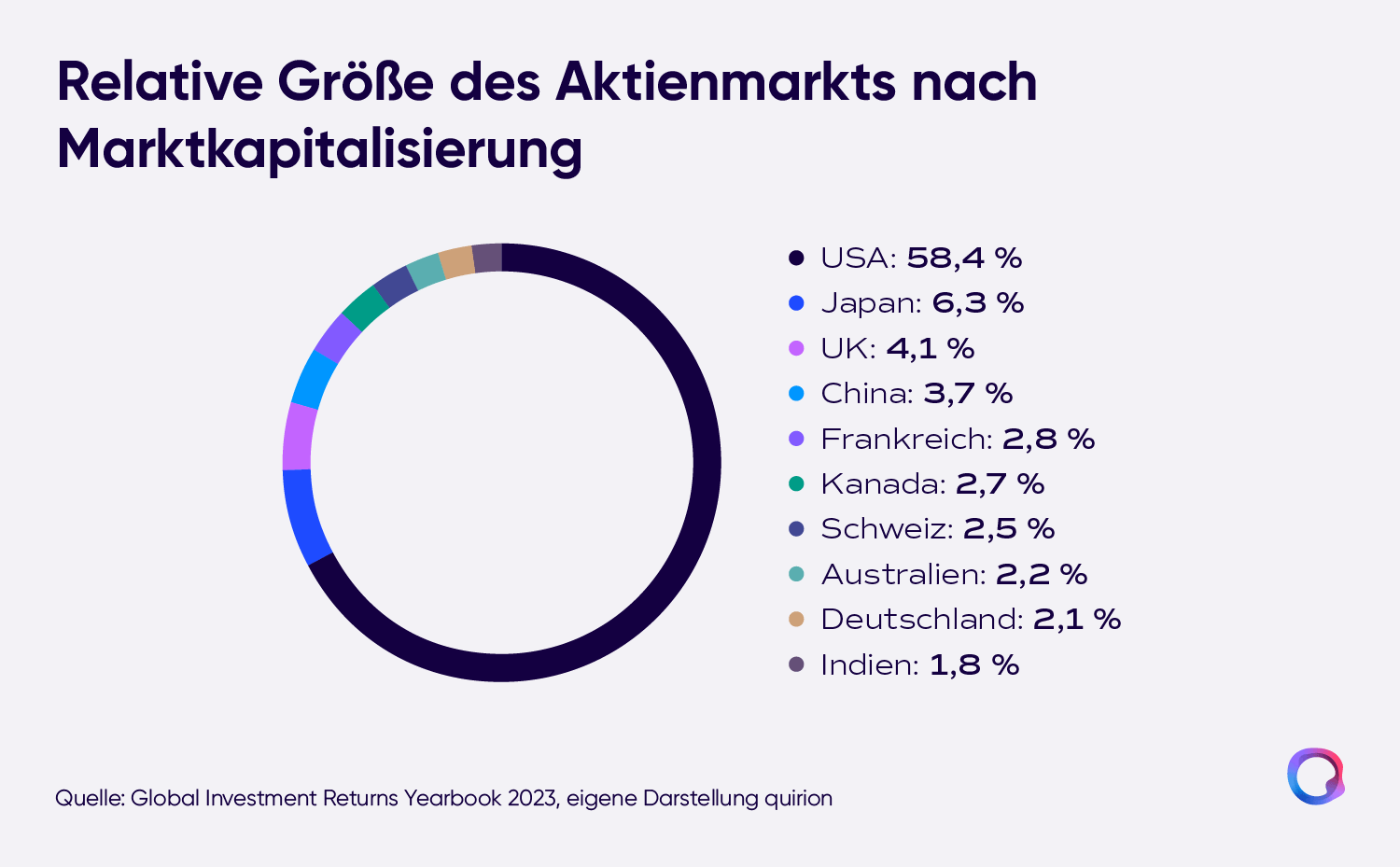
What is more, a stock market investment and the performance of the DAX are not necessarily closely linked. On a global scale, at any rate, the German stock market does not carry all that much weight. That is shown by an analysis from Credit Suisse and the London Business School. According to it, the US market far outshines all the others. Germany, behind Switzerland and Australia, ranks 9th with a share of the global stock market of only around 2 percent.
According to Deutsche Börse, the DAX represents around 80 percent of the market capitalisation of listed stock corporations in Germany. But it comprises only 40 companies from a single country. If you limited your investment to an ETF tracking this index, the risk diversification would therefore be very low. The MSCI World, for example, contains around 1,500 shares from 23 countries.
The thing about the crystal ball
A single share can, for a time, perform better than a stock exchange's leading index, and that index, in turn, better than an internationally positioned one. If you knew exactly when and for how long individual shares or markets would move, investment strategists could tailor portfolios to that precisely. But no one knows the future. And hindsight makes everyone wiser: which mix of shares would have been "optimal" over a given period can only ever be recognised after the fact. Trying to determine that in advance usually goes wrong.
Many years of capital market research teach us: the lower the diversification, the riskier the investment. A company can go bankrupt, an industry or region can lose economic strength. The aim of a global portfolio is to keep the effects of such risks as small as possible. The MSCI World already does this considerably better than the DAX. But to optimise the balance between return and risk, we at quirion go a few steps further still.
Smoothing out price fluctuations
The global portfolio comprises around 8,000 shares from more than 70 countries. The German stock market has a weight of around two percent, which, measured by market capitalisation, corresponds to its importance in the "global stock market". Unlike in the MSCI World, small companies and shares from emerging markets are also included. In addition, nine out of ten variants of the global portfolio contain bonds. Over the long term, these provide extra cushioning against price fluctuations in the stock markets.
Because of the broad positioning, the movements of individual shares or indices are not reflected one to one in the portfolio's performance. Smoothing out their price swings is the whole point of diversification. Even if that also means that individual indices sometimes perform better for a while: we do not leave investment success to a "lucky hand". We prefer to entrust it to a scientifically sound, long-term investment strategy.