Getting rich quickly on the stock market: many a person dreams of it. Most, however, doubt whether they can even entrust their money to the equity markets. We explain how to use the markets systematically to build wealth over the long term.
A few weeks ago, Allianz’s new Global Wealth Report was published. According to it, Germany ranks 18th in terms of net financial assets per capita. That’s not exactly impressive. Germans are far from exhausting their potential for wealth growth.
In any case, things work quite differently for the front-runner, the USA. There, far more people invest their savings straight away in order to build wealth. In doing so, they let the capital markets help them in particular. And with success: over the past 20 years, increases in value there contributed an average of 62.4 percent per year to the growth in wealth. In Western Europe it was only 34.2 percent. In Germany especially, the study says, wealth growth over the long term was “almost exclusively driven by savings efforts”. Not spending the money you’ve earned: wealth can grow that way, too. But it simply grows more slowly.
Approaching the matter properly
When Germans do invest money, they prefer classic interest-bearing products over securities. Many still associate stocks in particular with an unpredictable up and down of prices. People don’t quite trust the markets, and prefer to leave the field to “gamblers” or to those who already have a larger fortune.
Building a fortune with stocks: can that really work? “Of course,” says Arndt Kussmann, Head of Investment Communication & Analysis at quirion and Quirin Privatbank. “As long as you approach the matter properly – that is, with a long-term orientation and systematically.”
Systematically doesn’t mean what you might perhaps assume – namely, deliberately picking individual stocks. “That really would be gambling,” Kussmann notes. “Some stocks are always rising, but you never know in advance which ones, by how much, or for how long.” The attempt to make a fortune with the supposedly “right” stocks has already cost many a person a fortune. “It’s better not to waste time on picking, to swim with the market and to spread your investments as broadly as possible.”
“Tapping into” economic growth
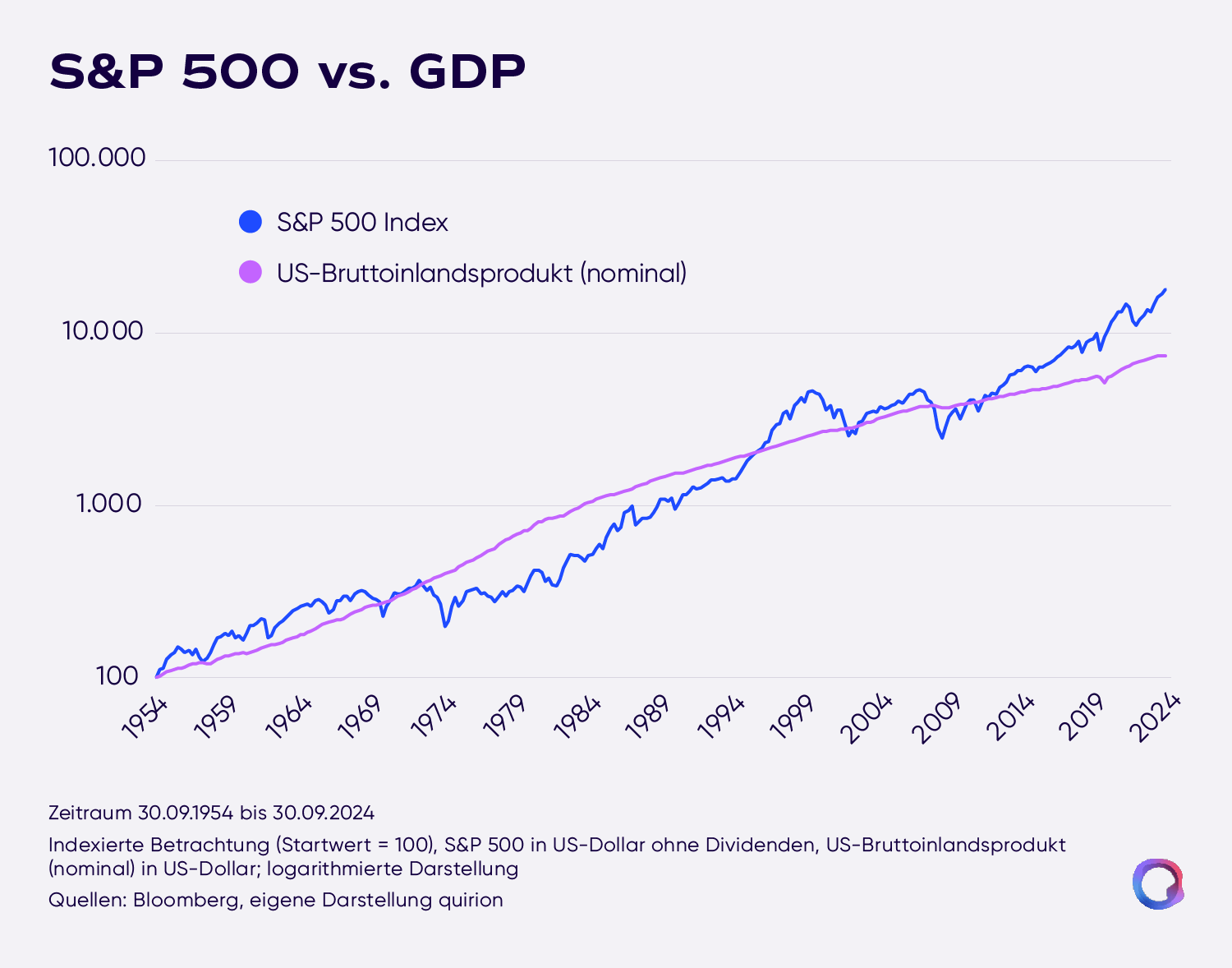
With a broadly diversified equity investment, you avoid the risk of backing the wrong horse – while still benefiting from a special feature that makes the equity asset class a source of attractive return opportunities: stocks allow you to participate in companies and thus in the economy. And the economy, in turn, is geared towards growth over the long term. “Stocks are productive capital,” Kussmann emphasises. “So with a well-diversified equity portfolio, you’re tapping into economic growth, in a sense.”
Keeping your own risk profile in mind
quirion’s global ETF portfolio shows how diversification can shape the balance between return opportunities and risks in the best possible way. It is diversified according to scientific criteria. Through ETFs, it allows you to participate in around 8,000 stocks from over 70 countries.
Despite broad diversification, however, a one-hundred-percent equity investment isn’t suitable for everyone. Because investing in the equity markets takes time. It’s true that returns of seven to eight percent per year are realistic there over the long term. But those are average figures. “In some years things go up more strongly, in others they go down,” Kussmann stresses. “That’s why it’s important to be invested for the long term – with a pure equity investment, at least five years.”
The question, then, is whether the sometimes sharp fluctuations in prices don’t bother you. “For long-term investment success, it’s very important to stay invested with discipline, even when things take a sharper downturn,” Kussmann notes. “Emotionally, though, that isn’t always easy.” Depending on your individual investment horizon and personal appetite for risk, quirion therefore adds bonds to the mix. “That cushions the price fluctuations of the equity portions in the portfolio, at least in part.”
This way, even those for whom a pure equity investment wouldn’t be the right choice can benefit from the return opportunities of the equity markets – conveniently, as part of a digital asset-management service where you don’t have to worry about a thing. And that’s possible, for example, through a savings plan too, with monthly instalments starting from just €25.