The gap between earned income and the state pension keeps widening. On top of that, the cost of living is rising. Here is what you can do to secure your standard of living in retirement.
The foundations of the state pension are shaking badly. And the situation is likely to get even worse. In 1962, in West Germany, every state retirement pension was supported by six actively insured contributors who paid in. Today there are two, and the trend is still downward. The gap in the system keeps growing. The state is contributing more and more money from tax revenue. According to the federal government's draft budget, the federal transfers to the state pension insurance scheme are set to grow by more than five billion euros again next year, bringing them to around 128 billion euros.
Figures like these sound abstract at first. But they matter a great deal for personal financial planning, especially for young people. Demographic change is the reason why the gap between income and pensions keeps growing too. At present the pension level in Germany stands at 48 percent. That means: the pension of an average earner who has paid contributions for 45 years is about half as high as the current average income.
Take taxes and inflation into account
How much retirement income you will have depends on many individual factors. If you want to know where you stand with the state pension, it helps to look at the annual pension statement. Everyone who is at least 27 years old and has paid contributions for at least five years receives one.
That said, the figures should be treated with a certain amount of caution. They are based on assumptions that can change. On top of that, you have to mentally deduct quite a bit from the amount. As a rule, there are contributions for health and long-term care insurance. And above all, taxes. What percentage of the state pension is taxed depends on the year your pension starts. This year it is already at 83.5 percent. The proportion will rise to 100 percent by 2058.
On top of that: inflation eats away considerably at the value of the amount paid out. Suppose that after all deductions you are likely to be left with a respectable 3,000 euros a month. With inflation of 2.0 percent a year, the purchasing power of this amount will, on paper, be only 1,656 euros in 30 years' time.
Make the most of compound interest
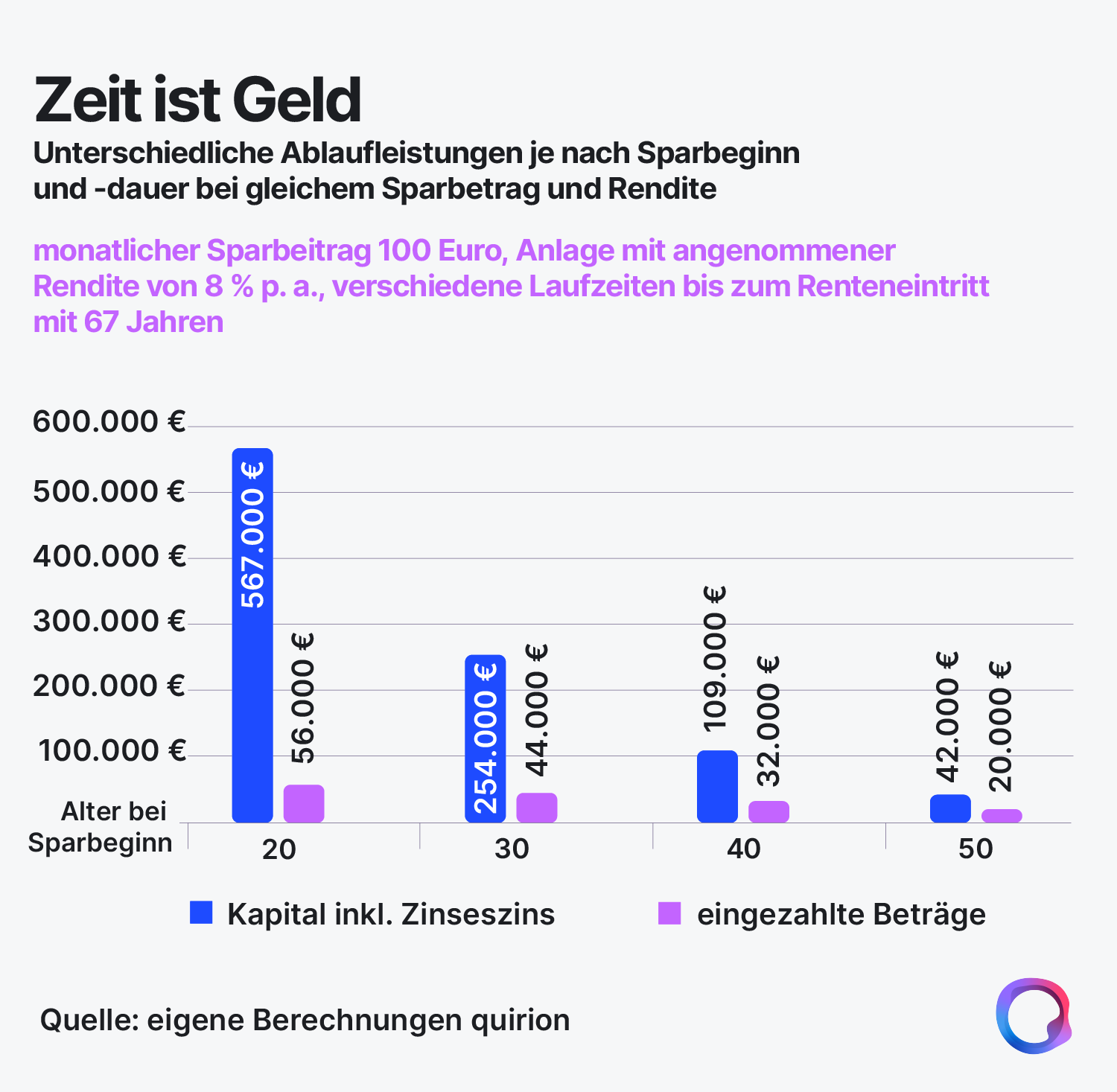
Those most affected by the impact of demographic change on the pension funds are precisely the people whose retirement is still a long way off. Yet the longer it is until retirement, the greater the chance of closing the gap. If you make use of the capital markets, you can build up considerable wealth over the long term thanks to compound interest. Worked examples show this.
Avoid unnecessary risks
If you want to make the most of the return opportunities of the capital markets, though, you need a sound investment strategy, especially when it comes to retirement provision. After all, with such an important investment goal you do not want to take any unnecessary risks. At quirion, we rely above all on broad diversification to optimise the balance between potential returns and risk. Our global ETF portfolio is diversified according to scientific criteria. It gives you a stake in around 8,000 shares from more than 70 countries.
Depending on your personal risk profile, we also add bonds. This can further cushion price fluctuations in the equity share of the portfolio. When it comes to retirement provision, we pursue a glide-path strategy: during the accumulation phase, potential returns take centre stage, so as to build up as much wealth as possible. Over time, the mix of shares and bonds is adjusted to keep stabilising the wealth you have built up, step by step, until you retire.
The first step, as they say, is usually the hardest. That is why we have made the hurdle for investing with our professional asset management very low: our savings plans are available from as little as 25 euros a month. Once a savings plan is set up, you do not have to worry about anything else yourself. We make sure the portfolio stays on track.
More about our retirement provision can be found here.