Bonds play a special role in our investment strategy. Here is how we use them and how our two bond modules are built.
Fixed interest instead of vague prospects of price gains, plus a reputation for far greater safety than shares: that is what makes bonds so appealing to many people. Not that all bonds are alike. This class of security is extremely varied. But it always comes down to debt capital, in other words lending money. Return and risk therefore depend above all on two factors: first, the maturity of the bond, and second, the credit quality, or creditworthiness, of the issuer. With bonds, the issuer is the borrower, meaning the institution (for example a government or a company) that issues the bond and undertakes to pay the investor interest and to repay the bond at the end of its term.
Shares give you a stake in companies. The potential returns and the risks are closely tied to how well those companies do commercially. Bonds follow a different logic: assuming the borrower is able to pay, they are repaid at the end of their term much like a loan. Both the risks and the returns you can expect are therefore lower than with shares.
Shares and bonds: what is the right mix?
If you invest money in the stock market, you can substantially reduce your risk through diversification. quirion's global portfolio gives you a stake, through ETFs, in around 8,000 shares from more than 70 countries. But a pure equity portfolio is not right for everyone.
"When it comes to investing, what matters is your individual investment horizon and your personal appetite for risk," explains Philipp Dobbert, Head of Asset Management at quirion and at Quirin Privatbank. And this is where bonds come in. Adding them lets you fine-tune the balance between potential returns and risk for different risk profiles. To do this, quirion uses two bond modules that each invest in different segments of the bond market through their own particular combination of ETFs.
Bonds as a risk buffer
One of the modules is designed to stabilise the respective equity share. It consists of around 80 percent government bonds with good to very good credit ratings, because these are usually far calmer than the stock market. "If the price of the ten-year German government bond rises or falls by one percent over the course of a day, that is already something out of the ordinary. With shares, movements like that are barely noticeable," Dobbert notes.
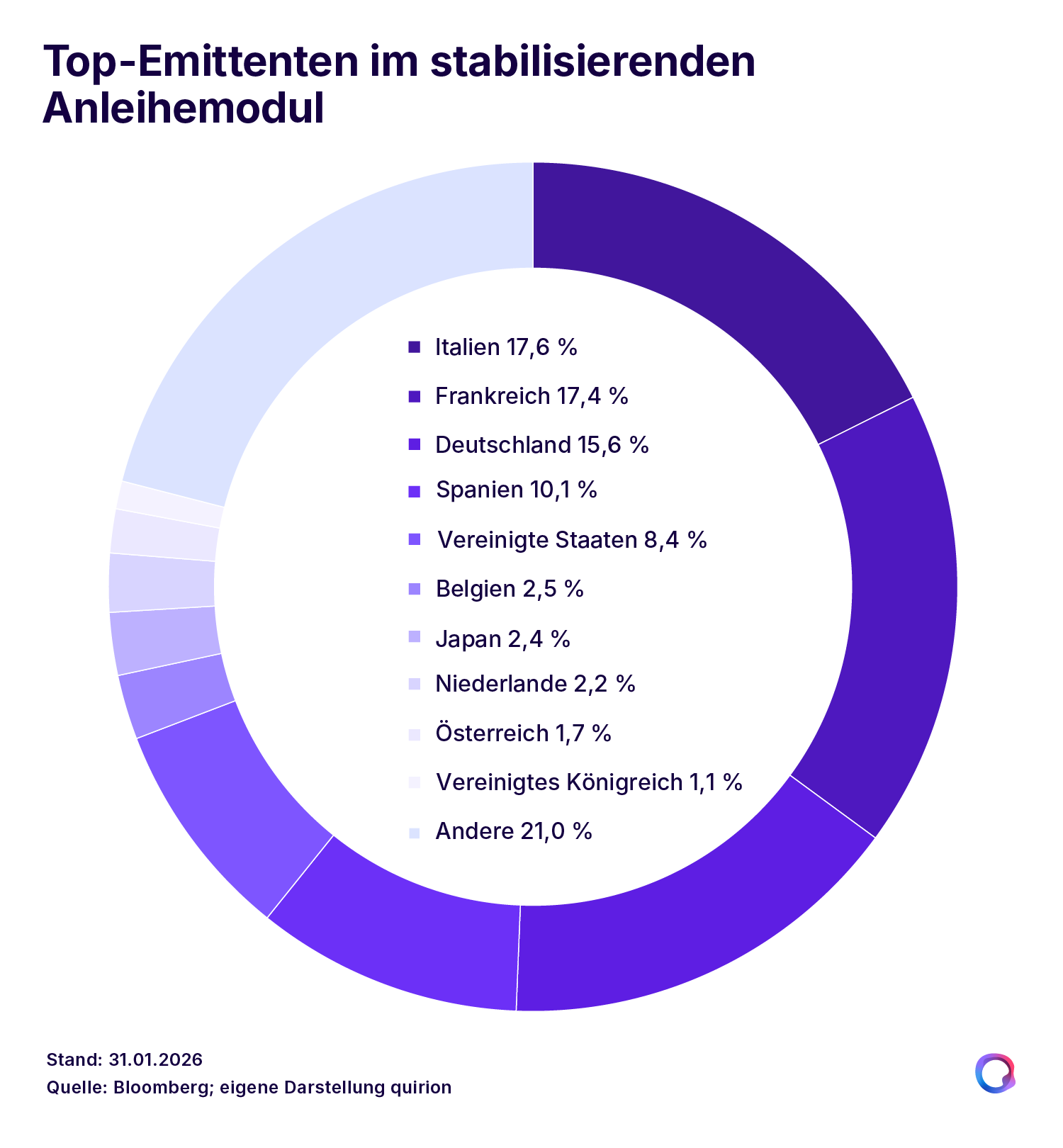
In the individual strategies, quirion adds only this bond building block whenever the equity allocation is between 90 and 50 percent. At an equity allocation of 40 to 10 percent, the share of the stabilising building block stays at the same level in each case. And on top of that, a second bond module then comes into play.
A complement for strategies with low equity allocations
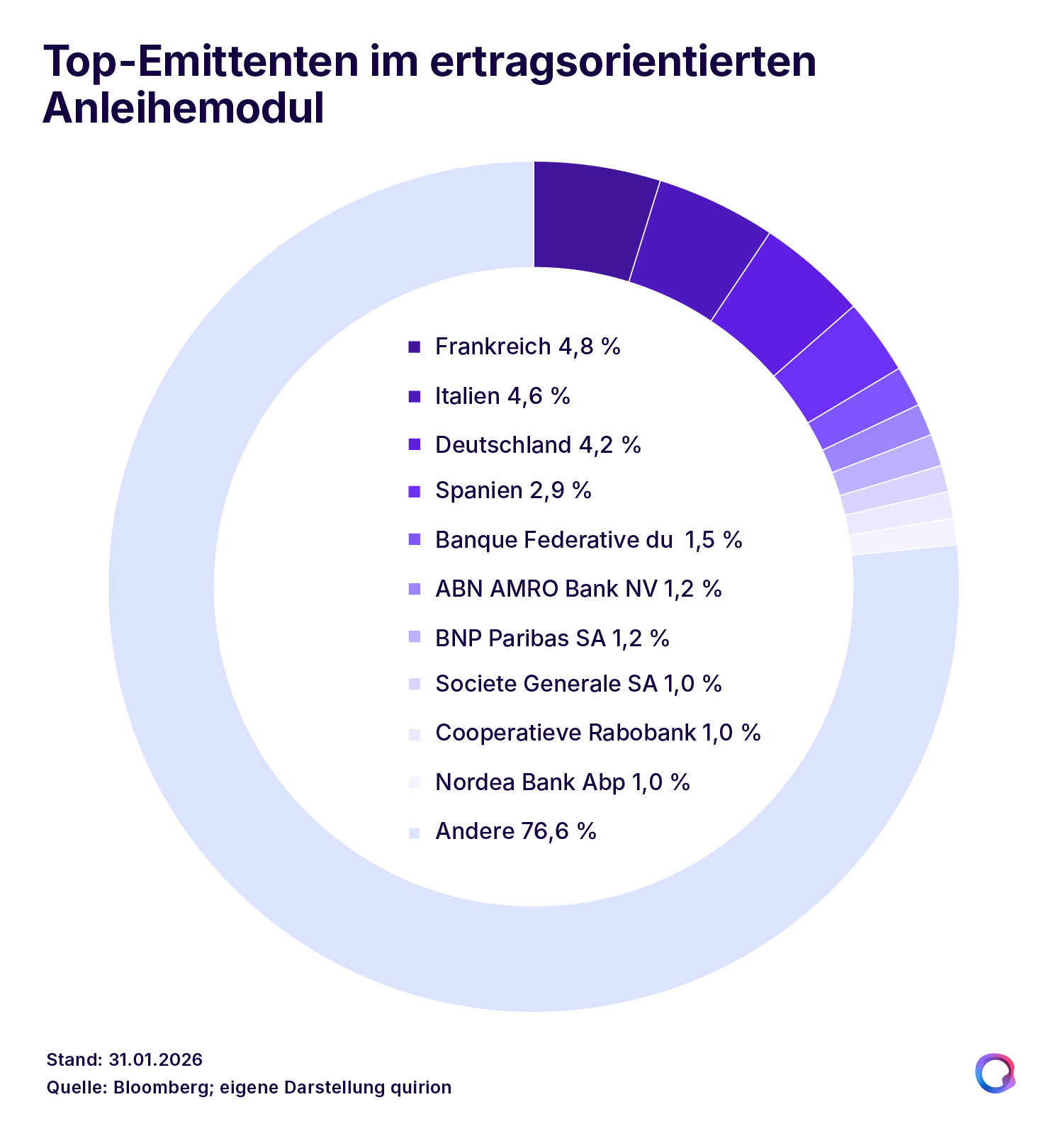
Alongside the stabilising bond building block, there is also an income-oriented one. At low equity allocations, it is added on top in steps of 20 percent. At a 40 percent equity share it is 20 percent, at a 30 percent equity allocation it is already 40 percent, and at 10 percent equity it is ultimately 80 percent.
In the income-oriented building block, corporate bonds make up 80 percent. Bonds from the financial sector are the main focus here, at more than 40 percent. The share of government bonds is only 20 percent. The logic behind this: "The lower the equity allocation, the less investors share in the value created in the economy," Dobbert notes. "The building block cannot fully compensate for that, but thanks to the high share of corporate bonds it brings additional sources of return into the portfolio." Even so, the key priority remains keeping risks low. "After all, we add this module to the more defensive strategies."
Avoiding currency risk with bonds
Both bond building blocks contain only ETFs on euro bonds or bonds that are hedged against currency movements. The reasoning: bonds usually fluctuate not only far less than shares, but also less than currencies. "Exchange-rate movements would partly undo the stabilising effect and bring additional risks into the portfolio," says Dobbert. That is why quirion pursues a different strategy for bonds than for shares.
At quirion, investors can even do without shares entirely. "But when investing in the global ETF portfolio, we advise adding at least a small equity share," Dobbert stresses. "Even if the equity share is small, it can significantly increase the potential returns, and thereby help you reach your own investment goals more efficiently."
Build wealth with quirion: find out more here.