“Passive” or “active”? That's a frequently asked question when it comes to fund investing. If you look at the relevant studies, the answer turns out to be quite clear.
More than €90 billion: European investors saved this sum from 2011 to the end of 2023 by investing in index funds instead of active funds. At least, that's how the Vanguard Investment Strategy Group (ISG) has calculated it. To do so, the ISG based its figures on the volume invested in each case as well as the respective expense ratios. And it hypothetically assumed that all the money would have flowed into active funds had index funds not existed.
Index funds represent a “passive” investment strategy. They track their index and thus a particular market or market segment as closely as possible. The concept has become known under the name ETFs (Exchange Traded Funds), though the two aren't quite identical. Because among ETFs there are now also some in which fund management “actively” selects securities – just as with classic funds.
One thing is clear: active fund management is expensive. And it's their low costs that have made passive ETFs so popular. How much investors have actually saved through their invention, however, is hard to put a number on. The savings effect was probably even greater than the ISG has now calculated. After all, passive ETFs set off a wave of competition that led to price pressure across the entire finance industry.
Expensive – but not very efficient
The costs of active funds, however, remain high. According to the Vanguard study, the average expense ratio of active funds in Europe was 1.05 percent at the end of 2023, while that of index funds was just 0.21 percent. Differences like these carry a lot of weight, especially over the long term. After all, costs eat into returns.
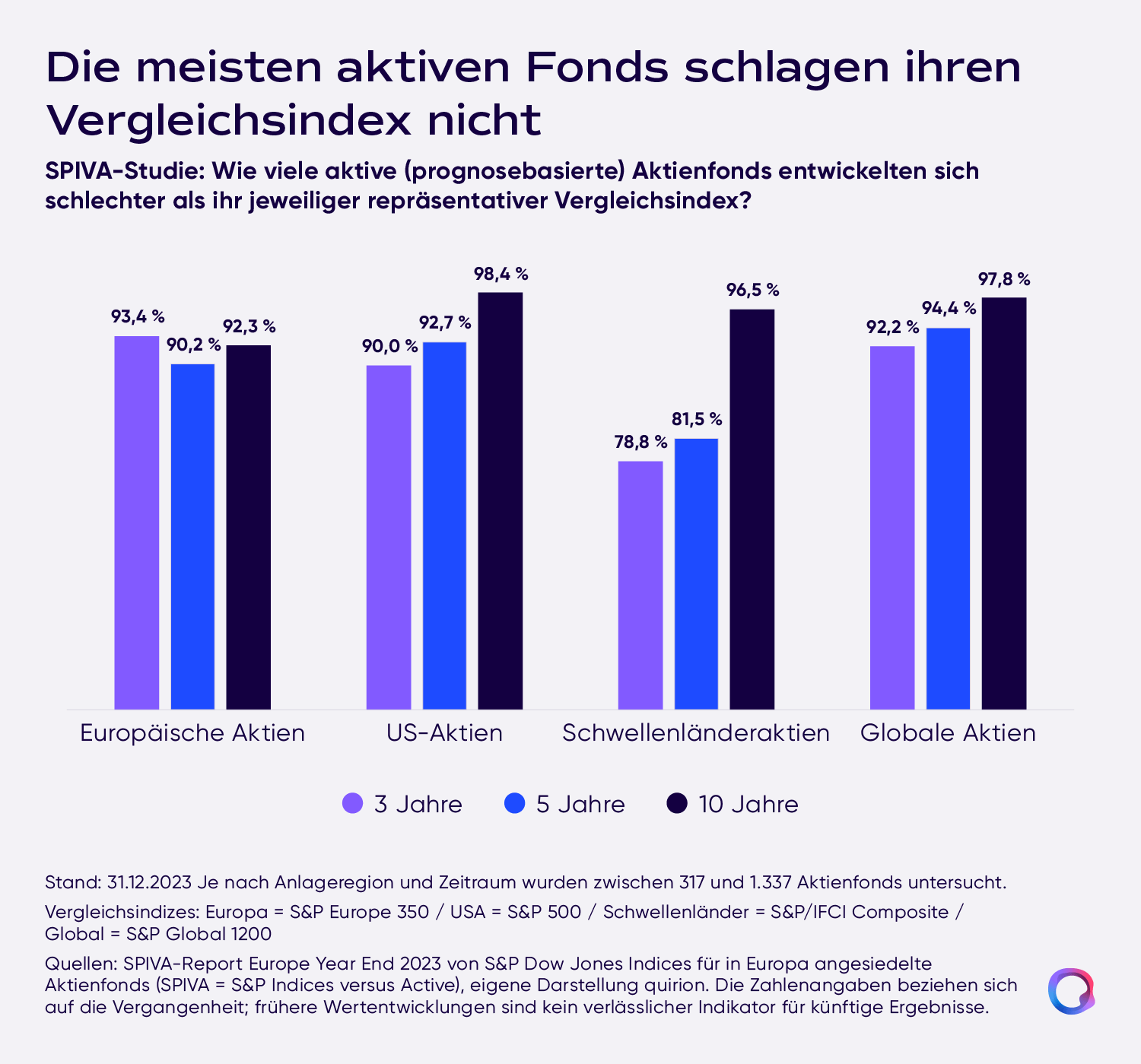
The higher costs of active funds are usually justified on the grounds that professionals, through their targeted selection of securities, can also achieve an outstanding investment result. Comparisons on this point, however, repeatedly raise considerable doubts. Take the SPIVA Europe, a study published in April by S&P Global. According to it, over a ten-year period, around 92 percent of active funds investing in European equities were unable to outperform a corresponding index – and among those investing globally, the figure was as high as around 98 percent.
The market can't be beaten (reliably)
The fundamental problem lies in the very approach of active strategies and their attempt to beat the market. This doesn't work consistently and reliably. This insight is backed up by findings from financial market research, which have proven it for many years now.
Whether it's a targeted selection of securities or the attempt to catch supposedly optimal entry and exit points: that can succeed by chance, but not systematically. Because no one can look into the future. Even someone who knows companies' balance sheets and outlooks in detail doesn't know exactly how their shares will perform in three weeks or three years. Many factors can influence this. But they don't have to. Perhaps last week a tech company's euphoric outlook triggered a jump in its share price. In the coming week, things may head in the other direction, because investors are now paying more attention to a solid financial position than to potentially strong earnings growth.
The path to an efficient ETF portfolio
Instead of betting on a specific selection, it is therefore wiser to trust the market. Because over the long term the market trends upward, since the economy as a whole is geared toward growth. Anyone who wants to make use of this should opt for the broadest possible diversification. You can do this efficiently, for example, with quirion's global ETF portfolio. Using a special combination of selected ETFs, the investment strategists optimize the balance between return opportunities and risks.
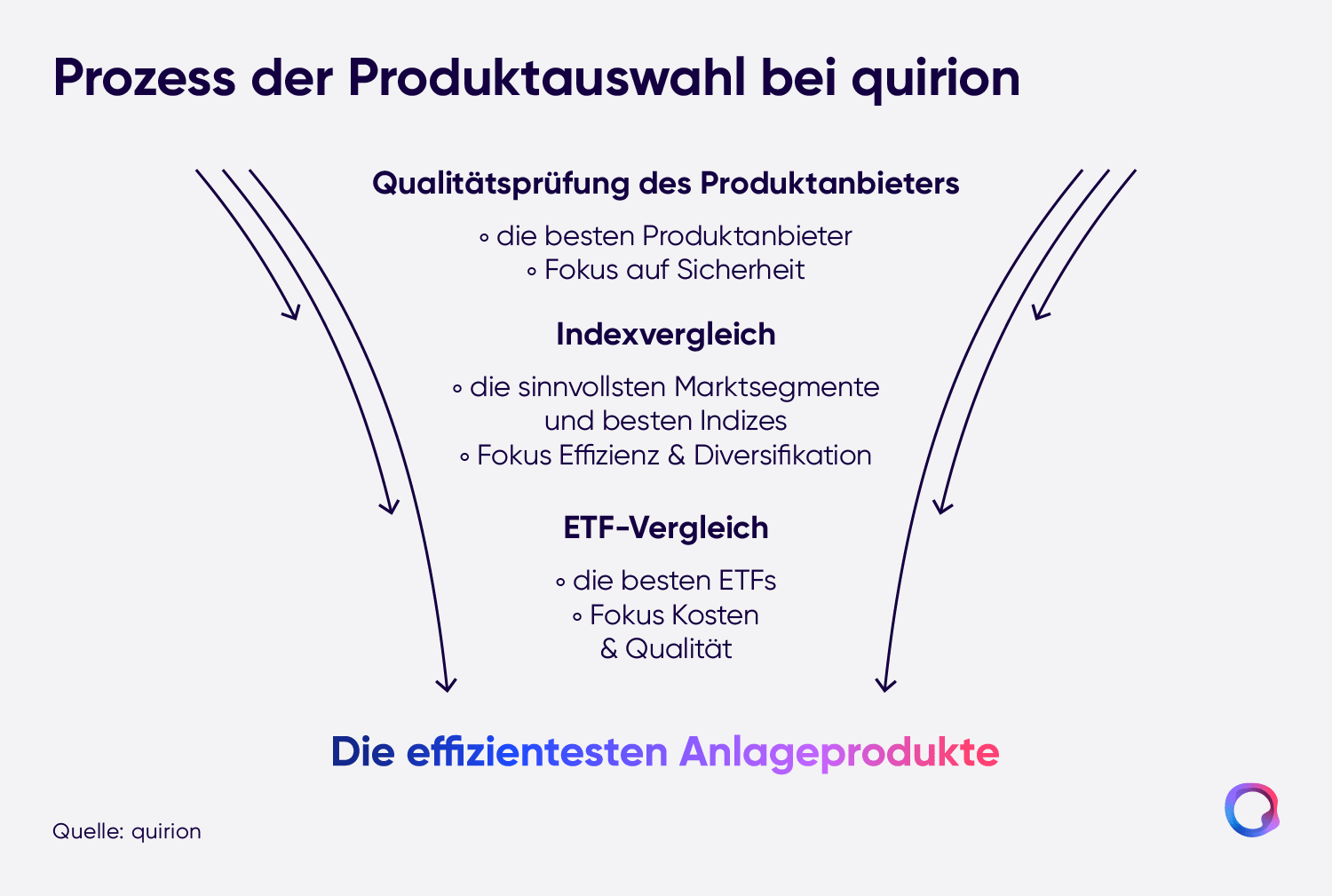
Before ETFs are included in the portfolios, they go through a strict filtering process. This ranges from a quality check of the product providers to the question of how precisely the ETFs track the underlying index. Even products on well-known stock indices sometimes differ considerably here. Choosing the best ETFs for your own investment goals and your own risk profile is therefore not so easy.
With quirion's global ETF portfolio, investors don't have to worry about a thing. Before investing, they simply answer a few easy questions, for instance about their investment horizon and their risk appetite. And right away they receive a proposal that suits their personal profile – along with the services of a professional, digital asset management based on a scientifically grounded investment strategy. Thanks to ETFs, the costs nevertheless remain manageable.