Forecasts do nothing for your investment strategy. Because things often turn out quite differently from how they were imagined in the annual outlooks. That was borne out again in 2025. A look back at five developments that simply couldn't have been foreseen.
1) The new rules in world trade
That a restrictive tariff policy was on US President Donald Trump's agenda was clear even before he took office. But what actually happened next was something hardly anyone had reckoned with. Tariff announcements that were at times absurdly high threw the whole world into fear and turmoil. New demands kept coming out of the White House, and it often remained unclear what was meant seriously and what was pure posturing.
Tariffs slow down world trade. They're positive neither for the economy nor for the markets. "New tariffs always mean losses of prosperity for everyone involved," emphasizes Philipp Dobbert, Chief Economist at quirion and at Quirin Privatbank. That said: "Donald Trump didn't invent tariffs." US import tariffs did in part rise as sharply as they hadn't since the 1930s. "But world trade is highly adaptable."
2) The resilience of the markets
After two exceptionally good years for equities, many had speculated at the end of 2024 that 2025 would see a sharper downturn. With Trump's tariff chaos and hectic market reactions, those fears seemed to be confirmed. But once again, things turned out differently than expected. "The exceptionally strong performance on many stock exchanges around the world is, to me, one of the biggest surprises of 2025," observes Dobbert. "In the first few months, it was above all the great uncertainty that led to nervousness. But then the markets demonstrated their resilience."
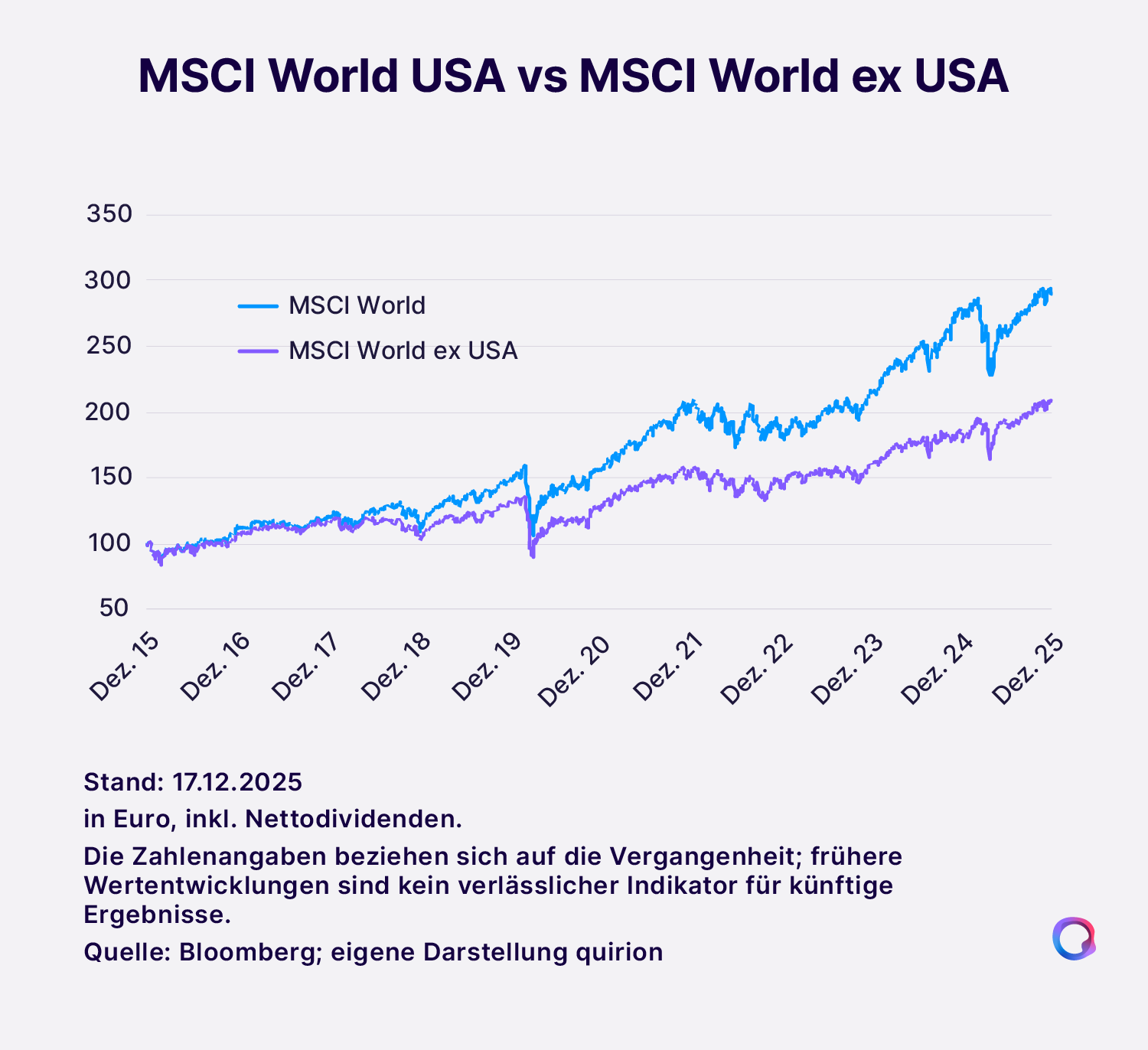
But it wasn't just prices that proved surprisingly robust. So did the economy of the world's largest economy – despite stubborn inflation and the uncertainty over Trump's political course. "In fact, most people had long since expected a pronounced weakness in the US economy," Dobbert explains.
Fed Chair Jerome Powell also demonstrated resilience. "It was remarkable, and very important, that the US central bank did not give in to the sharp criticism from the White House and preserved its independence."
3) The fly in the ointment: "dollar weakness"
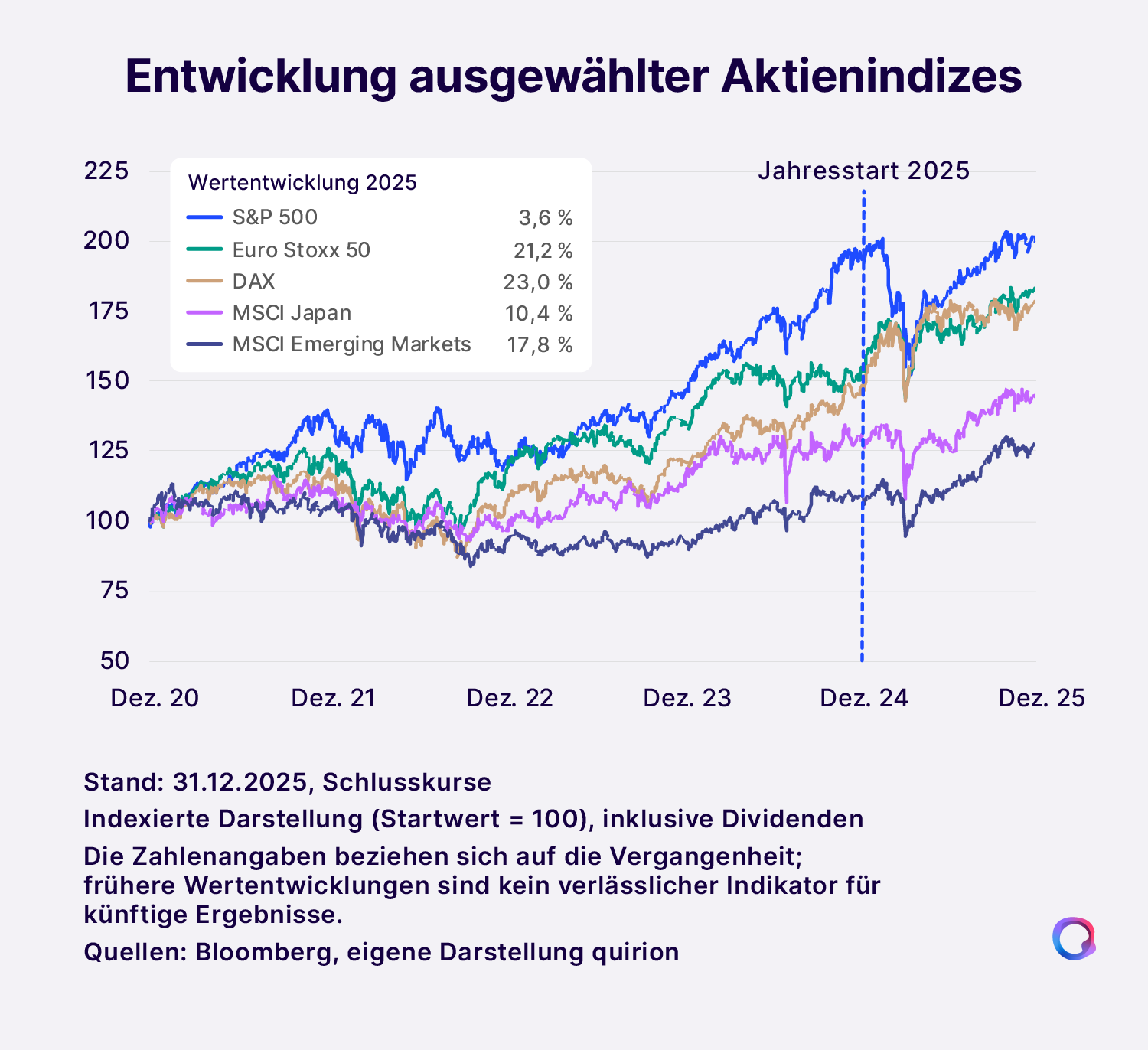
The strong upswing on the US market, however, wasn't quite so clearly reflected in the portfolios of investors in the eurozone. The reason is the weakness of the US dollar. "That the euro was undervalued against the dollar was something you could read off economic indicators some time ago," states Dobbert. "But the timing of the correction, of course, couldn't be foreseen." The speed and scale were surprising too.
Like other price movements, currency movements depend on numerous factors and cannot be reliably forecast. "That's why we don't hedge our equity portfolios against currency fluctuations." Because you can never say with any accuracy when and by how much exchange rates will change, you would have to set up currency hedging permanently. "So the costs would weigh on returns permanently. And the portfolio wouldn't benefit from currency gains, which has often been the case in the past."
4) The interplay of the front-runners
For a long time, the performance of the US stock exchanges outshone that of many other markets. But in the first few months, US equities temporarily fell behind. In a knee-jerk reaction, the media debated whether to place more weight on Europe, for example, or to avoid the US market entirely for the time being. "Many already seemed sure that US dominance on the equity markets was coming to an end," observes Dobbert.
But there can be no talk of that. The (weightiest and) most important equity market in the world absolutely belongs in a broadly diversified portfolio. Even if now one region and now another comes out ahead: "You shouldn't try to chase short-term trends," says Dobbert. "Such speculation is unnecessarily risky, and you miss out on a great deal of return potential." With the most systematic diversification possible, by contrast, you make yourself independent of risky speculation and shaky forecasts.
5) The performance of Bitcoin and gold
Bitcoin and other cryptocurrencies were predicted to have great potential for 2025. After all, in January a self-declared crypto fan moved into the White House with Donald Trump. Bitcoin temporarily managed to reach a price of over €100,000. But in the last quarter of the year it plunged sharply once again, at points to below €80,000. "The performance of crypto assets is based on pure speculation," emphasizes Dobbert. "Unlike with equities, it isn't tied to value creation. That's why extreme price swings are likely to remain the order of the day."
Gold moved more steadily upward – and, surprisingly, quite strongly. This is mainly because central banks have been increasing their holdings for some time now in order to make themselves less dependent on the US dollar. And because the upward movement itself feeds demand. "The trend isn't a sign of any newly discovered intrinsic worth of the precious metal," Dobbert explains. "There's still no economic reason for gold prices to rise over the long term, because – unlike with equities – money invested in gold doesn't represent productive capital."
Whether gold or crypto assets: "You should only invest with a high awareness of the risks," Dobbert advises. "And with a very small part of your assets." For building wealth, he says, equities are indispensable – in 2026 and beyond, too. "No other asset class can point to such a close link with economic value creation as this one."
How we invest your money efficiently for you: find out more here.