When it comes to investing, broad diversification is often recommended. Even if that makes sense in principle: what does it mean in practice?
Don't put all your eggs in one basket: the saying has been around for a long time. It supposedly dates back to the late Middle Ages, when the spread of card games left more and more people piling up debt and losing their belongings.
Today the phrase often comes up in connection with investing, paired with the recommendation to spread risk across many securities. But even if you know that, one question remains: what does it mean in practice, and how do you spread the risk as optimally as possible?
The more stocks, the better?
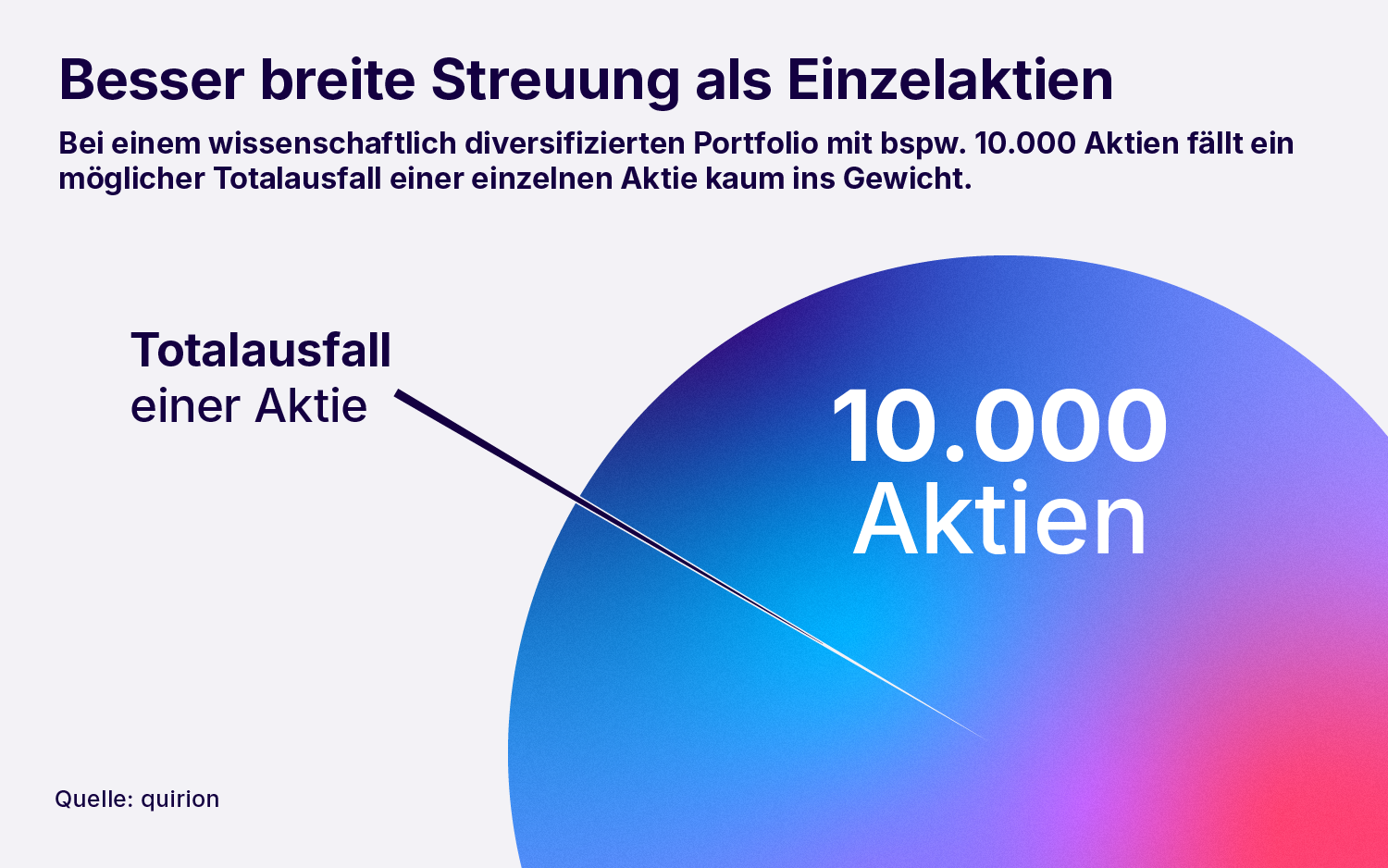
Anyone who, say, invests 10,000 euros in a single stock risks losing the entire capital invested if the company becomes insolvent. Spread the money evenly across 100 stocks and the failure of one of the companies has nowhere near as dramatic an effect. Mathematically, only 1 percent of the capital is affected. With 1,000 stocks it's 0.1 percent, and with 10,000 stocks 0.01 percent.
Even this very simple calculation shows that investing in individual stocks on your own is highly risky. Yet with ETFs you can invest in hundreds of stocks in one go relatively cheaply. An ETF on the MSCI World, for example, gives you a stake in around 1,300 stocks. That doesn't sound bad for a start.
However: measured against the total market of all stocks, individual indices always develop certain concentrations, which in turn carries concentration risks. The MSCI World, for instance, is overweighted in the USA, in information technology and in the ten largest stocks, while leaving out the shares of smaller companies and those from emerging markets. With a targeted combination of ETFs grounded in scientific insights, you can achieve far more in terms of diversification – both in the number of holdings and beyond.
Diversify more, speculate less
The basic thinking behind optimised diversification starts with a fairly simple observation: nobody can reliably predict how any given stock will perform. You can only guess, more or less well. Relying on forecasts when investing is a risky gamble.
Unlike a card game, though, with investing you don't have to trust to luck to be dealt the right hand. Because the fact that stock markets rise over the long term is no accident. Stocks give you a stake in companies, and thus in the economy. And the economy, in turn, is geared towards growth.
A sound investment strategy takes its cue from this and aims for the long-term average return of the world's stock markets. It avoids unnecessary speculation and doesn't try to beat the markets. Because that only increases the risk.
Better diversification through return factors
To pursue such a strategy and bring the world's stock markets into your portfolio, a single ETF isn't enough. What's needed is a combination that offsets the imbalances of the individual ETFs. To achieve this, we orient our global ETF portfolio around what are known as factors. These are categories that let you systematically organise the sheer variety of stocks. Because every stock has a range of characteristics that influence its return potential and its risks – for example the company's size, its valuation or the extent of its price fluctuations.
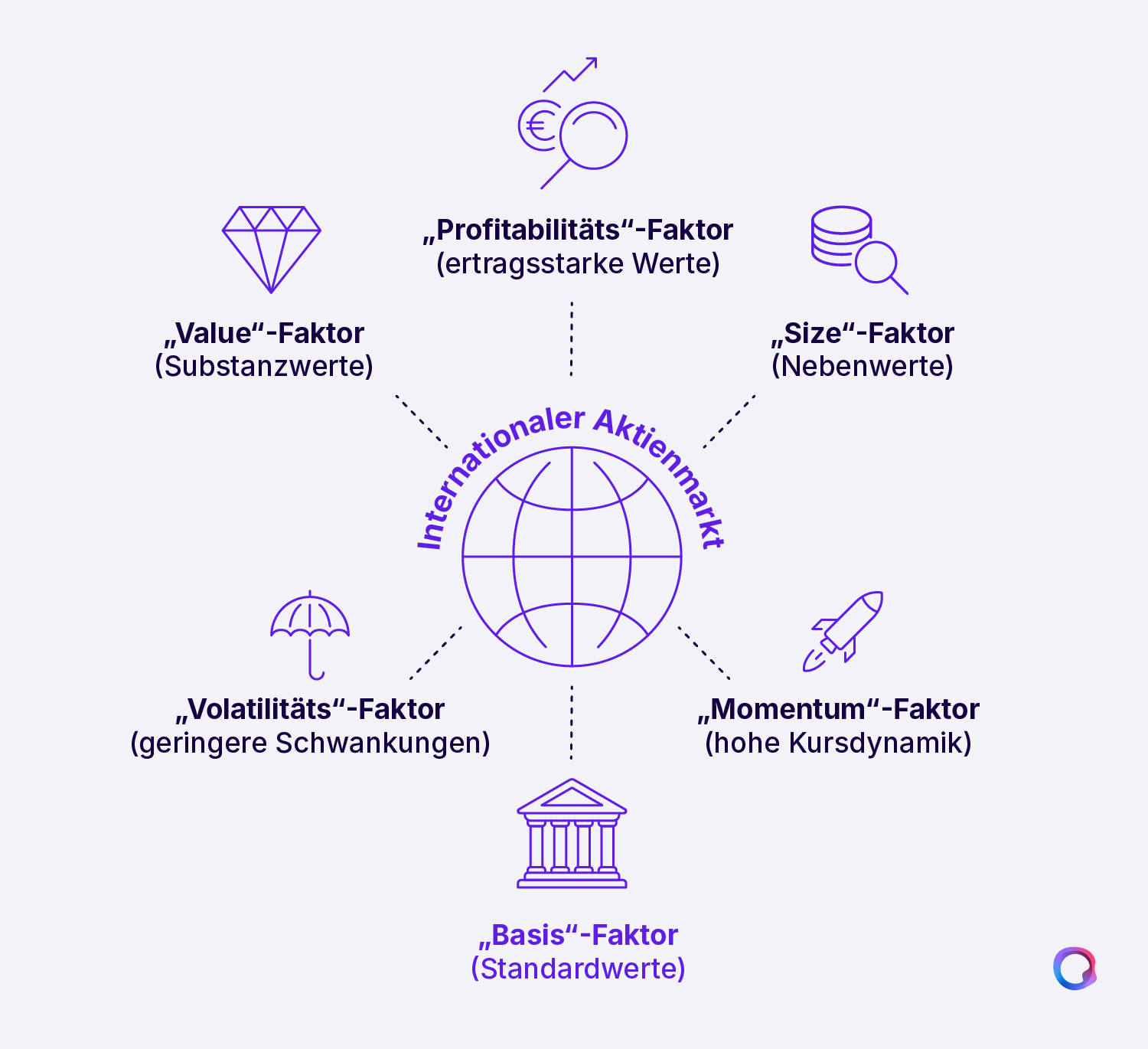
Six factors make up the world portfolio
The factors and their weighting are the basis for selecting and combining the individual ETFs in our global ETF portfolio. (link to https://www.quirion.de/anlagekonzept/anlageuniversum) Worth knowing: so-called factor ETFs always map several factors at once. That's why our investment strategists pay close attention to whether the product combination really brings the targeted factor weightings into the portfolio.
Over 13,000 stocks in the global ETF portfolio
Our global ETF portfolio currently holds a stake in over 13,000 stocks from more than 70 countries. Depending on your personal risk profile and individual appetite for risk, we also mix in bonds. Because a pure equity portfolio fluctuates more than a mixed one and isn't suited to every investment goal.
From a purposeful investment strategy with optimised diversification through to regular rebalancing: with our digital wealth management, all of these services are included. Thanks to the use of ETFs, investing nonetheless stays very affordable. Our global ETF portfolio is also available as a savings plan, starting from savings instalments of just 25 euros a month.
You can find out more about our savings plans here.