
Again and again there are disputes over funding questions in the US. After the conflict over the debt ceiling, the federal budget is now in the spotlight. Here's what it's all about and what impact the political wrangling has on the markets.
The shutdown has been averted. But once again only temporarily. So the dispute over funding questions in the US will likely soon head into the next round. Political brinkmanship “until the very last moment” has by now become routine. As recently as the spring, there was lengthy debate over the US debt ceiling. An agreement was reached “at the last minute.” It has now been suspended until 1 January 2025. Currently the federal budget is in the spotlight. In fact, it should already have been passed for the next fiscal year. But at the end of September only a stopgap solution was reached, which expired on 17 November. Shortly before the deadline, lawmakers agreed on a transitional budget. Part of the funding for government operations and federal agencies is thereby secured until 19 January and another part until 2 February 2024.
The background: US federal agencies may not spend any money without the annual authorization from Congress. But if Congress fails to pass the twelve required appropriations bills in time, “non-essential functions” are shut down in whole or in part until Congress acts. Such a funding freeze can bring work to a standstill in many places, because employees at federal agencies temporarily stop receiving their pay. And subsidy programs and welfare benefits may also have to be curtailed.
Markets Barely Affected
Since 1976, funding freezes in the US have led to disruptions in government operations in 20 cases. In ten of them there was a shutdown in the narrower sense, with temporary furloughs of employees at government agencies. Sometimes a shutdown lasts only a few days, sometimes several weeks. The longest shutdown was not that long ago. It ran from 22 December 2018 to 25 January 2019.
“The impact of such funding freezes on the capital markets is usually very small, and whether the markets react at all depends on how long they last,” notes Philipp Dobbert, chief economist at quirion and at Quirin Privatbank. Because, unlike with the US debt ceiling, the federal budget case is not about the possibility that interest and principal payments on bonds could also be affected.
It's true that in September and October there were phases of larger price losses on the US bond market. But in Dobbert's assessment this was due less to the budget dispute than to rising core inflation and robust economic data. “The temporary price losses and the associated rise in yields mainly reflected changed expectations for further interest rate moves.” In mid-November, yields fell again along with interest rate expectations.
Political Gridlock
So the bond markets continue to keep their eyes above all on inflation data and interest rate policy. However, it remains an open question whether the constant political jostling over funding matters might not at some point shake investors' confidence after all. It's not just the political polarization between Democrats and Republicans; the disputes over direction within the parties also repeatedly lead to gridlock. One example of the latter was the tough struggle over the election of a new Republican Speaker of the US House of Representatives.
In August, in any case, the rating agency Fitch slightly downgraded the long-term creditworthiness of the US – from AAA to AA+. That is still the second-best possible rating, but no longer the very best. As justification, Fitch pointed among other things to repeated political gridlock in connection with the debt ceiling – but also to a deterioration in the fiscal situation and to the growing national debt. At Moody's, the US still holds its top rating, but the rating agency changed its outlook in November from “stable” to “negative.” That means a downgrade could be imminent.
Growing National Debt
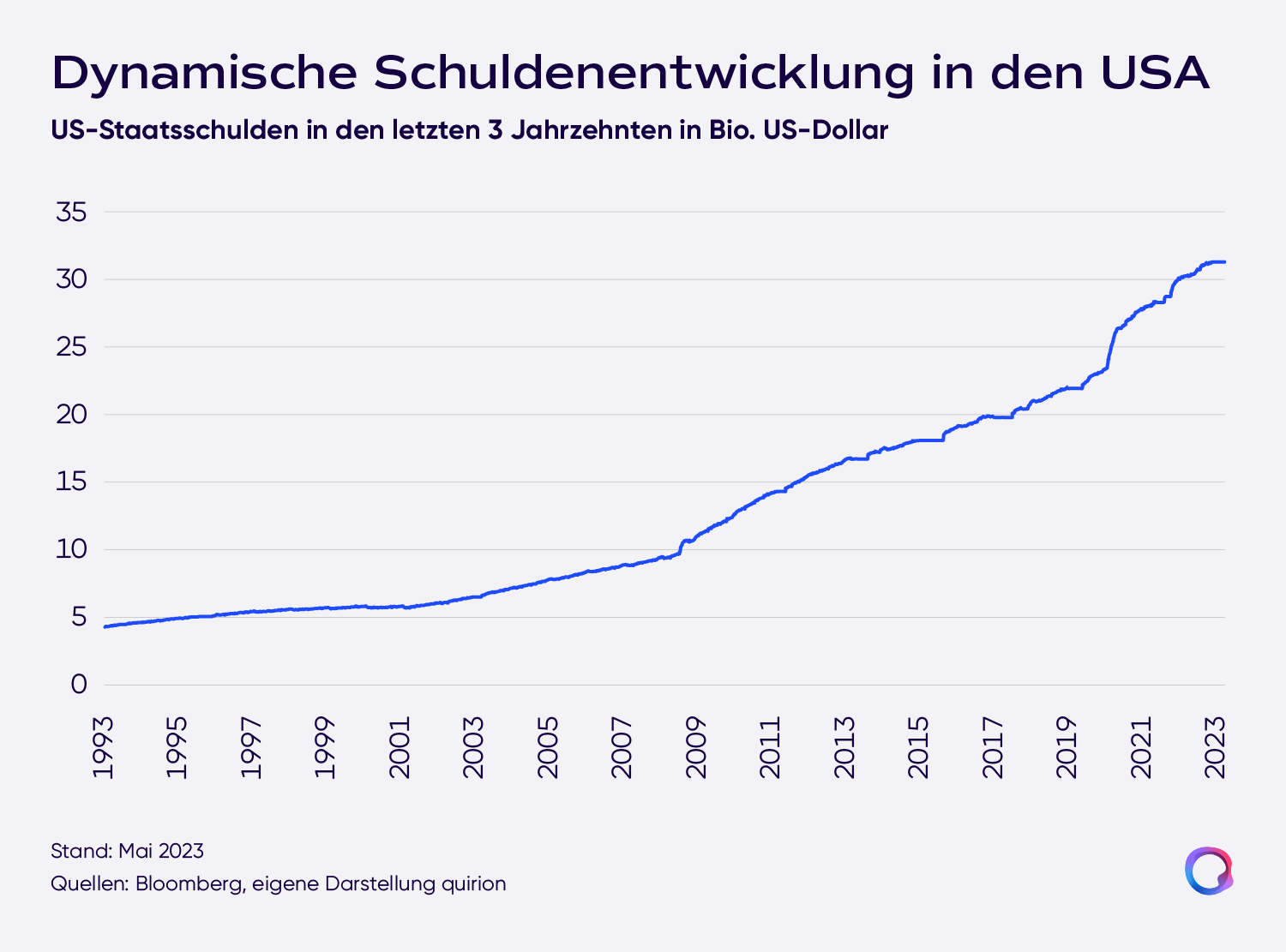
At the end of 2022, US national debt stood at over 120 percent relative to gross domestic product (GDP). For comparison: in Germany it was only around 66 percent. The International Monetary Fund expects US national debt to amount to more than 140 percent of GDP by 2028. “Figures like that would take some people's breath away in Europe,” Dobbert explains. “But the importance of the US dollar, and thus of US government bonds, for the global financial system is so outstanding that this development probably won't fundamentally impair the US bond market.”
Thanks to their still very good creditworthiness and their currently attractive yields, US government bonds are in any case hard to do without in globally diversified bond portfolios. At quirion, US government bonds and corporate bonds together currently make up around 15 percent of the bond portfolio. Dobbert and his team, however, place the main emphasis on bonds from the eurozone. “This way we keep the currency risks small,” the economist explains. Because, “in quirion's global ETF portfolios, bonds play the role of stabilizer.” There is no other asset class that fulfills this role so reliably over the long term. “We assume that this will remain the case in the future as well.”