On January 1, 2027, the new retirement provision accounts get under way. Interest is huge. But so is the need for information. We answer the questions we are asked particularly often.
1) What types of retirement account will there be?
The new retirement accounts are the centerpiece of the reform of private retirement provision. Unlike the Riester pension, retirement accounts do without guarantees. In this way, the state wants to encourage wealth building that is more geared towards opportunities and returns – for example with ETFs.
The variant most frequently discussed in public is the standard account. Special rules apply to it: one part of the invested assets has a rather cautious investment profile, while the other aims more at return opportunities. Before the payout phase begins, the accumulated capital is gradually shifted into the lower-risk part. For the standard account, costs are capped at a maximum of 1.0 percent per year.
The state also wants to provide a standard account through a public provider. However, it is still unclear who this provider will be and whether the offering will be ready by the beginning of January 2027. On the private side, there will be various individual retirement account offerings beyond the standard account. These come with more flexibility in product design. And there is no cost cap.
We are still working on our own offerings. But one thing is clear: they will be much cheaper than the cost cap prescribes. And not only for the standard account, but also for at least one further alternative that we will offer.
2) Am I eligible for the subsidies?
In principle, everyone in dependent employment is eligible, including apprentices. Unlike with the Riester pension, however, the self-employed and freelancers are now also eligible, provided they are subject to unlimited tax liability in Germany. They do not have to be compulsorily insured in the statutory pension insurance scheme for this.
Those eligible also include, among others, participants in the Federal Volunteer Service, recipients of unemployment or sickness benefits, and mothers or fathers during the three-year child-raising period. Anyone drawing a pension for full reduction in earning capacity or occupational disability is also eligible – but not anyone drawing a full old-age pension.
3) How high are the subsidies?
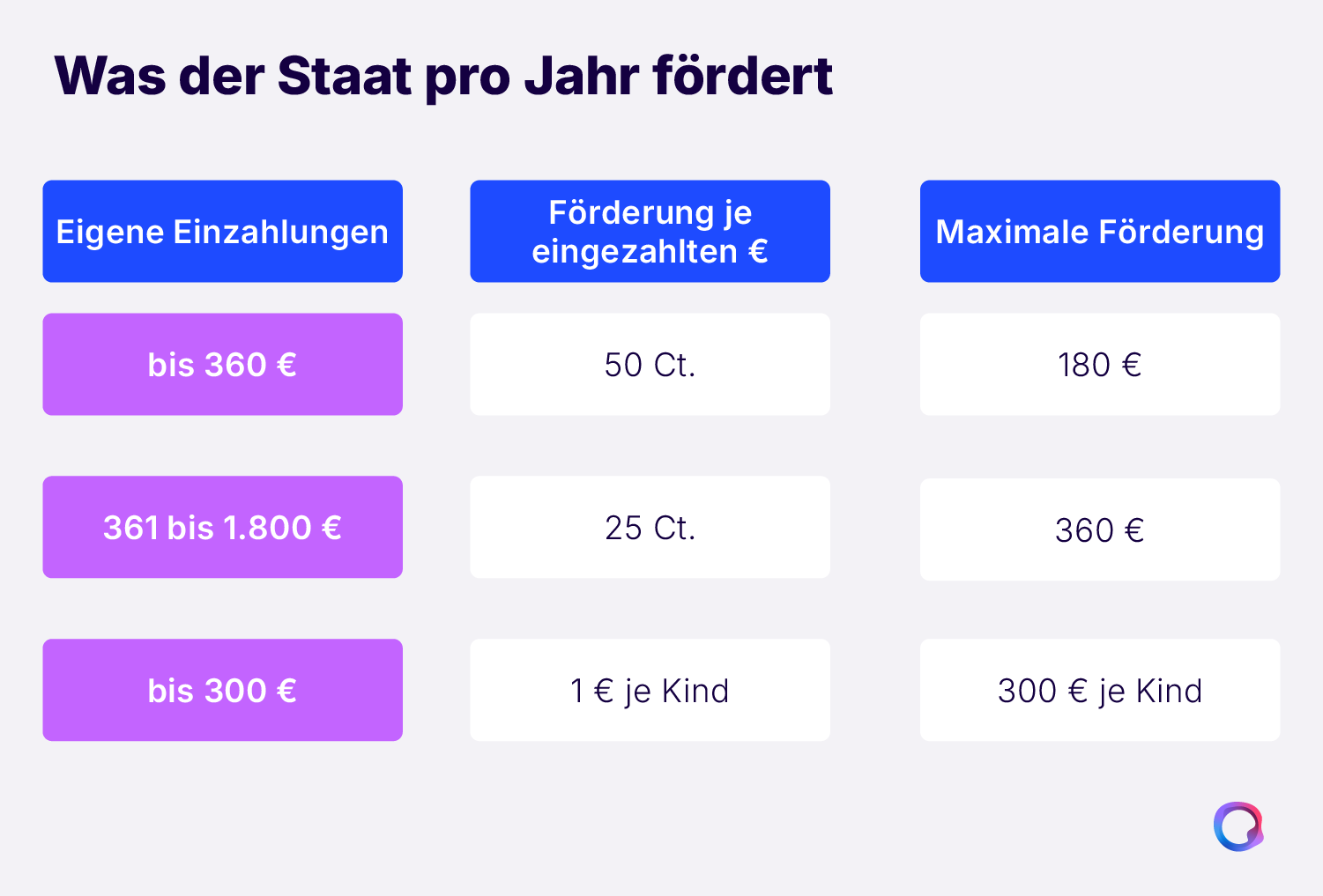
The basic allowance is 50 cents for every euro you pay in yourself, up to an amount of 360 euros per year. For a further 1,440 euros, those eligible receive 25 cents per euro saved. That adds up to 540 euros from the state on a maximum personal contribution of 1,800 euros.
The maximum child allowance of 300 euros per child per year is available from a savings rate of just 25 euros a month. Anyone who takes out a retirement provision contract before their 25th birthday receives a one-off career starter bonus of 200 euros.
4) What happens to my Riester contract?
If you do not take action yourself, old Riester contracts simply continue under the old subsidy conditions. That is because contracts concluded before January 1, 2027 are grandfathered. However: with a Riester contract, you can switch to the new subsidy system – or to the new retirement account.
From our survey on the new retirement account we know: many people are now considering whether to let their old contract rest and continue saving in a retirement account. Or whether to transfer the assets saved in their Riester contract right away. There is no blanket answer, though, as to which of the various options pays off more. That has to be examined case by case.
5) When do I get the money I have saved?
The payout phase begins at 65 at the earliest and at 70 at the latest. An earlier start of the payouts is only permitted if the old-age pension is also paid before the age of 65. Anyone who withdraws money from a retirement account early has to repay the subsidies – whether allowances received or tax advantages.
At the start of the payout phase, you can make a one-off withdrawal of up to 30 percent of the accumulated capital.
Because the obligation to take out a traditional, expensive insurance policy for a lifelong pension no longer applies, a payout plan running at least until age 85 is provided as an alternative. If you do not want to commit at that point yet: you are allowed to switch providers at the start of the payout phase. So anyone with a retirement account without an annuity option can still convert their retirement savings into a life annuity with an insurance company later on.
6) How much wealth can I expect later on?
The investment result of a retirement account depends on many individual factors. These include tax aspects, the investment period, the type of products it contains, and their cost efficiency. But if you want to get a basic sense of how deposits, subsidies, and the return opportunities of the stock markets interact, you can use our retirement account calculator.
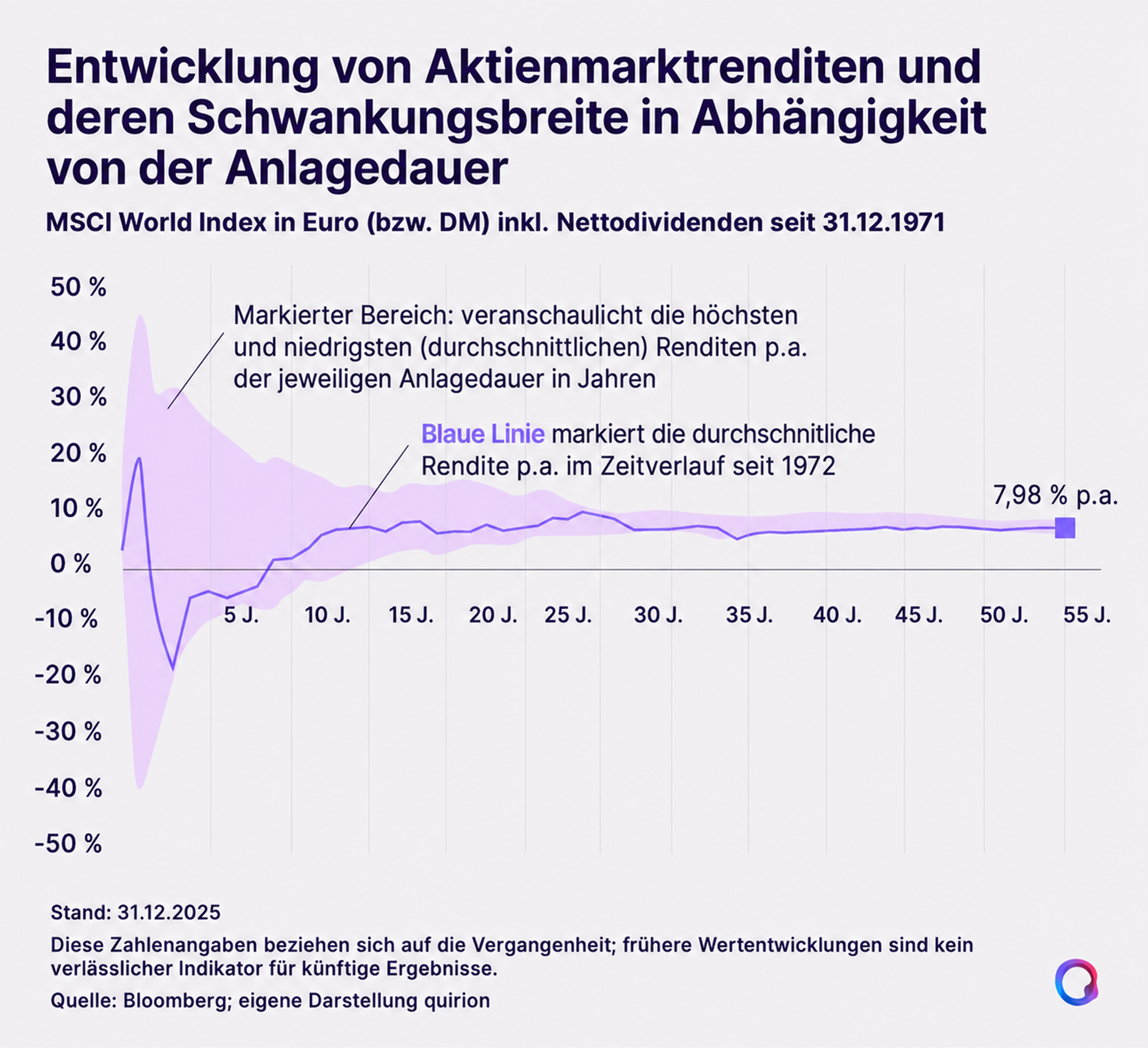
Over the long term and on average, returns of around 8 percent per year are entirely realistic on the stock markets. At times, returns are above that average, at times below it. But over time, the fluctuations smooth out. At least if you diversify your portfolio broadly.
7) Is it worth setting up several retirement accounts right away?
Under the new rules, a maximum of 6,840 euros per year can be paid into a retirement provision contract. You are even allowed to set up two retirement provision contracts. But the maximum subsidy is only granted once.
But why go so far beyond the subsidy limits at all? The idea: no flat-rate withholding tax is due during the accumulation phase. True, the payouts are taxed later, in retirement. But until the payout comes around, compound interest can work all the more powerfully the more you bundle your private retirement provision efforts.
We will keep you up to date on the retirement account: more here.