Making good resolutions at the start of a new year is a tradition in many countries around the world. Here are 7 suggested resolutions that will help you build wealth — and that are really easy to put into practice.
1) Seize the opportunities for returns
The first resolution is the foundation for everything else, namely: to start investing at all. And to use the capital markets to build wealth. Be brave! Because with the right investment strategy, everyone can share in lucrative opportunities for returns.
2) Consider your investment horizon
Interest rates have risen. That makes interest-bearing products more attractive again. However, they remain suitable primarily for a short investment horizon. If your invested money should stay available at all times: with the Cash Invest Portfolio from quirion, there's a clever alternative to an overnight-deposit account.
For long-term wealth building, equity markets offer better opportunities for returns. This is shown, for example, by a study from the London Business School and the Credit Suisse Research Institute. It examined the performance of various asset classes from 1900 to 2022. Over this period, stocks left bonds and money-market securities behind in all 35 markets examined. For instance, the performance of global stocks exceeded that of money-market securities by an average of 4.6 percent per year and that of bonds by 3.3 percent per year.
3) Diversify well, invest better
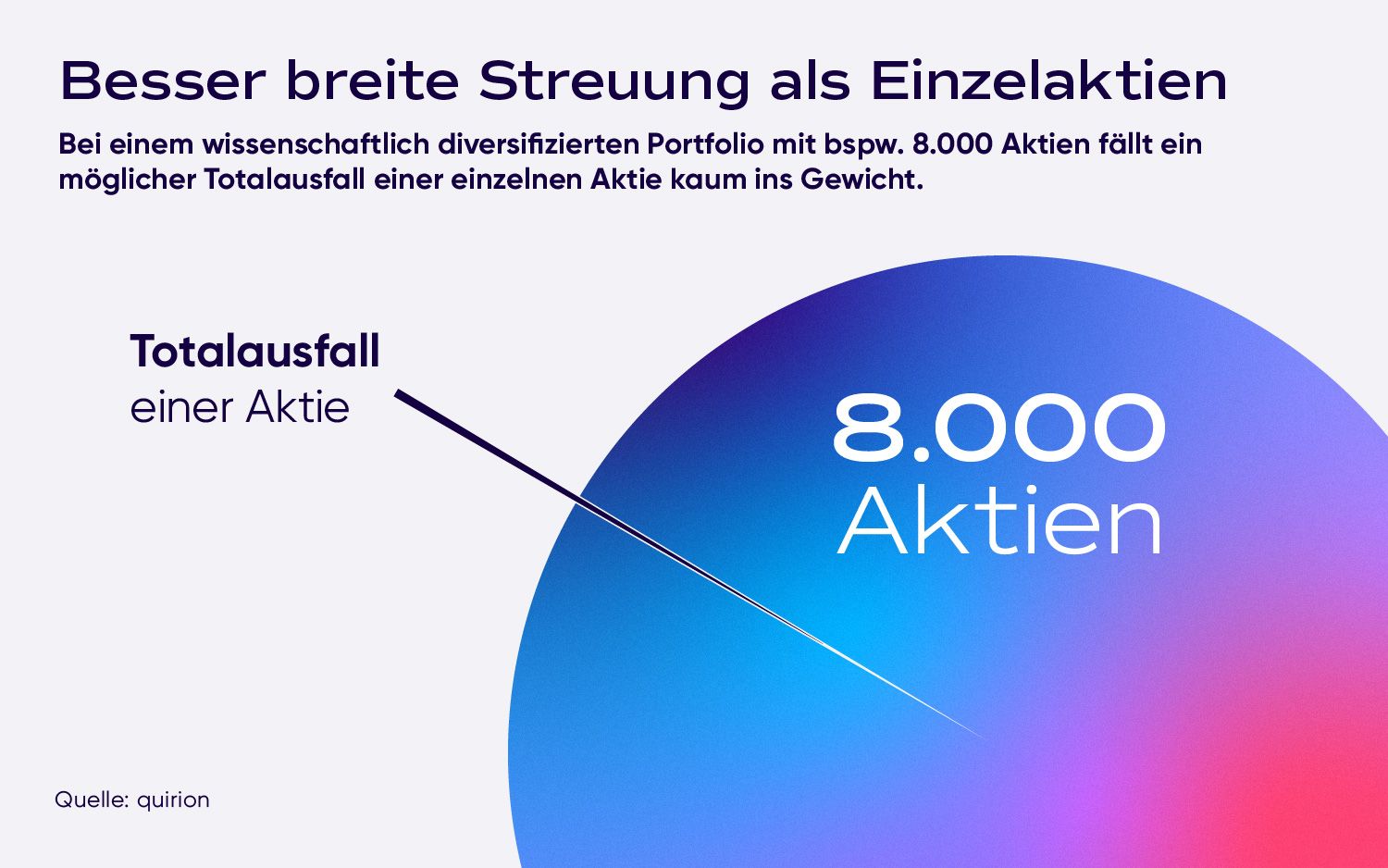
Return and risk go hand in hand. If you want to seize the opportunities for returns on the equity markets over the long term, you have to accept short-term price fluctuations. The risks can nonetheless be contained through broad diversification. Imagine a stock turns out to be a total loss. Then those who bet on that single security lose all of the capital they invested. The more securities you hold in your portfolio, the better the risk is spread.
4) Invest more efficiently — in ETFs
Funds do already offer a certain degree of diversification. But active funds, which are still in demand among many investors, are considerably more expensive than passive ETFs. According to an analysis published in 2023 by the European Securities and Markets Authority (ESMA), the costs of active equity funds averaged 1.7 percent per year between 2017 and 2021. That is roughly four times the average cost of equity ETFs (0.43 percent).
What's more, most active funds are inferior to passive products over the long term. This is shown by a performance comparison from S&P Global. Over a five-year period, for example, 86 percent of comparable active funds were unable to keep pace with the S&P 500. In the European investment region, as many as 93 percent of the "active" funds failed to beat a comparable index product.
5) Follow your own profile
When choosing your investment, you should be guided by your own risk appetite and your individual investment horizon — not by the current price level. How long do I want to stay invested? What price fluctuations am I willing to accept over this period? Adding bonds to the mix can additionally help stabilize a portfolio and keep price fluctuations manageable. With the right mix, even those for whom a pure equity portfolio wouldn't be the right choice can then take advantage of the opportunities for returns on the equity markets.
6) Avoid "market timing"
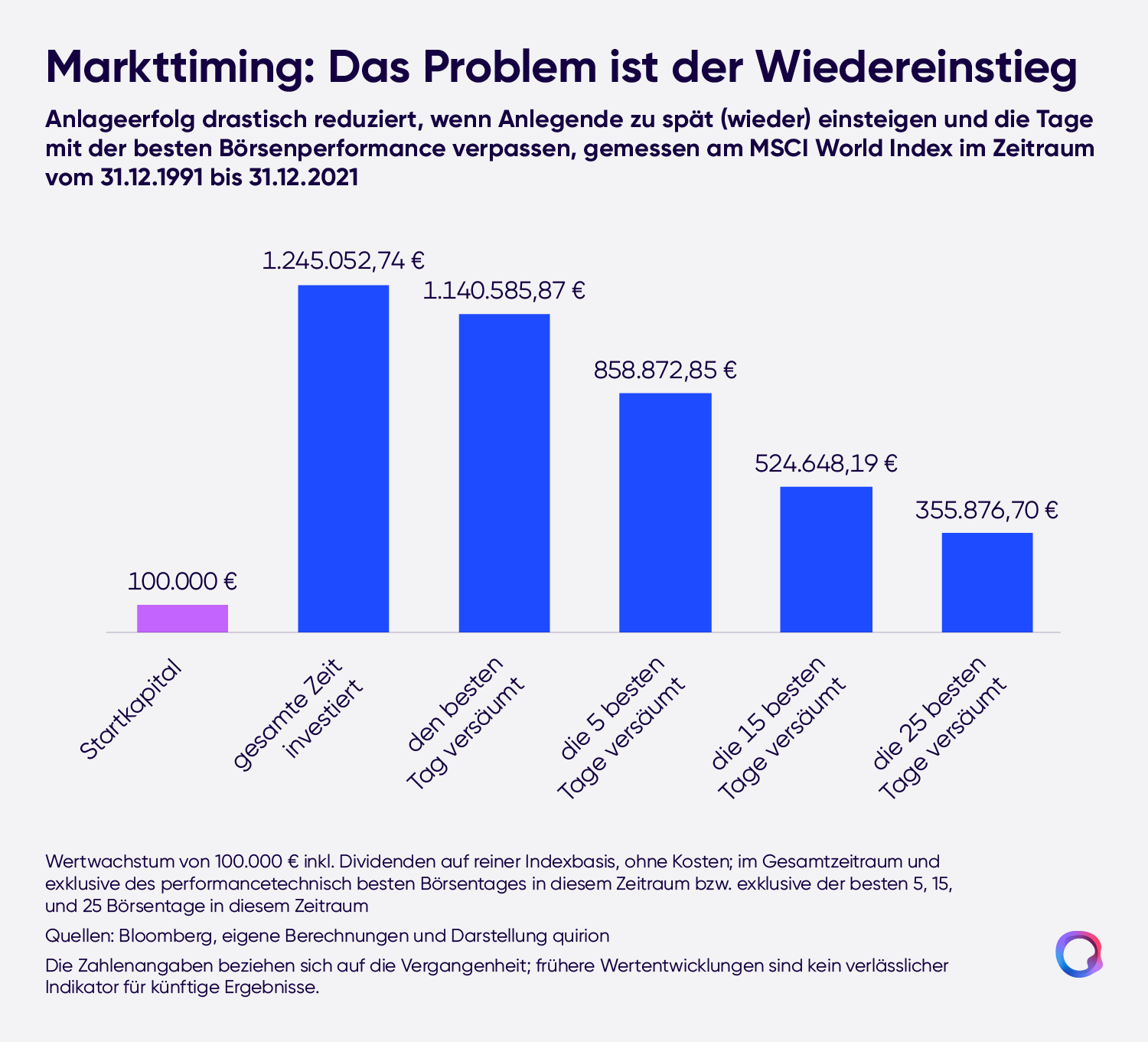
When do you get in, and when do you get out again? The question of "market timing" preoccupies many investors. But no one knows in advance exactly how prices will move over the next week or the next year. Even if you occasionally get lucky and catch a favorable exit point: for many people, missing the re-entry costs a lot of return. For long-term wealth building, it's important to follow a systematic investment strategy — and to stick with it consistently.
7) Rely on digital wealth management
Good resolutions are quickly made. Actually putting them into practice is considerably harder. When it comes to investing, though, it doesn't have to be: if you rely on digital wealth management in a global portfolio from quirion, you take advantage of the opportunities for returns on the world's capital markets — broadly diversified across ETFs that hold stakes in around 8,000 stocks from over 70 countries. The investment strategy is based on the current state of capital-market research.
Before investing, you only have to answer a few simple questions, for example about your personal risk appetite and your own investment horizon. The answers help determine the matching ratio of stocks to bonds. Digital wealth management in a global portfolio is also available as a savings plan, starting from an investment amount of €25 per month. That makes it even easier to turn your resolutions for better investing into action.