The USA plays an outstanding role for the world’s capital markets. That is why US stocks also carry the highest weighting in quirion’s portfolios. Why the US markets set the pace for many others, and what is currently moving prices there.
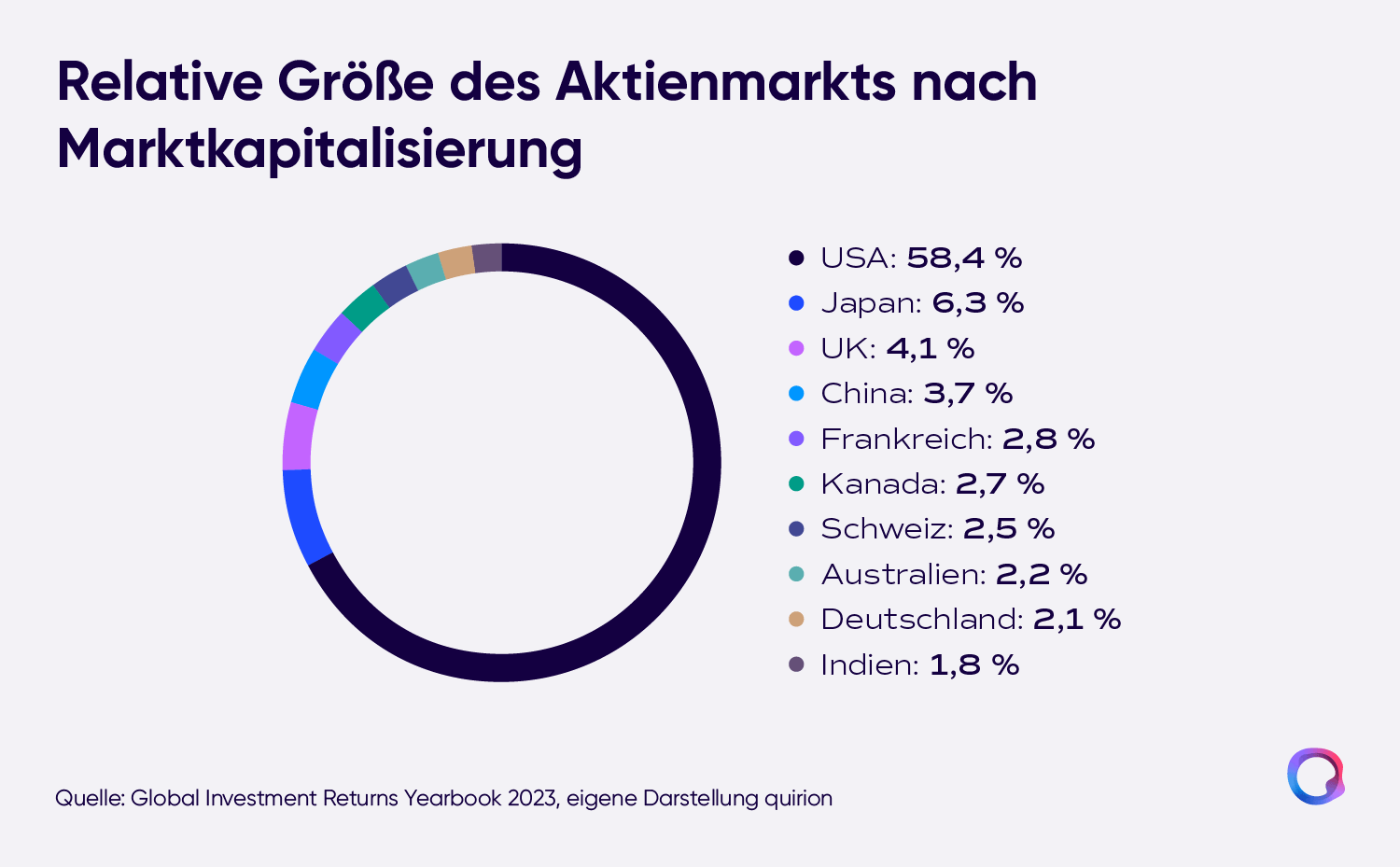
If you want to know where the action is on the capital markets, you can look at the top ten of the world’s biggest stocks for a first impression. Granted, the ranking is constantly in motion as prices move. Yet at the end of June, among the ten stocks with the highest market capitalisation, only two were not from the USA. Even in the top 50, only about a third came from other countries.
In the world economy, the importance of large emerging markets has grown strongly over the past few years. On the capital markets, however, the USA continues to set the pace. A comparison of size quickly makes this clear.
Economy, currency, bond market
The dominance of the USA on the capital markets has many causes. There is, for example, the size of its economy: in 2022, its gross domestic product came to 25.46 trillion US dollars. This once again placed the United States at the top, followed by China (18.1 trillion US dollars), Japan (4.2 trillion US dollars), and Germany (4.1 trillion US dollars). The USA also gains economic influence from the role of the US dollar in the world economy. It is the trading currency for important commodities and goods. In addition, many international loans are issued in US dollars, and bonds – for example from emerging markets – are in part denominated in US dollars.
The market for US government bonds is likewise of interest to investors from all over the world. “In international comparison, it doesn’t have the sheer size-based dominance that the US equity market has,” explains Philipp Dobbert, chief economist at quirion. “But US bonds have immense relevance for the global financial system and are held, for example, by many central banks as a kind of interest-bearing currency reserve.”
Prices are rising again
Not least because of the importance of the dollar and the bond market, the interest-rate decisions of the US central bank also carry a special resonance for the financial market. Investors felt this when the Fed ushered in the turn in interest rates in March 2022. “The pace of rate hikes that followed was historically unprecedented,” economist Dobbert emphasises. “The market reactions were correspondingly harsh – the prices of bonds and stocks came under the wheels at the same time.”
But last year’s turbulence is now history. “Market participants now expect the phase of rate hikes to gradually come to an end,” Dobbert notes. Inflation, he says, is still high. “But rate hikes take effect with a certain time lag.”
In this respect, the bond markets have stabilised. On the equity markets, prices moved significantly higher again in the first half of the year – despite intermittent turbulence in the banking sector. The momentum comes above all from technology stocks, which are of particular importance for the US exchanges. Their market weight is far higher in the USA than in Europe.
“The upward movement on the US markets has so far been carried by only a few stocks,” Dobbert notes. But investors, he says, apparently no longer see the danger of a massive economic downturn. “At the end of last year, no one would have foreseen the development of the first half of the year like this. That once again shows that you shouldn’t base your investment strategy on forecasts.”
The USA in quirion’s portfolio
The upward movement of the US markets is also reflected in quirion’s global ETF portfolio. Because there, it is above all market capitalisation that determines the weighting, though not exclusively. “Our goal is to mirror the return of the global equity market as precisely as possible,” Dobbert explains. To do so, he and his team at quirion take into account, across the equity portfolio, a total of five return factors.
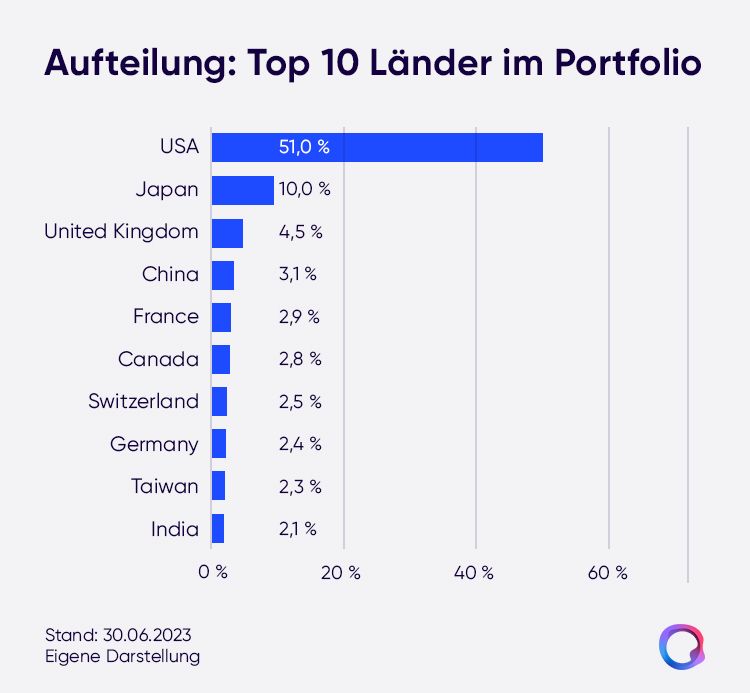
The size of an economy, by contrast, plays no role in the country weighting in quirion’s portfolios. “We work forecast-free,” Dobbert stresses. “So we don’t speculate about whether the growing economic importance of countries will at some point also lead to larger capital markets,” Dobbert notes. If that were ever to happen, it would show up automatically in the portfolios because of the rising market capitalisation.
But if the USA sets the direction on the capital markets – why not simply concentrate your investing there? “That, too, would be speculation and not a systematic investment strategy,” Dobbert emphasises. A diversified portfolio filters out the risks of individual companies, sectors, or countries as far as possible. “In terms of the expected risk-return ratio, a portfolio like this is superior to all others.”