A market slump stirs up a lot of emotions. The natural reflex: you want to do something – switch strategies, for example, or pull out of your investments. Anything but simply wait it out. Here is why it pays to stay invested and to stick with the strategy you have chosen.
From time to time, markets take a sharper dive. When they do, investors ask themselves a lot of questions: How long will this weak phase last? How should I react now? On top of that, in times like these the voices urging you to actively pick stocks or to step to the sidelines tend to grow louder. They follow a logic that is emotionally quite understandable. After all, in critical everyday situations it is often better to react quickly than to wait. "Especially in hectic phases on the markets, many people feel pressured to act," says our chief economist Philipp Dobbert. "Staying the course you have set out on is then particularly hard."
Stay rational and stay invested
Yet empirical studies show it again and again: when it comes to investing, knee-jerk action mainly causes costs and eats into returns. "What matters is keeping your composure, even during sharper market slumps or longer stretches of falling prices," Dobbert stresses. That holds regardless of why prices are falling. Whether financial crises, pandemics or armed conflicts: "Stay invested."
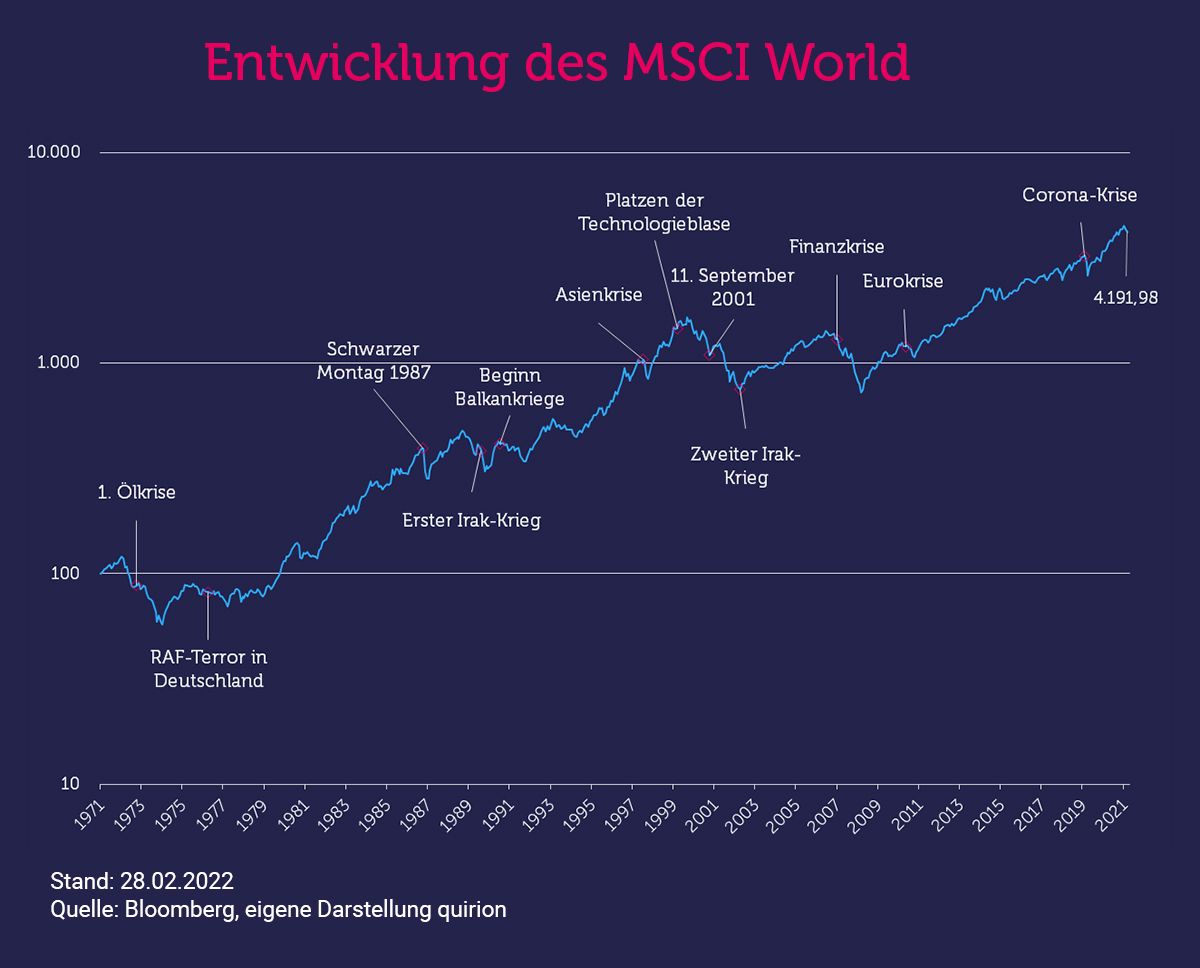
quirion's investment strategy rests on the solid assumption that equity markets rise over the long term. History has shown this time and again. The foundation of this assumption is the development of the global economy, which is structurally geared toward growth. And it is not just about quantity: "Economic growth is increasingly achieved qualitatively, for example by improving products." It is not only about volumes of goods, but above all about economic value.
A systematic strategy instead of a game of chance
With quirion's global ETF portfolios, clients participate in the returns of the equity markets in their full breadth. That is the principle. Actively selecting individual securities is not only significantly more expensive, it is also always speculation: "Unlike the economy as a whole, with individual securities it is by no means guaranteed that they will remain in demand over the long term," economist Dobbert explains. "Betting on rising or falling prices in individual stocks is therefore a game of chance."
The same is true of trying to catch supposedly favourable moments to buy in and sell out. Because those moments cannot be identified systematically. Hitting them is likewise pure luck. "At any given moment there are financial experts predicting a crisis. If one comes, it seems to prove those voices right," Dobbert notes. "But if we listened to them, we could essentially never invest at all." Even in the best market phases, you can identify circumstances and social developments that cause concern. Conversely, in crises there are always sound arguments in favour of a recovery in prices.
Movements no one saw coming happen all the time. None of them can be predicted down to the day and the hour. But that is exactly what would be needed for it to be worth thinking about ideal moments to buy in and sell out. "If you sell, say, when prices have fallen by 15 percent, you may already be locking in a loss," Dobbert offers as an example. "But when can you be sure that an upward move is truly sustainable again? Observations and studies confirm for us time and again that investors miss the point of re-entry – and then end up worse off on balance than if they had stayed invested."
How does quirion limit the risks?
quirion's investment strategists do take precautions to reduce the risks of price fluctuations. "In doing so, we rely on our strategic risk management, not on tactical risk management," Dobbert underlines. "That means: when prices slump, we neither hectically cut equity ratios nor set any kind of price floors." Strategic risk management uses low-volatility bonds to cushion movements in equity prices – depending on the investor's risk profile. "It works. It also proved its worth, for example, when prices slumped at the start of the coronavirus crisis."
An investor's risk profile does not, however, necessarily change along with the fluctuations of the markets. How much of my money do I invest, and for how long? How much fluctuation in value can I stomach for the prospect of return I want? "Questions like these determine the equity ratio, not forecasts about how things will develop next," Dobbert states. "As long as your individual answers to these questions do not change, your personal strategy should be maintained."