The strong influence a few stock market heavyweights have on indices like the S&P 500 comes up for heated debate again and again. Even if a heavy concentration in individual indices can indeed be a risk factor: for a broadly positioned global portfolio, orienting towards market capitalisation is extremely useful.
Detailed reports, before and after. Nervousness on the markets. From important economic data, you're used to that sort of thing. But rarely, as again at the end of August, from a company's quarterly report – in this case from Nvidia. After all, the chipmaker's market value already reached 3.34 trillion US dollars at one point this year. And in doing so it surpassed the gross domestic product of most economies in Europe.
For a while now, a few highly valued stocks have dominated significant stock indices such as the S&P 500. Among them are those that have already made plenty of headlines as the „magnificent seven“. The influence of Alphabet, Amazon, Apple, Meta, Microsoft, Nvidia and Tesla on the S&P 500 is immense. If you strip the performance of these seven companies out of the S&P 500, the index's gain in 2023 would have turned out only about half as high. And when a sharp correction hit at the beginning of August, they dragged the S&P 500 down more heavily than average.
„Allying“ yourself with the market
The fact that a small handful of stocks can decisively shape the performance of stock indices comes down to the significance of market capitalisation. Because in most cases it determines the weight of individual stocks in a stock index. A company's market capitalisation is arrived at by multiplying the number of outstanding shares by the share price.
Because market capitalisation is relevant for many stock indices, it's also relevant for index-oriented investing. Some people wonder: does it lead to a worrying dependence on a small handful of particularly heavy-weighted stocks? „A well-diversified portfolio shouldn't concentrate on a stock index like the S&P 500, but should be positioned globally and as broadly as possible,“ notes Stefan May, head of investment strategy at quirion and at Quirin Privatbank. „And weighting by market capitalisation is the only truly consistent weighting method.“ After all, he says, market capitalisation ultimately arises from supply and demand. „A portfolio weighted on this basis essentially harnesses the swarm intelligence of the overall market.“
The weights of a portfolio structured by market capitalisation can, admittedly, shift considerably over time. „But investors automatically go along with these movements and, in doing so, ally themselves with the market,“ May emphasises. „That's far smarter than getting drawn into speculation and, in the worst case, positioning yourself against the market, which in the vast majority of cases costs return prospects.“
Country weightings, too, fluctuate considerably over the long term
Market capitalisation is constantly on the move along with price developments. This applies to individual stocks, but over the long term it applies to entire stock markets as well. The US market has for many years been by far the most heavily weighted in the world. But that wasn't always the case. At the beginning of the 20th century, Europe's stock markets were the leaders, while the US share stood at only around 15 percent. By now, the weight of Europe as a whole has shrunk to about 18 percent.
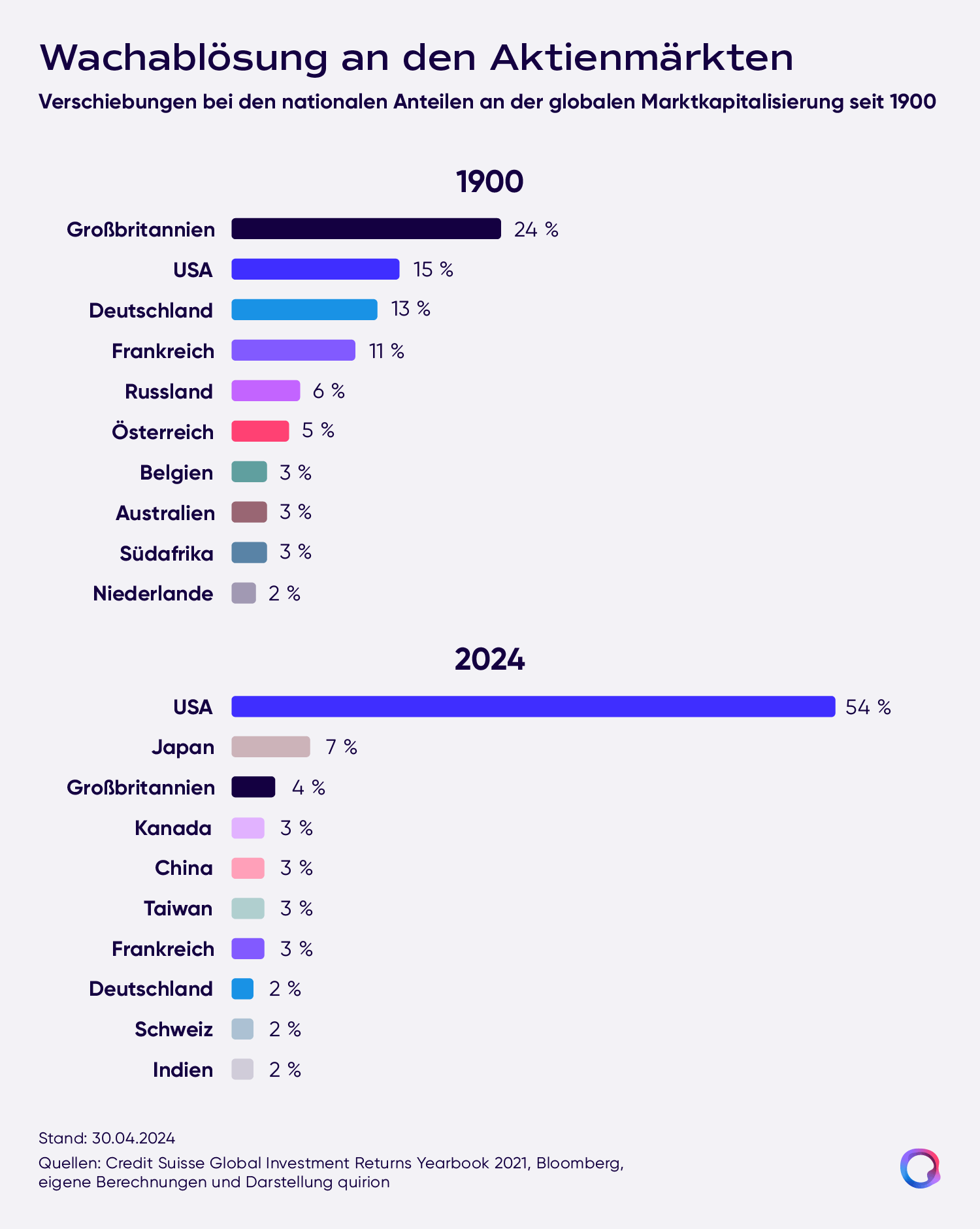
In between, over roughly the past 120 years of stock market history, markets were repeatedly swept to the top that have since been sharply „cut back down to size“ again. „For example, Japan's share of the global equity market amounted to a good 40 percent at the end of the 1980s – driven above all by the real estate sector,“ May observes. „From today's vantage point, that seems almost unbelievable.“ Japan's decline in value and the rise of the US stock market led to Japan's share of global market capitalisation shrinking to around 7 percent by now.
Alongside the performance aspect, another factor plays a role over the long term when it comes to the weight of individual countries in the global equity market, namely how many companies in a country are listed on the stock market at all. In Germany, with its strong Mittelstand, comparatively few companies are listed on the stock exchange, for example. In the US there are especially many.
Five return factors
Accordingly, the US is also heavily weighted in quirion's global ETF portfolio. That said: while market capitalisation carries great significance in this case for the weighting of the various markets and of the individual roughly 8,000 stocks, it isn't the only criterion. The investment strategists take five return factors into account, including, for example, value stocks („Value“) and small-cap stocks („Small Caps“).
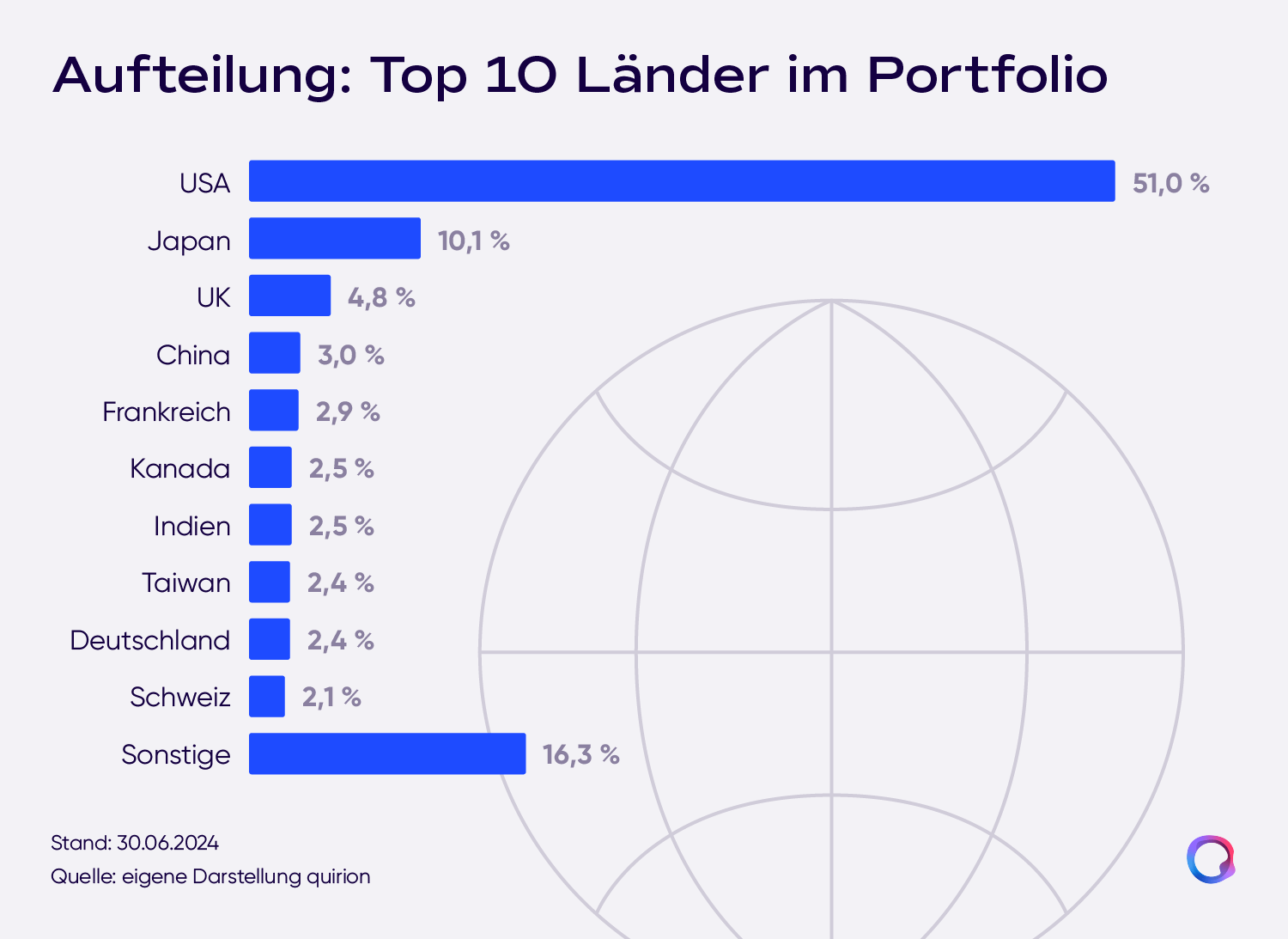
With an investment in the global ETF portfolio, quirion additionally blends in bonds, depending on the individual investor's investment horizon and personal risk appetite. This can dampen the fluctuations of your own portfolio. In any case, investors at quirion don't need to give any thought to an excessive concentration on individual securities.