
In the first seven months of the year, the DAX climbed to new all-time highs several times. Prices have also risen sharply in the US and in Japan. But then the momentum eased. A look at the movements on the equity and bond markets.
A gain of 12 percent in the DAX, 17 percent in the S&P 500 and 29 percent in the Nikkei 225: a year ago, hardly anyone would have painted such a positive picture of the equity markets' performance from the start of the year to the beginning of September. Yet there's no trace of euphoria. Because after several all-time highs in the DAX and strong price gains in the US and Japan, the upward movement has stalled. "The market is a bit jittery," is how our chief economist Philipp Dobbert describes the mood. "Even news of modest significance has recently sent prices wobbling."
Making sense of short-term price movements is sometimes difficult. One example: at the beginning of August, the rating agency Fitch downgraded the creditworthiness of the US from the top rating "AAA" to "AA+." One of the reasons was the fierce political dispute that had flared up in May over raising the debt ceiling. Not for the first time, an agreement had only been reached "at the last minute." In purely practical terms, though, the downgrade is unlikely to affect the attractiveness of US bonds. They're too sought after internationally for that. "Curiously, it was the DAX of all indices that reacted to the news with significant price losses," Dobbert notes.
A few days earlier, Germany's benchmark index had looked much more robust. That was when the International Monetary Fund (IMF) had lowered its forecast for economic development in Germany. According to it, gross domestic product is set to shrink more this year than previously expected, namely by 0.3 percent. The DAX had reacted to this news, too, with a brief dip, but then quickly reached a new all-time high.
Expectations move prices
Is all this rational? Does it reflect a decoupling of the economy and the stock market? "A sluggish economy had already been expected," Dobbert explains. At the same time, the IMF had revised Germany's outlook for 2024 slightly upward, and on the markets it's the future that counts. "But you also shouldn't overrate the significance of short-term market reactions," Dobbert emphasizes. "Prices reflect expectations, and those can always change again."
Right now, the bond market is contributing substantially to how expectations are formed on the equity markets. After all, the development of key interest rates is in focus on both markets. Inflation in the US recently ticked up a little again. That unsettled some people who had already factored in an end to the rate hikes. Overall, the bond market is moving much more steadily than last year, but still fairly erratically by its own standards. This shows, for example, in the yield on the internationally decisive 10-year US government bond. At the start of the year this stood at 3.88 percent. In early March it reached an interim high of just over four percent, then slid to 3.25 percent by early April. After that it climbed again and stood at 4.2 percent in mid-August.
An investment strategy for all eventualities
But whether on the bond or the equity market: as a matter of principle, investors shouldn't let themselves be unsettled by short-term price movements. "With a globally positioned portfolio, investors can focus on the fact that the movement on the equity markets is directed upward over the long term," Dobbert emphasizes. "This trend is based on the long-term growth of the global economy."
The broader a portfolio's diversification, the greater the likelihood of actually realizing the equity markets' return opportunities. That's why, at quirion, it's not only standard stocks that count toward the global and the sustainable ETF portfolio. There are also four additional return factors.
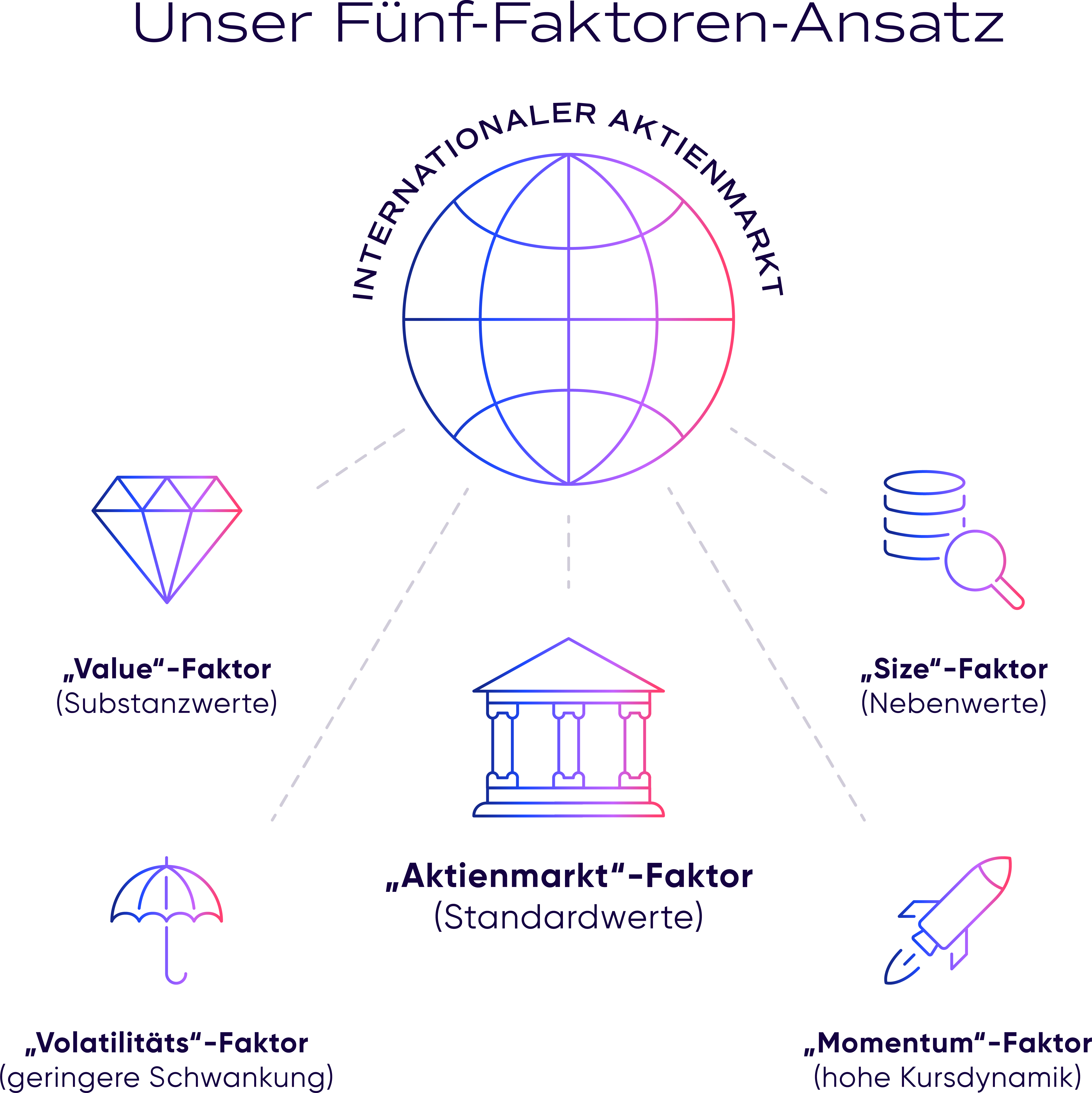
This positioning reduces the risks compared with less well-diversified portfolios. But it can sometimes also curb the momentum. "That was the case in the first half of the year. Back then it was mainly large standard stocks, especially from the technology sector, that carried the upward movement," Dobbert explains. Individual factors like value stocks or small caps had also developed positively, he says, but not as strongly.
If things go better here at one moment and there at another, wouldn't it be better to position yourself more deliberately? "A year ago, who would have foreseen the upswing on the Japanese stock market like that?" Dobbert counters. No one knows which regions or which market segments will be out in front in a few months' time. "To put it figuratively: anyone setting out for a big catch of fish is better off taking a large net onto the world's oceans than a fishing rod."